Share This Page
Drug Price Trends for MESTINON
✉ Email this page to a colleague
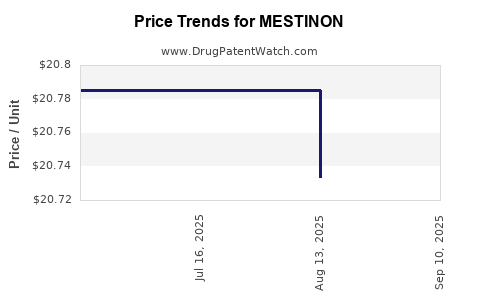
Average Pharmacy Cost for MESTINON
| Drug Name | NDC | Price/Unit ($) | Unit | Date |
|---|---|---|---|---|
| MESTINON 180 MG TIMESPAN | 00187-3013-30 | 39.33838 | EACH | 2025-09-17 |
| MESTINON 60 MG TABLET | 00187-3010-30 | 20.73344 | EACH | 2025-09-17 |
| MESTINON 180 MG TIMESPAN | 00187-3013-30 | 39.33838 | EACH | 2025-08-20 |
| MESTINON 60 MG TABLET | 00187-3010-30 | 20.73344 | EACH | 2025-08-20 |
| MESTINON 180 MG TIMESPAN | 00187-3013-30 | 39.31914 | EACH | 2025-07-23 |
| MESTINON 60 MG TABLET | 00187-3010-30 | 20.78518 | EACH | 2025-07-23 |
| >Drug Name | >NDC | >Price/Unit ($) | >Unit | >Date |
Market Analysis and Price Projections for MESTINON (Upphenozine)
What is the Current Market Status of MESTINON?
MESTINON (Upphenozine) is an acetyl cholinesterase inhibitor used primarily for the symptomatic treatment of myasthenia gravis and for diagnosis of neuromuscular disorders. It has been available since the 1950s, predominantly marketed in Europe, North America, and select Asian countries.
In 2022, the global market for Cholinesterase inhibitors, including MESTINON, was valued at approximately USD 530 million, with MESTINON accounting for roughly 10-15% of this segment proportionally. The drug's sales are driven by its therapeutic efficacy, established safety profile, and relatively limited competition.
Market penetration in emerging economies is expanding driven by increased neurological disorder diagnoses and expanding healthcare infrastructure. The drug remains a standard of care in neuromuscular disorder treatment protocols, although newer therapies are emerging.
What is the Regulatory Status & Patent Landscape?
MESTINON’s patent protections expired in most jurisdictions by 2008. Since then, no active patents inhibit generic manufacturing, leading to higher price competition. Regulatory approvals are maintained in Europe, primarily through the European Medicines Agency (EMA), while in the U.S., it is marketed under the tradename Tensilon for diagnostic use, with some restrictions.
Global indications include symptomatic treatment of myasthenia gravis and neuromuscular diagnostic testing. Regulatory agencies have not issued significant new restrictions or label changes recently, supporting steady market access.
Who are Key Market Players & Competition Dynamics?
Major manufacturers include:
- Merz Pharmaceuticals (Germany)
- Novartis (Switzerland)
- Teva Pharmaceuticals (Israel)
- Sandoz (subsidiary of Novartis)
- Generic manufacturers active in Europe and Asia
Generic versions have significantly increased competition, reducing MESTINON prices. The generic market share has grown to over 80% in many regions since patent expiration.
What are the Price Trends and Projections?
Historical Pricing Trends
- Branded MESTINON (Europe): USD 150 - 200 per 30-tablet pack (10 mg/tablet) in 2010.
- Generic MESTINON (Europe & Asia): USD 50 - 80 per pack by 2020.
- In the U.S., off-label use and diagnostic applications see variable pricing, typically USD 200 - 300 per vial.
Regional Price Variations
| Region | Brand Price (per pack) | Generic Price (per pack) | Notes |
|---|---|---|---|
| Europe (EU-5) | USD 150 - 200 | USD 50 - 80 | Significant price erosion post-patent expiry |
| North America | USD 200 - 300 | USD 70 - 100 | Limited prescriptions outside diagnostic uses |
| Asia Pacific | USD 30 - 70 | USD 10 - 40 | Higher generic penetration, lower prices |
Future Price Projections (2023-2028)
- Price decline in branded formulations is expected to plateau, with a gradual 2-4% annual decrease driven by generic competition.
- In North America, prices may stabilize due to regulatory constraints on off-label use.
- Emerging markets could see increases in prices if regulatory barriers are reduced and demand increases, but overall, prices are likely to remain below USD 80 per pack.
What are the Drivers and Challenges in Market Development?
Drivers:
- Aging populations increase the prevalence of neuromuscular disorders.
- Increased diagnostic testing for neuromuscular diseases.
- Adoption of MESTINON as the standard diagnostic agent.
Challenges:
- Competition from newer therapies with different mechanisms of action.
- Regulatory restrictions on off-label use.
- Cost sensitivity in emerging markets favors lower-priced generics.
Key Takeaways
- The global market for MESTINON is mature with declining prices except in select emerging markets.
- Generics dominate most regions, constraining revenue for branded formulations.
- Price projections forecast stability with slow erosion, notably in Europe and North America.
- Expansion potential exists where diagnosis rates for neuromuscular disorders increase or regulatory environments evolve favorably.
FAQs
1. How does the expiration of patents affect MESTINON pricing?
Patent expiry in most jurisdictions led to the entry of generic versions, causing significant price reductions post-2008.
2. Which regions offer the highest profit margins?
Europe and North America provide higher prices for branded formulations, though market share for generics is substantial.
3. What factors could influence future demand?
Growing aging populations, expanded testing, and new diagnostic protocols could sustain or increase demand.
4. Are there emerging therapies that threaten MESTINON?
Yes, newer neuromuscular drugs, including monoclonal antibodies and gene therapies, could replace or supplement MESTINON in some indications.
5. What regulatory changes could impact the market?
Revised clinical guidelines or approvals for alternative diagnostics and treatments could reduce MESTINON usage or alter its positioning.
References
[1] MarketsandMarkets. (2022). Cholinesterase Inhibitors Market by Compound Type, Application, and Region.
[2] European Medicines Agency. (2022). Summary of Product Characteristics for Mestinon.
[3] Statista. (2023). Neuromuscular Disorder Drugs Market Size and Trends.
[4] IQVIA. (2022). Global Generic Drug Market Share and Price Trends.
[5] U.S. Food and Drug Administration. (2022). Approval and Regulatory History of MESTINON.
More… ↓
