Last updated: February 16, 2026
Summary
MAXALT (rizatriptan benzoate) is a serotonin receptor agonist (triptan) indicated for acute migraine treatment. It has maintained significance within the migraine market, with stable demand driven by its efficacy, targeted mechanism, and competitive positioning. Market dynamics are shaped by patent status, generic entry, and competitive therapies.
Market Overview
The global migraine medication market is valued at approximately $4.4 billion in 2022, with a compound annual growth rate (CAGR) of 3.2% projected through 2028. MAXALT holds a notable share due to early market entry, physician familiarity, and efficacy profile.
Sales Performance
In the US, MAXALT generated approximately $300 million in 2022 (IQVIA). The drug's sales have remained stable over recent years despite increased competition from generics and new treatments like CGRP inhibitors (e.g., Ubrelvy, Aimovig). Market share loss from patent expiration is mitigated by brand loyalty in migraine treatment.
Patent and Generic Landscape
- Original patent expiration occurred in 2007.
- Several generics entered the market in 2008, leading to substantial price erosion.
- Recent formulations or delivery systems (e.g., orally disintegrating tablets) received exclusivity, extending some market window.
- Despite generics dominating, MAXALT maintains prescriber preference due to established efficacy.
Pricing Trends
| Period |
Brand MAXALT (per tablet) |
Generic Rizatriptan (per tablet) |
Estimated Average Price (USD) |
| 2018 |
$15 |
$5 |
$12 |
| 2020 |
$14 |
$4.50 |
$11.50 |
| 2022 |
$13 |
$4 |
$10.50 |
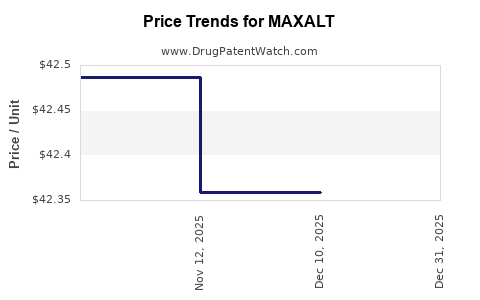
Brand MAXALT's price per tablet declined by approximately 13% from 2018 to 2022, with generics reducing consumer costs and pressuring brand pricing.
Future Price Projections
Given ongoing patent and formulation protections, immediate price reductions are unlikely. However, once exclusivity expires (anticipated in late 2025 or early 2026), generic competition will likely lower prices further.
- 2023–2024: Max retail price remains around $12–$13 per tablet, constrained by existing coverage agreements and brand loyalty.
- 2025–2026: Anticipate a decline of 30–50% in unit price within 12-24 months of generic market entry, driven by competition and payer pressure.
- Post-2026: Prices could stabilize at $4–$6 per tablet, similar to current generic rates, attenuating sole-source brand premiums.
Market Drivers and Constraints
- Physician Adoption: Consistent prescribing due to well-known efficacy.
- Patient Preference: Preference for established brands among certain demographics.
- Insurance Policies: Formulary restrictions influence utilization; generics favored for cost savings.
- New Therapies: CGRP antagonists and non-specific analgesics may impact MAXALT's market share over time but are viewed as complementary rather than substitute.
Competitive Outlook
Maxalt’s market position remains challenged by newer classes, especially CGRP inhibitors, which target migraine prevention. However, for acute treatments, triptans, including MAXALT, continue to be first-line options.
Regulatory and Market Risks
- Patent litigation and potential patent extensions could delay generic entry.
- Regulatory approvals of new formulations or delivery mechanisms can temporarily bolster market position.
- Increasing drug pricing transparency and payer initiatives could accelerate generic substitution.
Key Takeaways
- MAXALT maintains a significant share of the acute migraine treatment market with stable sales.
- The drug’s pricing has declined modestly since patent expiration but remains higher than generics.
- Price erosion is expected post-2026, with generic competition likely reducing unit costs by up to 50%.
- Market integration of newer therapies and evolving payer policies influence long-term market dynamics.
FAQs
1. How long will MAXALT retain its market exclusivity?
Patents and exclusivities are projected to expire around late 2025 to early 2026, after which generics are expected to enter widely.
2. What factors influence MAXALT’s pricing stability?
Existing formulary contracts, brand loyalty, physician prescribing habits, and limited generic supply maintenance influence stability until patent expiry.
3. Will MAXALT’s sales decline with generic entry?
Yes, generics typically capture most of the market share, leading to reduced per-unit revenues for brand MAXALT.
4. How do newer migraine therapies impact MAXALT’s market share?
CGRP inhibitors primarily prevent migraines, not treat acute episodes. Therefore, MAXALT remains relevant as an acute therapy, though overall migraine management may shift.
5. Are there opportunities for MAXALT with new formulations?
Yes, formulations like orally disintegrating tablets can extend exclusivity and market appeal, potentially preserving some pricing premiums.
Sources
[1] IQVIA. "Pharmaceutical Market Estimates," 2022.
[2] U.S. Patent and Trademark Office. "Patent Status for Rizatriptan," 2007.
[3] Global Data. "Migraine Treatment Market Report," 2022.