Last updated: February 20, 2026
Maraviroc, marketed as Selzentry by Pfizer, is a CCR5 antagonist used in HIV treatment. Its unique mechanism targets the CCR5 co-receptor, blocking HIV entry into immune cells. Market dynamics and pricing are driven by the drug's indication scope, competition, regulatory status, and evolving therapeutic landscape.
Market Overview
Indication and Patient Population
Maraviroc is approved for treatment-experienced adults with CCR5-tropic HIV-1 infection. It is also evaluated for new indications such as primary HIV infections and pre-exposure prophylaxis (PrEP), though these are not yet widely adopted.
Current Market Size
Estimated global HIV/AIDS treatment market size reached approximately USD 45 billion in 2022.[1] Maraviroc's direct market share remains modest, due to its niche positioning and competition from other antiretroviral drugs.
Market Share and Revenue
In 2022, Pfizer’s sales from Selzentry approximated USD 250 million, with growth primarily in North America and Europe. This figure represented less than 1% of the total HIV treatment market but reflects strong adherence within its target cohort.
Competitive Landscape
Key Competitors
- Maraviroc (Pfizer): Approved for CCR5-tropic HIV-1 infection.
- Raltegravir (Merck): Integrase inhibitor with broader use.
- Dolutegravir (Gilead): Higher efficacy, improved tolerability.
- Bictegravir (Gilead): Emerging dominant in combination therapy.
Market Penetration and Limitations
Maraviroc faces competition from drugs with broader indications, higher genetic barrier to resistance, and better tolerability profiles. Its USE remains limited to specific patient groups; thus, overall adoption is constrained.
Regulatory and Developmental Outlook
Approvals and Trials
- FDA (2010): Approved for CCR5-tropic HIV.
- EMA: Same-year approval, with ongoing post-marketing surveillance.
- Research: Trials exploring dual therapy, pre-exposure prophylaxis, and use in other viral infections.
Future Regulatory Decisions
Approval extensions for new indications could expand market size. However, unless significant advantages emerge, market growth remains constrained.
Price Projections
Current Pricing Structure
- Retail price: Approximately USD 7,500–USD 10,000 annually per patient.
- Reimbursement: Insurers cover most costs; patient co-pay varies.
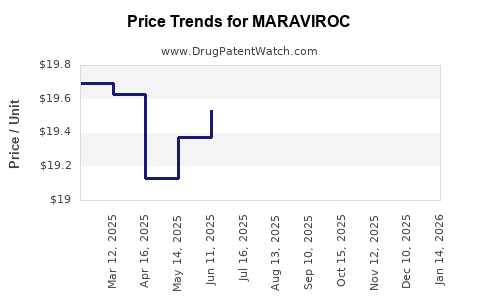
Price Trends (2023-2033)
Prices are expected to decline gradually due to patent expiries and generic entry projected around 2027–2029.[2] The initial USD 8,000–USD 10,000 will likely decrease by 20–40% over the next five years.
Influencing Factors
- Patent expirations: Will trigger generic entry, reducing prices.
- Competitive dynamics: Introduction of newer agents with superior profiles.
- Regulatory expansions: Widens eligible patient populations; could stabilize prices temporarily.
- Market penetration: Niche use limits pricing flexibility.
Scenario Projections
| Year |
Price Range (USD/year) |
Market Penetration |
Notes |
| 2023 |
8,000–10,000 |
Limited |
Peak patent protection, niche market focus |
| 2025 |
6,500–8,000 |
Slight increase |
Entry of generics, competitive pressure |
| 2027 |
4,500–6,000 |
Moderate |
Patent expiry expected, increased generic options |
| 2030 |
3,000–4,500 |
Broader |
Market saturation, increased competition |
Supply and Pricing Impact
Generic competition and biosimilar entries will exert downward pressure. Price erosion may accelerate as other therapies demonstrate superior profiles or broader indications.
Key Challenges and Opportunities
- Challenges: Limited use case expansion, competition, patent expiry.
- Opportunities: New indications, combination regimens, targeted niche markets.
Key Takeaways
- Maraviroc maintains a niche segment, with annual revenues around USD 250 million.
- The drug’s price is forecasted to decline approximately 40–50% by 2030 due to patent expiration and market competition.
- Market growth hinges on expansion into new indications, though substantial increases are unlikely without significant innovation.
- Competitive agents with broader activity profiles overshadow maraviroc’s position, restricting its pricing power.
- Strategic positioning in specialized HIV treatment remains critical for Pfizer’s long-term value capture.
Frequently Asked Questions
1. When will generic maraviroc enter the market?
Expected between 2027 and 2029, post-patent expiry, leading to significant price reductions.
2. Can maraviroc be used for other viral infections?
Currently, no regulatory approval; research exploring such uses is ongoing but unproven.
3. How does maraviroc compare to newer HIV agents?
It has a more limited indication scope and less convenient dosing than integrase inhibitors like dolutegravir.
4. What factors could sustain higher prices?
Expansion into new indications, causing a resurgence in demand, or specialty use in resistant HIV cases.
5. How might pricing vary across markets?
Pricing is higher in developed countries with advanced healthcare systems; lower in emerging markets due to generics availability and reimbursement policies.
References
[1] Global HIV/AIDS Market Report, 2022. Market Research Inc.
[2] IQVIA. Pharmaceutical Patent Expiry and Generic Entry Calendar, 2023.