Last updated: February 12, 2026
What Is the Size of the Market for Magnesium Oxide?
The global magnesium oxide market was valued at approximately $4.5 billion in 2022. It is projected to grow at a compound annual growth rate (CAGR) of 5.3% from 2023 to 2030, reaching an estimated $7.5 billion by 2030. Key growth drivers include increasing demand in the construction sector for refractory bricks, rising adoption in agriculture as a soil supplement, and expanding applications in environmental remediation.
Regionally, Asia-Pacific accounts for the largest share—over 50%—driven by high consumption in China and India. North America and Europe follow, with advanced infrastructure and stricter regulatory standards for refractory materials and environmental uses.
How Is the Market Segmented?
The market segments primarily into applications:
- Construction and refractory materials (approximately 45% of market share)
- Agriculture (around 25%)
- Environmental remediation (roughly 10%)
- Chemical manufacturing (about 10%)
- Others, including personal care and pharmaceuticals (remaining 10%)
Refractory materials dominate due to magnesium oxide's high refractory properties, such as thermal insulation and resistance to corrosion.
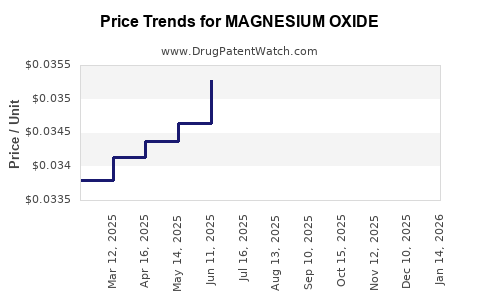
What Are the Pricing Trends for Magnesium Oxide?
Prices for magnesium oxide vary with grade, purity, and form. Key grades include light (dead-burned) and dead-burned magnesium oxide:
| Grade |
Price Range (USD/ton) |
Characteristics |
| Light magnesium oxide |
$800 - $1,200 |
Lower density, used in agriculture, environmental applications |
| Dead-burned magnesium oxide |
$1,000 - $1,400 |
Higher purity, utilized in refractory applications |
Pricing is influenced by raw material costs, energy prices, and environmental regulations. Prices trend upward during periods of increased demand or supply constraints, like energy shortages affecting calcination processes.
What Are Major Factors Affecting Market Dynamics?
- Raw material availability: Magnesium ore quality and access impact production costs.
- Energy prices: High energy consumption during calcination makes magnesium oxide sensitive to electricity and fuel prices.
- Environmental policies: Stricter emissions regulations increase operational costs, especially in Europe and North America.
- Technological advancements: Improved calcination and processing technologies can reduce costs and enhance purity.
- Competitive landscape: Large producers in China, India, and North America dominate, influencing pricing and supply stability.
Projected Price Trends and Market Outlook
Prices are expected to gradually increase at about 2-3% annually through 2030, driven by rising energy costs and demand in end-use sectors. However, overcapacity in China has periodically led to price drops, with export tariffs and trade policies influence pricing globally.
Market expansion into emerging applications, such as environmental catalyst supports and advanced ceramics, is projected to create new revenue streams. The focus on sustainable and low-carbon magnesium production methods is gaining momentum, aiming to reduce environmental impact and meet stricter regulatory standards.
Key Takeaways
- The global magnesium oxide market is set to reach $7.5 billion by 2030.
- Construction and refractory use dominate the sector, with significant contributions from agriculture.
- Prices for high-purity grades range from $800 to $1,400 per ton.
- Market growth is tempered by raw material constraints, energy costs, and geopolitical factors.
- Price increases are expected steadily but remain sensitive to supply-demand dynamics and policy changes.
FAQs
1. What are the main applications of magnesium oxide?
Construction refractory materials, agriculture as a soil amendment, environmental remediation, chemical manufacturing, and specialty uses in personal care and pharmaceuticals.
2. How does China influence global magnesium oxide prices?
China accounts for over 70% of global magnesium oxide production, making its export policies, production capacity, and environmental regulations key price determinants.
3. What are the primary raw materials for magnesium oxide production?
Magnesite and dolomite ore are the principal raw materials, with the quality of the ore directly impacting feedstock costs.
4. How do energy prices impact magnesium oxide costs?
Calcination, the key processing step, consumes significant energy; thus, rises in electricity and fuel prices directly increase production costs.
5. What trends could disrupt the magnesium oxide market?
Supply chain disruptions, stricter environmental policies, technological shifts, or trade restrictions could influence prices and market growth patterns.
References
- MarketWatch (2022). Magnesium Oxide Market Size, Share, Growth, and Forecast 2023-2030.
- Grand View Research (2023). Magnesium Oxide Market Analysis.
- Engineering & Mining Journal (2022). Global Magnesium Production and Pricing Trends.