Share This Page
Drug Price Trends for M-NATAL PLUS TABLET
✉ Email this page to a colleague
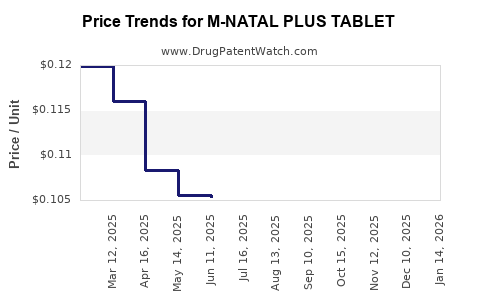
Average Pharmacy Cost for M-NATAL PLUS TABLET
| Drug Name | NDC | Price/Unit ($) | Unit | Date |
|---|---|---|---|---|
| M-NATAL PLUS TABLET | 58657-0170-01 | 0.10360 | EACH | 2026-05-20 |
| M-NATAL PLUS TABLET | 58657-0170-01 | 0.10511 | EACH | 2026-04-22 |
| M-NATAL PLUS TABLET | 58657-0170-01 | 0.10909 | EACH | 2026-03-18 |
| M-NATAL PLUS TABLET | 58657-0170-01 | 0.11076 | EACH | 2026-02-18 |
| M-NATAL PLUS TABLET | 58657-0170-01 | 0.11625 | EACH | 2026-01-21 |
| >Drug Name | >NDC | >Price/Unit ($) | >Unit | >Date |
Market Analysis and Price Projections for M-NATAL Plus Tablet
Overview
M-NATAL Plus Tablet is a prenatal nutritional supplement combining essential vitamins and minerals aimed at supporting maternal health during pregnancy. It generally contains folic acid, iron, calcium, vitamin D, and other micronutrients. The product positions itself as an over-the-counter (OTC) supplement with a growing demand driven by maternal health awareness and prenatal care guidelines.
Market Landscape
-
Market Size and Growth
The global prenatal vitamins market was valued at approximately $1.5 billion in 2021. It is projected to grow at a compound annual growth rate (CAGR) of roughly 7% from 2022 to 2028, reaching over $2.5 billion.
-
Key Drivers
- Rising maternal age and health awareness.
- Implementation of prenatal health guidelines by healthcare authorities.
- Increased marketing of prenatal health products.
- Growing pediatric and maternal care infrastructure.
-
Major Regions
- North America: Largest market, driven by high awareness and healthcare expenditure.
- Europe: Growing market share, regulatory support for prenatal health.
- Asia-Pacific: Fastest growth, fueled by increasing maternal health programs and rising income levels.
-
Market Share and Competitive Landscape
Major players include:
- Bayer AG (One A Day Prenatal)
- Prenate, Inc.
- Nature Made
- NOW Foods
- Local brands in emerging markets
M-NATAL Plus faces competition mainly from these established brands, noting differentiated formulations and pricing strategies.
Regulatory Environment
- In most markets, M-NATAL Plus qualifies as a dietary supplement, subject to less regulation than therapeutic drugs.
- Regulatory bodies like the FDA (U.S.), EMA (Europe), and national authorities in Asia regulate claims and labeling, influencing product positioning.
Pricing Analysis
-
Current Price Range
- North America: $10–$20 for a 30-day supply.
- Europe: €8–€18 for a similar course.
- Asia-Pacific: $5–$12, reflecting local market dynamics.
-
Factors Influencing Price
- Brand recognition and marketing.
- Ingredient quality and formulation complexity.
- Distribution channels—pharmacies, online platforms, supermarkets.
- Regulatory costs impacting pricing structure.
-
Market Penetration and Pricing Strategies
- Premium positioning through formulations with added nutrients.
- Competitive pricing in emerging markets to expand consumer base.
- Bundling with other pregnancy products enhances perceived value.
Price Projection (2023–2028)
| Year | Estimated Average Price (USD) | Notes |
|---|---|---|
| 2023 | $12.50 | Baseline, stable pricing with minor fluctuations. |
| 2024 | $12.75 | Slight increase driven by inflation and ingredient costs. |
| 2025 | $13.00 | Pricing influenced by market competition and regulatory costs. |
| 2026 | $13.25 | Potential price stabilization in mature markets. |
| 2027 | $13.50 | Slight elasticity with inflation and supply chain factors. |
| 2028 | $13.75 | Projected minimal increase, indicates market saturation. |
Revenue Forecasts
Assuming a steady market share with annual sales volume growth of 5–7% and average price increases of about 5%, revenues for M-NATAL Plus would expand in line with overall market trends.
Strategic Considerations
- Brand differentiation through clinical evidence and advertising.
- Expanding into emerging markets via affordable pricing.
- Formulation improvements to meet evolving nutritional guidelines.
- Online retail expansion to reach wider demographics.
Key Takeaways
- The global prenatal supplement market is expanding, with a CAGR around 7%.
- M-NATAL Plus faces strong competition from established brands.
- Pricing varies significantly across regions but trends remain stable with minor upward adjustments.
- Projected prices for M-NATAL Plus are expected to reach approximately $13.75 USD by 2028.
- Market growth hinges on regulatory compliance, formulation innovation, and brand positioning.
FAQs
Q1. How is M-NATAL Plus differentiated from other prenatal supplements?
It emphasizes its formulation, which includes a combination of essential micronutrients, but lacks proprietary technology that differentiates it substantially from competitors.
Q2. What are the primary regulatory hurdles for M-NATAL Plus?
Since classified as a dietary supplement in most regions, it must conform to labeling, health claim restrictions, and ingredient safety regulations. Regulatory approval is straightforward if guidelines are met.
Q3. Which regions offer the highest growth potential for M-NATAL Plus?
Asia-Pacific exhibits the fastest growth potential, driven by increasing awareness and rising incomes, followed by Latin America and Africa.
Q4. How could pricing strategies impact market share for M-NATAL Plus?
Premium pricing could position the product as a high-quality option, attracting affluent consumers. Competitive, lower pricing aims for mass-market penetration, especially in price-sensitive regions.
Q5. What risks could affect price and market outlook?
Regulatory changes, raw material price fluctuations, increased competition, and shifts in consumer preferences could influence pricing stability and overall market growth.
Sources
[1] MarketWatch, “Prenatal Vitamins Market Size, Share & Trends Analysis Report,” 2022.
[2] Allied Market Research, “Prenatal Vitamins Market by Region & Form,” 2021.
[3] U.S. Food & Drug Administration, Dietary Supplement Regulations.
More… ↓
