Share This Page
Drug Price Trends for LURASIDONE
✉ Email this page to a colleague
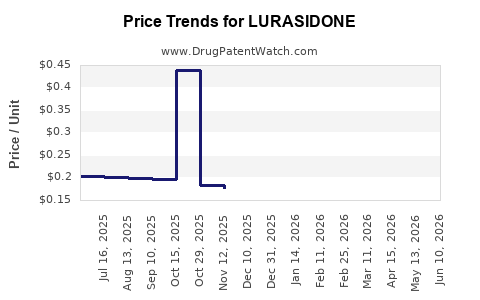
Average Pharmacy Cost for LURASIDONE
| Drug Name | NDC | Price/Unit ($) | Unit | Date |
|---|---|---|---|---|
| LURASIDONE HCL 120 MG TABLET | 00904-7359-04 | 0.49080 | EACH | 2026-07-22 |
| LURASIDONE HCL 120 MG TABLET | 00904-7425-46 | 0.49080 | EACH | 2026-07-22 |
| LURASIDONE HCL 120 MG TABLET | 13668-0467-30 | 0.49080 | EACH | 2026-07-22 |
| LURASIDONE HCL 120 MG TABLET | 23155-0891-03 | 0.49080 | EACH | 2026-07-22 |
| >Drug Name | >NDC | >Price/Unit ($) | >Unit | >Date |
Best Wholesale Price for LURASIDONE
| Drug Name | Vendor | NDC | Count | Price ($) | Price/Unit ($) | Unit | Dates | Price Type |
|---|---|---|---|---|---|---|---|---|
| LURASIDONE HCL 40MG TAB | Golden State Medical Supply, Inc. | 51407-0832-05 | 500 | 2000.00 | 4.00000 | EACH | 2024-02-10 - 2028-06-14 | FSS |
| LURASIDONE HCL 80MG TAB | Golden State Medical Supply, Inc. | 51407-0833-05 | 500 | 2000.00 | 4.00000 | EACH | 2024-02-10 - 2028-06-14 | FSS |
| >Drug Name | >Vendor | >NDC | >Count | >Price ($) | >Price/Unit ($) | >Unit | >Dates | >Price Type |
rasidone Market Analysis and Price Projections (United States and Key Ex-US Markets)
Lurasidone has lost some early exclusivity value but still carries meaningful market share in schizophrenia and bipolar depression. The near-to-midterm price trajectory is dominated by generic entry timing, payer contracting, and brand-to-generic mix shifts rather than new patent-driven supply constraints. Sustained U.S. demand is supported by oral dosing flexibility and a label centered on schizophrenia and bipolar I depression, with competitive pressure from other branded atypicals (and, where available, generics) reshaping net price faster than list price.
How big is the lurasidone market and what drives sales?
Executive answer
The lurasidone market opportunity is primarily U.S.-centric (with additional revenue in Europe, Canada, and selected Asia-Pacific markets), driven by:
- persistence of schizophrenia treatment with long-term adherence
- bipolar I depression treated with lurasidone monotherapy or adjunctive regimens (depending on line-of-therapy and payer rules)
- payer preference design around formulary tier placement and step edits versus competing atypicals
Demand drivers
- Schizophrenia maintenance and symptom control: Lurasidone is positioned for bipolar and schizophrenia populations that require chronic treatment. Long duration of therapy increases addressable prevalence.
- Bipolar I depression: U.S. label adoption depends on prescriber comfort and payer edits, which can change quickly when competing products negotiate formulary terms.
- Formulary design mechanics: Net price is shaped less by wholesale acquisition cost and more by rebate structures, patient assistance, and managed care contracting.
What most affects revenue in the next 3 to 5 years?
- Generic penetration and substitution: Where generics are available, net price compresses sharply; uptake tends to be fast if formulary access is granted.
- Contracting cadence: Even without new generic launches, branded net price can drift downward as contracts renew and competitors gain shelf access.
- Safety and tolerability perceptions: Lurasidone’s metabolic profile tends to influence payer and prescriber channel dynamics, affecting share retention.
What is the current pricing structure for lurasidone (list price vs net price)?
Executive answer
Lurasidone’s price outcomes follow the standard branded pattern: list price stays relatively stable longer than net price. Net declines accelerate after generic competition and during major payer renegotiations.
Key pricing levers
- Wholesale acquisition cost (WAC): Often lags true market economics.
- Rebates and discounts: Typically account for most of the delta between WAC and net.
- Patient cost-share: Copay assistance can support adherence and volume for remaining branded share, but payer restrictions and budget caps can reduce its effect over time.
- Medicaid and government pricing: State formularies and Medicaid managed care can shift faster than commercial.
When does lurasidone lose exclusivity and how does that impact price?
Executive answer
Generic price compression risk rises materially around the first credible generic entry and subsequent waves of additional ANDA supply. In practice, price pressure peaks in the year of entry and the two following contract cycles.
How generic entry typically changes price
- Year 0 to entry year: sharp drop in net price for the brand as payers convert to preferred generic coverage.
- Entry year +1: brand share often declines most at the pharmacy counter. Net price can show continued pressure even if list price changes are limited.
- Entry year +2 onward: remaining branded share depends on prior authorization, step therapy, and patient-level stability.
Residual brand pricing power
- Oral dosing continuity: If payers maintain coverage for brand due to specific clinical exceptions, brand share can persist.
- Formulation-specific demand: If branded tablets remain preferred for some dose combinations, that can delay full substitution.
- Switching friction: Clinicians and patients may resist switching if symptom control is stable.
What patents protect lurasidone and how strong is the patent estate?
Executive answer
A robust patent estate generally slows generic erosion and reduces the depth of early price compression. Once the estate clears via expiration or successful challenges, pricing tends to drop quickly through formulary conversion.
What to analyze for “patent strength”
- Active ingredient composition-of-matter: earliest expiration driver
- Formulation patents: salt forms, polymorphs, or release characteristics that can block certain generic manufacturing designs
- Method-of-use patents: typically matter only if generics pursue “carve-out” labeling strategies
- Orange Book listing status: governs challenge visibility through Paragraph IV suits
Why the estate matters for price projection
If exclusivity blocks generic entry, branded net price may remain more stable and brand volume can hold longer. If exclusivity is already gone, the market moves faster to generic parity, producing larger net price declines.
What is the Orange Book status of lurasidone and which patents are listed?
Executive answer
Orange Book status is the single most actionable gating item for generic launch risk. The presence, type, and expiration of listed patents define when ANDA exclusivity windows open or close.
How to use Orange Book listings in pricing projection
- Claimed expiration windows: align to expected generic entry cohorts
- Patent type mix: composition-of-matter listings generally have later impact; formulation and method-of-use can shape “partial” market outcomes
- Recent amendments or removals: often signals litigation posture and helps refine entry timing assumptions
Which companies are challenging lurasidone with Paragraph IV ANDAs?
Executive answer
Paragraph IV litigation is the market signal for imminent generic entry. The settlement terms often determine launch timing and can limit early price compression if delayed.
Key litigation-to-price translation steps
- Filed date and court timeline: indicates earliest launch if not enjoined
- Injunction scope: whether courts block entry until a specific patent expiration or only for certain strengths
- Settlement design: brand may agree to a delayed entry date, shared risk, or carve-outs impacting substitution speed
Price impact by litigation stage
- Pre-filing: limited immediate effect on price, but increases uncertainty premium for contracts.
- Ongoing litigation: payers may pause switching to avoid downstream reversal risk, supporting brand share longer than generic availability alone would suggest.
- Post-settlement: price tends to follow settlement-driven timing, often aligning to the settlement “switch date.”
What generic entry risks exist for lurasidone?
Executive answer
The biggest generic entry risks are not only “if” generics launch, but “how fast substitution happens.” That depends on:
- number of ANDAs approved
- formulary coverage decisions
- number of strengths available from first wave
- pharmacy stocking behavior
Fast substitution scenarios
- Multiple generic entrants quickly: increases competitive rebates and accelerates net price declines.
- Full-strength coverage at launch: speeds switching for stable chronic patients.
- Low administrative friction: if prior authorization is not required, substitution happens rapidly.
Slower substitution scenarios
- Limited strengths in early generic supply: delays switch for patients on less common doses.
- Non-interchangeable rules in formularies: can delay substitution even after approval.
How does lurasidone compare with other atypical antipsychotics on price and market share?
Executive answer
Lurasidone competes in the atypical antipsychotic and bipolar depression space where multiple drugs face distinct generic timelines. In pricing, the key comparison is not clinical differentiation alone, it is whether competing agents are branded or generic in the payer’s preferred tier.
Comparison dimensions
- Generic availability of close competitors: drives differential rebate intensity and net price erosion.
- Formulary tier position: a branded alternative with a higher tier suffers faster share loss after generic launches in the class.
- Dosing convenience: adherence and switchability impact whether payers can force substitution.
How do payer decisions and formulary management affect lurasidone net price?
Executive answer
Payers can reduce net price without changing WAC by tightening formularies, limiting prior authorization exceptions, and shifting patient flows to preferred generics or competing agents.
Tactics that typically drive net price compression
- Step therapy edits: restrict brand to patients who fail preferred generics/alternatives.
- Prior authorization: increases administrative burden that can reduce branded persistence.
- Restrictive pharmacy networks: shift utilization toward channels with lower acquisition economics.
Price projection for lurasidone: what scenarios are most likely?
Executive answer
Price outcomes bifurcate into three practical scenarios driven by generic entry timing and payer contracting speed:
Scenario 1: Generic entry is imminent
- Brand net price: declines sharply in the entry year and continues contracting for 12 to 24 months through contract cycles.
- WAC: may show modest change; net is the dominant economic lever.
- Volume: brand share declines as switching accelerates.
Scenario 2: Generic entry is delayed
- Brand net price: stays higher for longer; rebating pressure builds gradually as contracts renew.
- Volume: stabilizes, especially for patients already on therapy due to inertia.
Scenario 3: Generic entry occurs but substitution is slow
- Brand net price: declines but less aggressively due to clinical exceptions and limited early generic coverage.
- Volume: erodes gradually based on payer restrictions and strength coverage.
What revenue exposure exists across strengths, settings, and geographies?
Executive answer
Revenue exposure is strength-sensitive and setting-sensitive. Chronic schizophrenia patients can be concentrated on stable maintenance doses, reducing speed of switching if early generic coverage misses those strengths.
U.S. setting exposure
- Commercial managed care: drives most contraction via rebates and tier placement.
- Medicaid managed care: sensitive to state formulary policies and plan-level benefit design.
Ex-U.S.
- Europe: pricing depends on national health service tendering and reference pricing mechanisms that compress brand price after generic launch.
- Canada: price negotiation frameworks and public reimbursement schedules impact net quickly after approval.
- Selected Asia-Pacific markets: procurement dynamics can compress price rapidly, but local patent and pricing policy variations change timing.
What manufacturing and IP barriers could slow generic substitution?
Executive answer
Even after patent clearance, substitution speed can be affected by manufacturing scale-up and strength-specific availability. If a generic supplier launches only a subset of strengths, payer switching can slow.
IP-related launch friction
- Product-specific formulation constraints: can delay “full portfolio” generic supply.
- Residual litigation for additional patents: can keep some strengths blocked longer.
Key Takeaways
- Lurasidone’s price trajectory is primarily governed by generic entry timing and payer contracting speed, not by WAC alone.
- Generic availability typically causes the largest net price declines in the entry year plus the next 12 to 24 months.
- Substitution speed depends on strength coverage, formulary design, and prior authorization rules.
- Patent estate strength and Orange Book listing status are the leading indicators for launch timing and thus near-term price compression risk.
FAQs
- How fast do lurasidone generic uptake rates typically occur after approval in the U.S.?
- Do lurasidone strength-level availability differences change net price more than overall launch timing?
- How do prior authorization and step therapy policies affect lurasidone brand share during generic competition?
- What settlement terms in lurasidone Paragraph IV litigation usually determine launch delay windows?
- How does lurasidone price compression differ between commercial managed care and Medicaid managed care?
References
- FDA. Orange Book: Approved Drug Products with Therapeutic Equivalence Evaluations. U.S. Food and Drug Administration.
- U.S. FTC and DOJ. Competition and Antitrust materials related to pharmaceutical settlements and generics. Federal Trade Commission / Department of Justice.
- FDA. Drug Approval and Safety. U.S. Food and Drug Administration.
More… ↓
