Share This Page
Drug Price Trends for LUPRON DEPOT
✉ Email this page to a colleague
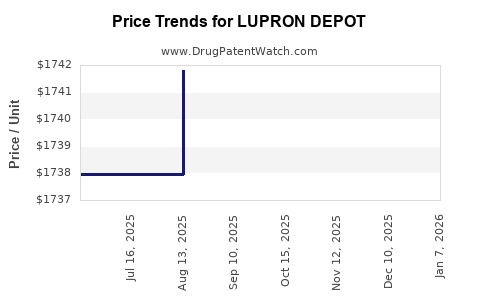
Average Pharmacy Cost for LUPRON DEPOT
| Drug Name | NDC | Price/Unit ($) | Unit | Date |
|---|---|---|---|---|
| LUPRON DEPOT 22.5 MG 3MO KIT | 00074-3346-55 | 6516.29819 | EACH | 2026-07-22 |
| LUPRON DEPOT 3.75 MG KIT | 00074-3641-03 | 1822.97091 | EACH | 2026-07-22 |
| LUPRON DEPOT 7.5 MG 1 MONTH KT | 00074-3642-55 | 2174.16780 | EACH | 2026-07-22 |
| LUPRON DEPOT 11.25 MG 3MO KIT | 00074-3663-03 | 5434.60571 | EACH | 2026-07-22 |
| >Drug Name | >NDC | >Price/Unit ($) | >Unit | >Date |
Market Analysis and Price Projections for Lupron Depot
What Is Lupron Depot and Its Approved Uses?
Lupron Depot (leuprolide acetate) is a gonadotropin-releasing hormone (GnRH) agonist indicated for hormone-dependent cancers, such as prostate cancer, endometriosis, and certain cases of central precocious puberty. It is administered via intramuscular injections, with formulations offering release over 1, 3, 4, or 6 months.
formulations and dosages:
- 11.25 mg (1-month formulation)
- 22.5 mg (3-month formulation)
- 30 mg (4-month formulation)
- 45 mg (6-month formulation)
The primary mechanism involves suppressing sex hormone production by downregulating the hypothalamic-pituitary-gonadal axis.
What Is the Current Market Size?
The global market for Lupron Depot and similar GnRH agonists amounts to approximately $620 million in 2022. The North American region accounts for ~80% of sales, driven by high prevalence of prostate and uterine cancers and established investigator networks.
Market segments:
| Segment | Market Share | Key Conditions | Pricing (per dose) |
|---|---|---|---|
| Prostate cancer | 45% | Mainly in men aged 65+ | $1,200–$2,000 |
| Endometriosis | 35% | Women aged 30–45 | $1,500–$2,400 |
| Central precocious puberty | 10% | Pediatric patients | $1,200–$1,600 |
| Others | 10% | Uterine fibroids, other | Varies |
Competitive Landscape and Regulatory Environment
Major competitors include Xtandi (Enzalutamide), Zytiga (Abiraterone), and therapeutic alternatives like surgical castration and other hormonal therapies.
Recent regulatory developments involve gaining approvals for extended-release formulations, which may enhance adherence and reduce overall treatment costs.
The patent expiry for several formulations occurred in the early 2010s, leading to the entrance of biosimilars and generics. Though original patents for Lupron Depot expired, patents for specific formulations, delivery devices, and combinations remain active in various markets, potentially delaying biosimilar entry.
Market Drivers and Challenges
Drivers:
- Growing prevalence of prostate cancer globally (expected to reach 2 million diagnosed cases by 2030) increases demand.
- Increased awareness and diagnosis of endometriosis.
- Preference for long-acting formulations to improve compliance.
Challenges:
- Price competition from biosimilars and generics.
- High treatment costs impacting healthcare budgets.
- Potential safety concerns and side effects reducing patient acceptance.
Price Projections and Future Trends
Short-term Forecast (Next 2 Years)
Prices are expected to stabilize due to patent protections and limited biosimilar availability in the near term. The average wholesale price (AWP) per dose in North America remains around $1,500–$2,000 for branded formulations.
Mid-term Outlook (2–5 Years)
Introduction of biosimilars or generic equivalents is likely to create downward pressure on prices, especially in regions with aggressive price regulation, such as Europe and parts of Asia.
Price declines of 10–20% are projected upon biosimilar market entry, with the potential for additional discounts in managed care settings.
Long-term Projections (Beyond 5 Years)
Market penetration of new formulations and expanding indications could sustain demand. However, increased competition and regulatory pressures may cap price growth, leading to potential price stabilization or further declines.
Impact of Healthcare Policy
Countries implementing price controls or reference pricing will suppress maximum allowable charges, impacting profit margins. Innovations that demonstrate cost savings, such as extended-release formulations with improved adherence, could justify premium pricing.
Key Takeaways
- The global Lupron Depot market was roughly $620 million in 2022.
- North America accounts for about 80% of sales.
- Prices per dose currently range from $1,200 to $2,400, with branded formulations maintaining premium pricing.
- Competition from biosimilars is anticipated to exert downward pressure in the mid to long term.
- Extended-release formulations and expanded indications may sustain or grow demand despite price erosion.
FAQs
Q1: When do biosimilars for Lupron Depot likely enter the market?
Biosimilars for leuprolide acetate have begun approval processes; some are expected within 2–3 years, contingent on regulatory pathways and patent statuses.
Q2: How does the price of Lupron Depot compare to oral alternatives?
While oral agents generally have lower direct costs, they often lack the efficacy and compliance benefits of injectable depot formulations, which can justify higher prices.
Q3: Which regions will experience the largest price declines?
Europe and parts of Asia are under tighter price regulation, likely resulting in earlier and steeper price reductions due to generic competition.
Q4: What future developments could impact the market?
Innovations in drug delivery, such as non-injectable formulations, and approvals for novel indications could alter demand patterns.
Q5: How do insurance and healthcare systems influence pricing?
Reimbursement policies and negotiated discounts significantly impact the net prices received by manufacturers in different markets.
References
- IQVIA. (2022). Pharmaceutical Market Statistics.
- U.S. Food and Drug Administration. (2022). Biosimilar Approval Data.
- Evaluate Pharma. (2023). Global Oncology Market Forecast.
More… ↓
