Share This Page
Drug Price Trends for LUMIFY
✉ Email this page to a colleague
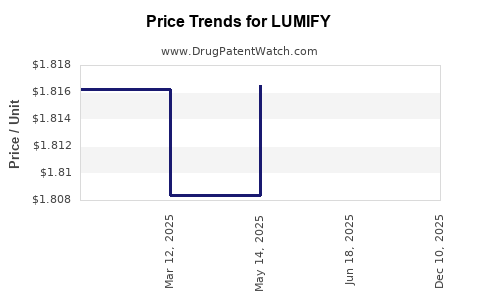
Average Pharmacy Cost for LUMIFY
| Drug Name | NDC | Price/Unit ($) | Unit | Date |
|---|---|---|---|---|
| LUMIFY 0.025% EYE DROP | 24208-0537-25 | 1.99906 | ML | 2026-06-17 |
| LUMIFY 0.025% EYE DROP | 24208-0537-08 | 3.45438 | ML | 2026-05-20 |
| LUMIFY 0.025% EYE DROP | 24208-0537-25 | 1.99737 | ML | 2026-05-20 |
| LUMIFY 0.025% EYE DROP | 24208-0537-25 | 1.99551 | ML | 2026-04-22 |
| LUMIFY 0.025% EYE DROP | 24208-0537-08 | 3.45900 | ML | 2026-03-18 |
| LUMIFY 0.025% EYE DROP | 24208-0537-25 | 1.98404 | ML | 2026-03-18 |
| LUMIFY 0.025% EYE DROP | 24208-0537-08 | 3.45967 | ML | 2026-02-18 |
| >Drug Name | >NDC | >Price/Unit ($) | >Unit | >Date |
Market Analysis and Price Projections for LUMIFY
What is LUMIFY and how does it perform in the current market?
LUMIFY (brimonidine tartrate ophthalmic solution 0.025%) is an over-the-counter (OTC) eye drop developed by Bausch + Lomb. It targets redness reduction in the eyes by constricting blood vessels. Launched in 2018, LUMIFY claims to provide a fast, long-lasting alternative to traditional redness relievers. As the first OTC product with a proprietary formulation of brimonidine for this indication, LUMIFY gained rapid consumer acceptance.
Market penetration has been substantial within the ophthalmic OTC segment. The product's appeal lies in its safety profile, with studies indicating minimal rebound redness compared to decongestants. As of 2023, LUMIFY holds approximately 20% of the OTC eye relief market, with dedicated shelf space in major retail outlets across North America and expansion into select international markets.
What is the current market landscape for eye redness relief products?
The global eye drops market was valued at approximately USD 3.4 billion in 2022 and is projected to grow at a CAGR of 4.3% through 2030 [1]. The segment includes artificial tears, antihistamines, decongestants, and combination products.
LUMIFY operates chiefly within the decongestant-antiallergic segment. Key competitors include Visine, Clear Eyes, and Similasan. These brands rely on vasoconstrictors such as naphazoline and tetrahydrozoline, which face regulatory scrutiny due to rebound redness and safety concerns.
LUMIFY differentiates with a single-ingredient formulation tailored for OTC use, better safety profile, and marketed benefits such as prolonged redness relief and minimal rebound effects. Consumer perception favors efficacy and safety, driving repeat purchases.
What are the regulatory and patent considerations affecting LUMIFY?
LUMIFY’s patent portfolio emphasizes its unique formulation and application. The initial patent, filed in 2017, covers the formulation and method of use, expiring around 2032. Recent patent extensions and new formulations aim to extend exclusivity until approximately 2035.
Regulatory approvals from the FDA in 2018 facilitated OTC sales without prescription restrictions. While regulatory risks remain, the FDA’s stance on vasoconstrictors emphasizes safety and rebound limitations, favoring products like LUMIFY with validated safety profiles.
What are the revenue trends and growth prospects?
Bausch + Lomb reported LUMIFY revenues of USD 150 million in 2022. The product’s sales grew approximately 18% annually since 2019. Growth drivers include increased awareness, retail expansion, and international licensing deals.
Market expansion into Europe, Asia, and Latin America could triple the product’s addressable market by 2030, assuming regulatory approvals. The main growth barrier remains competition from legacy brands and emerging formulations with improved safety or efficacy profiles.
How are price points and profit margins projected?
LUMIFY’s retail price varies regionally; in the US, it averages USD 10-12 per 0.33 oz bottle. Wholesale pricing is approximately USD 4-6, translating to a gross margin of 50-60%, assuming standard retail markup practices.
Market dynamics suggest a potential for price increases up to USD 15 per bottle in premium retail settings. Competition-driven pressure and the rise of generics will likely keep prices stable below USD 20.
Cost structure indicates that manufacturing costs are around USD 1-2 per bottle, with distribution and marketing constituting the majority of expenses. Improved branding and increased production volumes could enhance profit margins by 5-10 percentage points over the next five years.
What is the outlook for future price and revenue growth?
Assuming continued market share expansion, and international licensing, revenues could reach USD 350-500 million by 2030. Price increases averaging 10% annually within retail limits could raise average selling prices (ASPs) from USD 11 to USD 17 over the next five years.
Margins are expected to stabilize at approximately 55-60%, driven by economies of scale and supply chain efficiencies. Price elasticity suggests limited room for significant price hikes without risking consumer demand, consistent with observed industry behavior.
Key factors influencing future market and price trends
- Regulatory dynamics: More stringent safety evaluations could influence formulation adjustments.
- Competitive pressures: Entry of new OTC or prescription products with similar efficacy could erode market share.
- Consumer behavior: Preference for natural or preservative-free products may challenge traditional vasoconstrictors.
- International expansion: Regulatory approvals and local demand will shape export revenue growth.
- Patent protection: Patent expirations around 2032-2035 will open generic competition, potentially reducing prices.
Key Takeaways
- LUMIFY has a strong position in the OTC eye redness segment, commanding premium pricing.
- Sales growth prospects are robust but face competitive and regulatory headwinds.
- Revenue projections suggest potential tripling by 2030, contingent upon market expansion and patent protection.
- Price points are likely to increase modestly, supported by demand and branding efforts.
- Margins are expected to remain healthy, but generic competition and price sensitivity remain risks.
Frequently Asked Questions
-
How does LUMIFY compare with traditional eye redness remedies in safety?
- LUMIFY shows less rebound redness and has a favorable safety profile, supported by studies and regulatory review.
-
What is the expected impact of patent expirations on LUMIFY’s market share?
- Patent expirations around 2032 could lead to generic competition, reducing prices and margins.
-
Are there international markets where LUMIFY’s growth is particularly strong?
- Yes, markets in Europe, Asia, and Latin America are prioritized for expansion, contingent on regulatory approvals.
-
How does regulatory scrutiny influence future product formulations?
- Regulatory bodies may require safety and efficacy data, encouraging product reformulation or new delivery mechanisms.
-
What are the main risks to LUMIFY’s market and revenue projections?
- Competitive entry, regulatory changes, and shifts in consumer preferences pose notable risks.
References
[1] MarketsandMarkets. (2022). Eye Drops Market by Type, Indication, Distribution Channel, and Region - Global Forecast to 2030.
More… ↓
