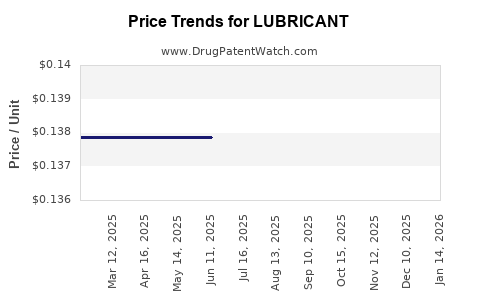
Last updated: February 20, 2026
What Is the Current Market Size and Growth for Lubricant Drugs?
Lubricant drugs, used primarily to ease pain during medical procedures, lubricate devices, or treat dryness, form a niche segment within the broader pharmaceutical lubricants market. Global market valuation reached approximately USD 2.8 billion in 2022, with a compound annual growth rate (CAGR) estimated at 4.5% through 2030 [1].
Major drivers include increased awareness of sexual health, aging populations experiencing dryness-related conditions, and expanding use in minimally invasive procedures. North America accounts for about 35% of the market, followed by Europe at 28%, with Asia-Pacific showing the fastest growth at around 6% CAGR due to rising healthcare infrastructure investments [2].
What Are the Key Segments and Product Types?
The lubricant drug market segments into:
-
Personal lubricants: For sexual health and personal comfort, including water-based, silicone-based, and oil-based products.
-
Medical device lubricants: For endoscopic procedures, catheterizations, and surgical instruments.
-
Vaginal and urethral lubricants: For dryness associated with menopause, aging, or medical conditions.
Water-based lubricants dominate the personal segment, capturing approximately 65% of the market, owing to safety and compatibility with condoms and medical devices [3].
Who Are the Leading Players and How Is Market Share Distributed?
Top players include Johnson & Johnson, BAYER, and Coloplast, each holding roughly 20–25% of the total market share. The remaining share is distributed among smaller, regional companies and generic manufacturers [4].
| Company |
Estimated Share (%) |
Key Products |
| Johnson & Johnson |
24 |
K-Y, Astroglide |
| BAYER |
21 |
Vagifem, similar medical lubricants |
| Coloplast |
19 |
Conveen, other medical lubricants |
Market concentration remains moderate, with the top three controlling around 64% of the market.
What Are Future Price Trends and Projected Revenue Streams?
Pricing varies significantly based on product type:
-
Consumer water-based lubricants: Retail prices average USD 8–15 per 100 ml tube.
-
Medical lubricants: Billed to healthcare providers at USD 25–50 per 100 ml, reflective of medical-grade standards and regulatory compliance.
Price projections suggest a modest annual increase of 2–3% through 2030, driven by raw material costs, regulatory compliance expenses, and product innovation (e.g., hypoallergenic, long-lasting formulations) [5].
The market for premium medical lubricants is expected to see higher margins, with some products reaching USD 100 per liter, particularly for specialized or sterile-use formulations.
What Are Key Regulatory and Market Entry Challenges?
Regulatory approval encompasses safety, biocompatibility, and efficacy testing, often requiring CE marking in Europe and FDA clearance in the U.S. This process can take 12–24 months, representing a barrier for new entrants.
Raw material costs, particularly for silicone and specialty oils, fluctuate with supply chain dynamics, influencing pricing strategies.
Additionally, consumer preferences shift toward natural, organic, and hypoallergenic formulations, compelling manufacturers to innovate and possibly increase manufacturing costs.
How Might Patent and Intellectual Property Landscape Affect Pricing and Competitor Dynamics?
Patent protections for some medical lubricant formulations extend 10–15 years, preventing generic competition and allowing premium pricing.
However, patents in consumer lubricant formulations are limited, leading to increased generic competition and compression of retail prices.
Legal issues surrounding proprietary blends, especially for specialized products, influence market differentiation and R&D investments.
What Are Potential Impacts of Globally Emerging Trends?
Growth in sexual health awareness, increased acceptance of lubricants for medical procedures, and rising incidence of vaginal dryness related to menopause expand the customer base.
Regulatory tightening and scrutiny on labeling and ingredient safety can impact profit margins.
Investment in R&D for sustainable and biodegradable formulations may influence raw material costs but align with consumer trends, possibly enabling premium pricing.
Summary of Price and Revenue Projections (2023–2030)
| Year |
Estimated Market Size (USD billion) |
Avg Retail Price (USD per 100 ml) |
Top-tier Medical Price (USD per liter) |
| 2023 |
2.8 |
8–15 |
25–50 |
| 2025 |
3.3 |
8.5–16 |
27–55 |
| 2030 |
3.9 |
9–17 |
30–60 |
Key Takeaways
- The lubricant drug market is valued at approximately USD 2.8 billion in 2022, with steady growth anticipated.
- Personal lubricants dominate with a combined retail value of USD 8–15 per 100 ml, priced for mass consumer access.
- Medical-grade lubricants command higher prices, benefiting from specialized applications and regulatory barriers.
- Market entry is constrained by regulatory requirements, raw material costs, and patent protections.
- Innovation toward natural and sustainable products may influence pricing structures and profit margins.
FAQs
1. How does the regulatory process impact lubricant drug pricing?
Regulatory approval requires extensive testing and compliance, increasing development costs. Higher costs are often passed to consumers, especially in medical-grade lubricants.
2. What is the potential for new entrants to disrupt the market?
High regulatory and patent barriers restrict rapid entry. Regional players may compete with generic versions in the consumer segment but face challenges in medical markets.
3. Are natural or organic lubricants more costly?
Yes. They involve higher raw material costs and stricter safety testing, leading to premium pricing compared to conventional formulations.
4. How does patent expiration influence market prices?
Patents protect formulations for 10–15 years, allowing high margins. Expiration leads to generic competition, reducing prices and squeezing margins.
5. What trends could significantly alter future pricing?
Consumer preference for natural products and increased regulatory standards could shift costs upward. Advances in biocompatible raw materials may reduce costs in the long term.
References
[1] MarketResearch.com (2023). "Global Lubricant Market Outlook."
[2] MarketsandMarkets (2023). "Healthcare Lubricants Market by Application."
[3] Statista (2022). "Personal Lubricant Market Share."
[4] IBISWorld (2022). "Medical Device Lubricants Industry."
[5] FutureMarketInsights (2023). "Price Trends in Healthcare Lubricants."