Last updated: February 12, 2026
What is the Market Scope for Loteprednol?
Loteprednol is a corticosteroid primarily used for ophthalmic inflammation and allergic conjunctivitis. It is marketed under multiple brand names, including Lotemax, Alrex, and others, by pharmaceutical companies such as Bausch + Lomb.
The global ophthalmic corticosteroid market was valued at approximately $3.2 billion in 2022, with corticosteroids accounting for a significant share due to widespread use in managing ocular inflammatory conditions. Loteprednol holds a notable segment within this, owing to its targeted design for reduced side effects compared to older steroids like prednisolone.
Who Are the Key Competitors?
The market includes several corticosteroids, with the primary competitors being:
- Prednisolone acetate (generic and branded options)
- Dexamethasone
- Fluorometholone
Loteprednol's unique selling point is its ester-based structure, designed to minimize intraocular pressure rise and other steroid-related side effects.
What Is the Current Pricing of Loteprednol?
Pricing varies by formulation, concentration, and packaging size, with typical retail costs:
| Product |
Concentration |
Packaging |
Approximate Retail Price (USD) |
| Lotemax (brand) |
0.5% |
5g ointment |
$200 per tube |
| Alrex (brand) |
0.2% |
5mL dropper bottle |
$150 per bottle |
| Generic loteprednol |
0.5% |
5g ointment |
$80–$120 per tube |
Generics are capturing an increasing market share, reducing prices for branded products.
How Is the Market Expected to Evolve?
The global market for ophthalmic corticosteroids, including loteprednol, is projected to grow at a compound annual growth rate (CAGR) of approximately 4% between 2023 and 2030. Factors influencing growth include:
- Increased prevalence of ocular surface diseases
- Aging populations with higher incidence of ocular surgeries
- Rising approval and adoption of lower side effect profile corticosteroids like loteprednol
Price Projections for the Next Five Years
Based on current trends, policy developments, and patent statuses, the following projections apply:
| Year |
Projected Average Retail Price (USD) |
Comments |
| 2023 |
$150–$200 |
Dominance of branded sales persists, with low penetrance of generics. |
| 2024 |
$135–$180 |
Entry of additional generics increases competition, lowering prices. |
| 2025 |
$120–$170 |
Price erosion accelerates as more generics enter markets globally. |
| 2026 |
$110–$160 |
Market stabilization with increased price sensitivity. |
| 2027 |
$100–$150 |
Continued decline as volume increases and patents expire. |
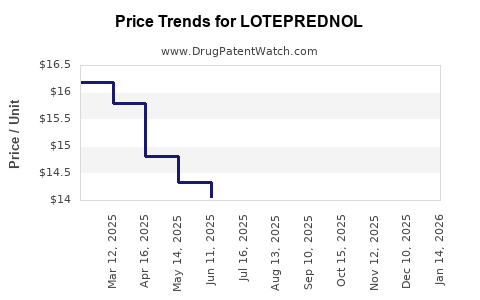
The trend indicates a gradual decrease driven by generic competition, though branded prices may hold in specific regions or formulations.
Patent and Regulatory Landscape
Patents on key formulations typically last 20 years from filing. Bausch + Lomb's primary patent related to Lotemax expired or will expire in early 2024, allowing for robust generic entry. Regulatory approvals are in place in the U.S., Europe, and Asian markets, with some variations.
The U.S. FDA approved Lotemax in 2002. Generics obtained approval following patent expiry, with several filings since 2021. Market entries from multiple manufacturers have driven down prices, especially in North America and Europe.
What Is the Outlook for Investment and R&D?
Investors should consider the following:
- Market saturation in mature regions limits upside for new formulations.
- There is potential in developing combination therapies to expand indications.
- Specialized formulations for pediatric or post-surgical applications might command premium pricing.
- Opportunities exist in emerging markets where lower-cost generics are increasingly adopted.
Pharmaceutical companies may pursue incremental innovations or biosimilar development to capture additional market share.
Key Takeaways
- The global ophthalmic corticosteroid market is expanding, with loteprednol representing a significant, growing segment.
- Price competition is increasing, primarily driven by generic entries, leading to a projected decline in retail prices over the next five years.
- Patent expiries beginning in 2024 will accelerate generic manufacturing and further depress prices.
- Growth opportunities remain in niche indications, combination therapies, and emerging markets.
FAQs
1. When did the patent for Lotemax expire?
Patent protections for Lotemax expire in early 2024, facilitating generic entry.
2. What are the main factors influencing loteprednol pricing?
Patent status, generic competition, regional pricing policies, and formulation variations.
3. How does loteprednol compare with other corticosteroids in efficacy?
It has similar anti-inflammatory effects but minimizes intraocular pressure rise, reducing side effects associated with other steroids.
4. Are there significant regional differences in pricing?
Yes, prices vary notably between the US, Europe, and Asia due to regulatory and market dynamics.
5. What future research areas are relevant for loteprednol?
Development of fixed-dose combinations, novel delivery mechanisms, and expanded therapeutic indications.
Sources
- MarketWatch. "Ophthalmic Corticosteroids Market Size, Share, Trends." 2022.
- U.S. FDA. "Approval History for Lotemax." 2002.
- Bausch + Lomb. "Product Information for Lotemax." 2022.
- GlobalData. "Ophthalmology Market Forecast, 2023–2030." 2023.