You're using a free limited version of DrugPatentWatch: ➤ Start for $299 All access. No Commitment.

Last Updated: December 19, 2025

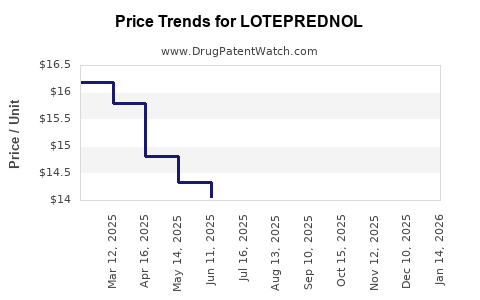
Drug Price Trends for LOTEPREDNOL


✉ Email this page to a colleague

« Back to Dashboard


Drug Price Trends for LOTEPREDNOL

Average Pharmacy Cost for LOTEPREDNOL

These are average pharmacy acquisition costs (net of discounts) from a US national survey
Drug Name NDC Price/Unit ($) Unit Date
LOTEPREDNOL ETABONATE 0.5% DRP 82260-0299-15 18.20793 ML 2025-12-17
LOTEPREDNOL 0.5% OPHTHALMC GEL 24208-0508-01 15.79900 GM 2025-12-17
LOTEPREDNOL 0.5% OPHTHALMC GEL 72485-0630-05 15.79900 GM 2025-12-17
LOTEPREDNOL ETABONATE 0.2% DRP 60219-1366-03 35.85112 ML 2025-12-17
>Drug Name >NDC >Price/Unit ($) >Unit >Date

Best Wholesale Price for LOTEPREDNOL

These are wholesale prices available to the US Federal Government which, by law, must be the best prices available to any customer under comparable terms and conditions
Drug Name Vendor NDC Count Price ($) Price/Unit ($) Unit Dates Price Type
ZYLET OPHTH SUSPENSION Bausch & Lomb Americas Inc. 24208-0358-05 5ML 218.00 43.60000 ML 2024-01-01 - 2027-09-14 FSS
LOTEMAX OPHTH SUSPENSION Bausch & Lomb Americas Inc. 24208-0299-05 5ML 210.53 42.10600 ML 2023-01-01 - 2027-09-14 FSS
LOTEPREDNOL ETABONATE 0.5% SUSP,OPH Bausch & Lomb Americas Inc. 68682-0299-05 5ML 171.76 34.35200 ML 2022-09-15 - 2027-09-14 FSS
LOTEPREDNOL ETABONATE 0.5% SUSP,OPH Bausch & Lomb Americas Inc. 68682-0299-15 15ML 166.34 11.08933 ML 2023-01-01 - 2027-09-14 Big4
>Drug Name >Vendor >NDC >Count >Price ($) >Price/Unit ($) >Unit >Dates >Price Type
Price type key: Federal Supply Schedule (FSS): generally available to all Federal Govt agencies / 'BIG4' prices: VA, DoD, Public Health & Coast Guard only / National Contracts (NC): Available to specific agencies

Market Analysis and Price Projections for Loteprednol

Last updated: July 27, 2025

Introduction

Loteprednol, a corticosteroid with anti-inflammatory properties, is widely used in ophthalmology to treat conditions such as seasonal allergic conjunctivitis, postoperative inflammation, and keratitis. Its unique formulation offers a favorable safety profile compared to traditional steroids, making it a preferred option for both acute and chronic ocular inflammation. Given its therapeutic profile and rising global demand, understanding the current market landscape and forecasting future pricing trends are critical for stakeholders including pharmaceutical companies, investors, healthcare providers, and policymakers.

Market Overview

Current Market Landscape

The global ophthalmic corticosteroids market, which includes loteprednol, was valued at approximately USD 860 million in 2022, with a compound annual growth rate (CAGR) of around 4.8% projected through 2030 [1]. Loteprednol, marketed under brands such as Lotemax and Alrex, holds a significant share within this market due to its safety profile and efficacy.

Therapeutic Applications and Market Drivers

  • Prevalence of ocular inflammatory conditions: Conditions like dry eye syndrome, allergic conjunctivitis, and post-surgical inflammation are on the rise globally, driven by aging populations and increased awareness.

  • Safety profile advantages: Compared to earlier corticosteroids, loteprednol's decreased risk of intraocular pressure elevation and cataract formation makes it preferable, especially in long-term use.

  • Regulatory approvals: The approval of branded formulations by major regulatory bodies (FDA, EMA) bolsters market trust and accessibility.

Competitive Landscape

Key players include Bausch + Lomb (Lotemax), Alcon, Santen Pharmaceutical, and Hovione. Patent expirations and the entry of generic equivalents are expected to influence pricing and market share dynamics moving forward.

Regulatory and Patent Dynamics

Patent Status and Generics

  • The primary patent for Lotemax, held by Bausch + Lomb, expired in the United States in 2018, opening avenues for generic formulations.
  • Several generic versions are now available, intensifying price competition and downward pressure.

Regulatory Environment

  • Regulatory approvals for both branded and generic formulations in Europe, Asia-Pacific, and Latin America are expanding.
  • Ongoing clinical trials and research foster the development of novel delivery systems (e.g., sustained-release implants), potentially diversifying market offerings.

Price Analysis and Projections

Historical Pricing Trends

  • Branded formulations: The retail price for a 0.5% ophthalmic suspension (e.g., Lotemax) has historically ranged between USD 150–200 per bottle in the United States.
  • Generic formulations: Post-patent expiry led to a price reduction of approximately 30–50%, with retail prices falling to USD 80–110.

The pricing variability is influenced by factors such as formulation, packaging, pharmacy pricing strategies, and regional healthcare policies.

Factors Influencing Future Prices

  • Market competition: Increased generic entry is expected to sustain downward pricing trends.
  • Regulatory incentives: Price controls in certain regions may further suppress costs.
  • Manufacturing costs: Advances in formulation and scalable manufacturing could reduce production expenses, influencing retail prices.
  • Value-added formulations: Development of novel delivery systems (nanoemulsions, sustained-release implants) could command premium pricing in niche markets.

Forecasted Price Trends (2023–2030)

  • United States and Europe:

    • Branded loteprednol: Prices are expected to stabilize around USD 180–220 per bottle, given brand loyalty and clinical preferences, despite generic competition.
    • Generic loteprednol: Expected to hover around USD 50–70 due to manufacturing efficiencies and increased market penetration.
  • Emerging Markets (Asia-Pacific, Latin America):

    • Prices are anticipated to decline gradually to USD 20–40 per bottle for generics, driven by local manufacturing and procurement policies.

Price Projections Summary

Region Branded (USD) Generic (USD) Expected Trend
North America 180–220 50–70 Stabilization with incremental decline
Europe 170–210 45–65 Similar to North America, sustained demand
Asia-Pacific 150–200 20–40 Decline due to increased generics, volume growth
Latin America 140–190 20–40 Competitive pricing, local production

Note: These projections are contingent upon regulatory changes, patent litigation, and market entry of new formulations.

Emerging Trends and Their Impact

Novel Delivery Systems

  • Sustained-release implants: Companies are exploring biodegradable implants releasing loteprednol over extended periods, potentially commanding premium prices (USD 300–500 per unit) due to convenience and improved adherence.

  • Nanotechnology-based formulations: These may enhance bioavailability and reduce dosing frequency, influencing price settlement and competitive positioning.

Regulatory and Reimbursement Policies

  • Price controls in regions like the European Union may limit profit margins but ensure broader access.
  • Reimbursement frameworks influence retail prices, with pathways for premium formulations to command higher prices.

Market Penetration and Adoption

  • Increasing ophthalmic surgery volume and expanding indications, such as for dry eye and inflammation management, will sustain demand.
  • Generic availability and clinician familiarity will accelerate adoption, impacting pricing strategies.

Key Market Opportunities and Challenges

Opportunities

  • Expansion into emerging markets via partnerships and licensing.
  • Development of combination eye drops (e.g., loteprednol + antihistamines) offering value-added therapies.
  • Investment in novel delivery platforms promising better patient compliance.

Challenges

  • Patent expiration and generic competition threaten revenue streams.
  • Stringent regulatory requirements across regions pose hurdles for new formulations.
  • Pricing pressures driven by healthcare cost containment policies.

Conclusion

The loteprednol market is positioned for steady growth, with a clear trend toward lower prices driven by patent expiries and increasing generic availability. Despite this downward pricing pressure, innovative delivery formulations and expanding indications could preserve premium segment margins. Stakeholders should focus on differentiating formulations and strategic regional expansion to capitalize on emerging opportunities.


Key Takeaways

  • The global ophthalmic corticosteroids market, including loteprednol, is forecasted to grow at a CAGR of approximately 4.8% through 2030.
  • Patent expirations have catalyzed the proliferation of generics, significantly reducing prices in mature markets.
  • Branded loteprednol formulations are expected to stabilize around USD 180–220 in developed regions, with generics likely to trade below USD 70.
  • Emerging markets will see more aggressive price declines, driven by local manufacturing and regulatory policies.
  • Innovation in delivery systems, such as sustained-release implants, presents an opportunity for premium pricing but requires regulatory approval and market acceptance.

FAQs

1. How does patent expiration influence loteprednol pricing?
Patent expiration opens the market to generics, increasing competition and exerting downward pressure on prices, especially in mature markets like the U.S. and Europe.

2. What factors could disrupt current price projections?
Regulatory changes, patent litigation, technological breakthroughs in delivery systems, and shifts in healthcare reimbursement policies could alter pricing trends.

3. Are there any emerging formulations that could command higher prices?
Yes, sustained-release implants and nanotechnology-based formulations could command premium prices due to enhanced efficacy and patient compliance.

4. How does regional variation affect loteprednol prices?
Pricing is influenced by regional regulatory environments, competitive landscape, healthcare budgets, and local manufacturing, leading to significant variation across markets.

5. What should stakeholders prioritize for future success in the loteprednol market?
Investing in innovative delivery technologies, expanding into emerging markets, and navigating regulatory pathways efficiently are critical for maintaining profitability amid price pressures.


Sources

[1] MarketsandMarkets, "Ophthalmic Drugs Market," 2022.

More… ↓

⤷  Get Started Free

Make Better Decisions: Try a trial or see plans & pricing

Drugs may be covered by multiple patents or regulatory protections. All trademarks and applicant names are the property of their respective owners or licensors. Although great care is taken in the proper and correct provision of this service, thinkBiotech LLC does not accept any responsibility for possible consequences of errors or omissions in the provided data. The data presented herein is for information purposes only. There is no warranty that the data contained herein is error free. We do not provide individual investment advice. This service is not registered with any financial regulatory agency. The information we publish is educational only and based on our opinions plus our models. By using DrugPatentWatch you acknowledge that we do not provide personalized recommendations or advice. thinkBiotech performs no independent verification of facts as provided by public sources nor are attempts made to provide legal or investing advice. Any reliance on data provided herein is done solely at the discretion of the user. Users of this service are advised to seek professional advice and independent confirmation before considering acting on any of the provided information. thinkBiotech LLC reserves the right to amend, extend or withdraw any part or all of the offered service without notice.