Last updated: February 12, 2026
Market Analysis and Price Projections for Losartan-Hydrochlorothiazide
Current Market Landscape
Losartan-hydrochlorothiazide (HCTZ), a combination drug used for hypertension management, is marketed primarily as a generic medication with multiple formulations. The drug combines losartan, an angiotensin II receptor blocker (ARB), with hydrochlorothiazide, a thiazide diuretic.
Globally, the hypertension treatment market was valued at approximately $23.7 billion in 2022, forecasted to reach $35 billion by 2030, growing at a CAGR of 5.2% (source: Grand View Research). Losartan-hydrochlorothiazide accounts for a significant share in ARB combination therapy, especially in the U.S., where ARBs constitute roughly 60% of antihypertensive prescriptions.
Key Market Drivers
- Widespread hypertension prevalence: affects over 1.3 billion adults worldwide (source: World Health Organization).
- Increasing adoption of fixed-dose combinations (FDCs): improves patient compliance.
- Patent expirations of initial formulations: heightened generic competition.
- Insurance coverage expansion: supports broader access to prescription medications.
- Favorable safety profile: compared to alternative classes like ACE inhibitors or beta-blockers.
Competitor Landscape
Numerous generic manufacturers produce losartan-HCTZ, such as Teva Pharmaceuticals, Mylan, and Sandoz. Brand-name versions, such as Cozaar-HCTZ, had patent expiry dates around 2010-2012, leading to price erosion.
Regulatory Environment
In the U.S., the FDA approved numerous abbreviated new drug applications (ANDAs) for losartan-HCTZ with bioequivalence, facilitating market entry of generics. The presence of multiple suppliers ensures price competition.
Price Trends and Projections
Current Pricing
- United States (retail): average retail price for losartan-HCTZ 100 mg/12.5 mg ranges between $0.15 to $0.30 per tablet (source: GoodRx).
- Wholesale acquisition cost (WAC): around $0.10 per tablet.
- Variations exist due to insurance, discounts, and pharmacy benefits.
Price Dynamics
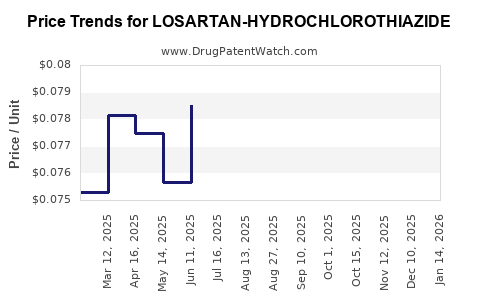
Prices have declined 60-80% since patent expirations, stabilizing in the past two years due to manufacturing capacity and supply chain stabilization.
Future Price Projections (2023-2028)
- In the U.S., the average wholesale price is expected to remain stable around $0.08-$0.12 per tablet.
- Discounts and pharmacy benefit management (PBM) negotiations could push net prices lower by about 15% annually.
- Potential price reduction due to increased competition from biosimilars or new formulations is minimal, given the mature generic market.
Note: Cost trends vary across regions. In Europe, prices are generally 20-30% higher than in the U.S., driven by different healthcare policies.
Market Opportunities and Challenges
- Opportunities: Expansion into emerging markets, where hypertension prevalence is rising and generic substitution practices are growing.
- Challenges: Pricing pressures from payers, potential shifts toward alternative therapeutics, and regulatory constraints on drug formulations.
Key Takeaways
- Losartan-hydrochlorothiazide remains a low-cost, widely prescribed antihypertensive, with margins stabilized by generic competition.
- Price levels are likely to hold steady through 2028, with slight declines driven by market saturation.
- Expansion in emerging markets offers growth prospects outside mature markets.
- Regulatory and reimbursement policies will influence future pricing dynamics.
FAQs
1. Will the price of losartan-hydrochlorothiazide increase due to new formulations?
No. The market is mature with multiple generic suppliers; new formulations are unlikely to affect pricing significantly.
2. How does competition influence the price in different regions?
High competition in the U.S. drives prices down, while variations in healthcare policies maintain higher prices in Europe and Asia.
3. Are biosimilars or biosimilar-like products a threat to losartan-hydrochlorothiazide?
Not biosimilars, as the drug is not biologic. However, newer ARB or combination therapies could influence market share.
4. What role do insurance companies play in pricing?
Insurance and PBMs negotiate rebates and discounts, effectively lowering patient out-of-pocket costs but stabilizing or reducing net prices.
5. What market segments are emerging for losartan-HCTZ?
Growing markets include countries with expanding healthcare infrastructure, where generic prescriptions are more widely adopted.
Sources:
- Grand View Research. "Hypertension Market Size, Share & Trends Analysis Report," 2022.
- World Health Organization. "Hypertension," 2022.
- GoodRx. "Losartan-Hydrochlorothiazide Prices," 2023.
- U.S. Food and Drug Administration. "ANDA Approvals for Losartan," 2012.