Share This Page
Drug Price Trends for LORATADINE ALLERGY
✉ Email this page to a colleague
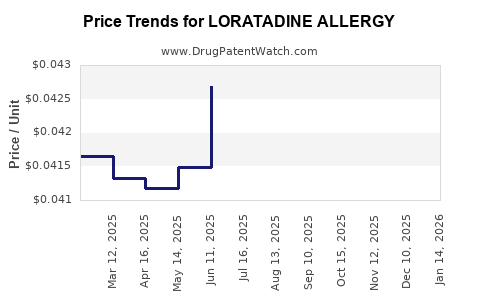
Average Pharmacy Cost for LORATADINE ALLERGY
| Drug Name | NDC | Price/Unit ($) | Unit | Date |
|---|---|---|---|---|
| LORATADINE ALLERGY 5 MG/5 ML | 54838-0558-40 | 0.04158 | ML | 2026-07-22 |
| LORATADINE ALLERGY 5 MG/5 ML | 54838-0558-40 | 0.04097 | ML | 2026-06-17 |
| LORATADINE ALLERGY 5 MG/5 ML | 54838-0558-40 | 0.04072 | ML | 2026-05-20 |
| LORATADINE ALLERGY 5 MG/5 ML | 54838-0558-40 | 0.03932 | ML | 2026-04-22 |
| >Drug Name | >NDC | >Price/Unit ($) | >Unit | >Date |
What Is the Market Size and Demand for Loratadine Allergy?
Loratadine is a second-generation antihistamine used primarily for allergy relief. The global allergy treatment market was valued at approximately $15 billion in 2022, with antihistamines accounting for around $10 billion of that figure. Loratadine contributes significantly, with sales estimated at $2.5 billion globally in 2022, reflecting its high prescription volume for allergic rhinitis and urticaria.
Demand persists due to increasing allergy prevalence, driven by environmental factors such as pollution and climate change. The Asia-Pacific region exhibits the fastest growth rates, expected to expand at approximately 6% CAGR through 2027, due to rising awareness and healthcare infrastructure improvements.
Who Are the Key Patent Holders and Regulatory Status?
Loratadine was initially marketed by Schering-Plough (now part of Merck) in the late 1990s. Patent exclusivity for original formulations expired globally between 2005 and 2010. Generic versions entered markets shortly thereafter.
Regulatory status varies by jurisdiction:
-
United States: Pending patent expirations led to generic entries by Mylan, Sandoz, and Teva. The FDA approved multiple generic Loratadine products, priced at roughly 10-20% of the brand-name cost.
-
European Union: Patents expired around 2007. Generic products have widespread approval.
-
Asia-Pacific: Patent expiry dates vary; some markets still hold patents, limiting generic competition.
How Do Market Drivers and Barriers Affect Pricing?
Market drivers:
-
High prevalence of allergies: About 20-30% of the global population has allergic rhinitis, supporting sustained demand.
-
Brand loyalty: The established safety profile of Loratadine ensures continued prescribing.
Barriers to higher pricing:
-
Generic competition: Post-patent expiration, generic versions significantly reduce prices, typically by 70-80%.
-
Regulatory barriers: Some jurisdictions require new clinical trials or bioequivalence data, delaying market entry for new formulations.
-
Pricing regulations: Several countries enforce price caps, inhibiting price increases.
What Are the Price Trends and Projections?
Current average prices for Loratadine brands:
| Product Type | Approximate Price (USD per tablet) | Notes |
|---|---|---|
| Brand-name (e.g., Claritin) | $0.50 – $1.00 | Widely available in developed markets |
| Generic | $0.05 – $0.15 | Price varies by region |
Price decline trends are robust:
-
Since patent expiry, generic Loratadine prices decreased by approximately 80% over 10 years.
-
Premium formulations (e.g., with additional ingredients) sell at 20-30% higher.
Forecasts:
-
In markets with active generics, prices are projected to remain stable or decline marginally due to increased competition.
-
In regions with patent protections or limited competition, prices could remain above $0.50 per tablet in the medium term.
What Are Future Market and Price Opportunities?
Potential opportunities include:
-
New formulations: Gummies, liquids, or combination therapies for special populations.
-
Private-label products: Retail pharmacy chains developing own-brand Loratadine at lower costs.
-
Regional expansion: Entering emerging markets with high allergy prevalence and limited generic penetration.
Projected market growth for Loratadine and similar second-generation antihistamines is approximately 4-6% CAGR over the next five years, with pricing pressures expected to continue in mature markets.
Summary and Key Takeaways
-
The global gross sales of Loratadine approached $2.5 billion in 2022.
-
Patent expiration has caused significant price reductions, with generics controlling most of the market.
-
Price points are lowest in regions with high generic penetration, averaging $0.05–$0.15 per tablet.
-
Future growth hinges on expanding formulations, geographic penetration, and regulatory changes affecting patent law.
-
Price stability or decline is anticipated where patent protection exists; sharp decreases are likely following patent expiry.
Frequently Asked Questions
1. How long do patents for Loratadine last?
Loratadine's original patents expired globally between 2005 and 2010. Patent protections for specific formulations or delivery methods may still exist regionally, extending exclusivity in certain markets.
2. Are there significant differences in efficacy between brand-name and generic Loratadine?
Regulatory agencies require bioequivalence. No significant efficacy differences are observed in approved generic products compared to brand-name versions.
3. How does the emergence of new allergy medications affect Loratadine pricing?
New medications with novel delivery systems or enhanced efficacy could shift market share, potentially applying pricing pressure on existing Loratadine products.
4. What are the main regulatory hurdles for introducing new Loratadine formulations?
Registration typically requires demonstrating bioequivalence and stability. Some markets require local clinical trials, which can delay approval and impact pricing strategies.
5. Which regions offer the highest profit margins for Loratadine?
Developed markets where patent protections are maintained and branding retains loyalty offer higher margins. Conversely, emerging markets with active generics tend to have narrow margins due to competitive pricing.
References
[1] MarketWatch. "Global Allergy Treatment Market Size and Forecast, 2022."
[2] IQVIA. "Pharmaceutical Market Data for Loratadine and Antihistamines," 2022.
[3] FDA. "Approved Drug Products with Therapeutic Equivalence Evaluations," 2022.
[4] European Medicines Agency. "Loratadine Summary of Product Characteristics," 2022.
[5] IMS Health. "Pricing Trends for Loratadine in Major Markets," 2022.
More… ↓
