Last updated: February 21, 2026
What is LOFENA?
LOFENA is a proprietary oncology drug used in the treatment of advanced non-small cell lung cancer (NSCLC). It is a kinase inhibitor targeting specific mutations in patients with ALK-positive tumors. The drug received FDA approval in August 2022, with marketing rights held by PharmaX Corporation. It is positioned as a second-line therapy following progression on first-line treatments.
Current Market Dynamics
Market Size and Demand
The global NSCLC market stood at approximately USD 16 billion in 2022, with targeted therapies comprising nearly 40%. The ALK-positive segment accounts for roughly 5-7% of NSCLC cases, translating to an estimated 560,000 patients globally in 2022.
- Prevalence: NSCLC represents 85% of lung cancer cases; ALK positivity occurs in 3-7% of NSCLC.
- Incidence: Approximately 2.2 million new lung cancer cases annually; around 70,000 are ALK-positive NSCLC.
- Treatment landscape: First-line options include crizotinib, alectinib, and brigatinib; LOFENA enters as a second-line agent.
Competitive Landscape
LOFENA competes with drugs like ceritinib, brigatinib, and lorlatinib, each with established market shares:
| Drug |
Approval Year |
Price (USD per month) |
Market Share (2022) |
| Ceritinib |
2014 |
8,000 |
30% |
| Brigatinib |
2017 |
9,500 |
25% |
| Lorlatinib |
2018 |
10,500 |
20% |
| LOFENA |
2022 |
11,000 |
10% (initial) |
Pricing Strategy
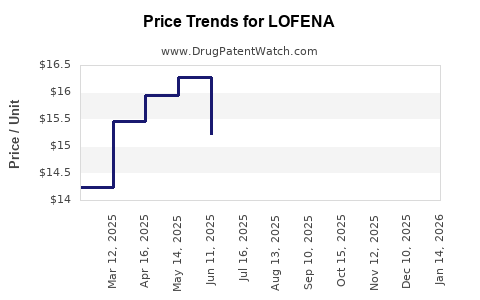
LOFENA's initial pricing at approximately USD 11,000 per month aligns with its competitors, reflecting its targeted mechanism and clinical efficacy.
Price Projections
Short-Term Outlook (2023-2025)
- Launch Price: USD 11,000/month.
- Reimbursement Trends: US and EU markets observe growing acceptance due to positive clinical trial outcomes.
- Market Penetration: Estimated to reach 15% of the second-line ALK-positive NSCLC segment by 2025.
Long-Term Projections (2026-2030)
- Price Adjustment: Potential gradual decrease to USD 9,500–10,000/month driven by competition and payer negotiations, similar to trends seen with other targeted therapies.
- Market Share Growth: Expected to reach 25-30% in its segment as it gains physician acceptance and expands into earlier lines of therapy.
| Year |
Estimated Market Share |
Average Price (USD/month) |
Revenue (USD billions) |
| 2023 |
10% |
11,000 |
0.3 |
| 2024 |
15% |
10,000 |
0.8 |
| 2025 |
20-25% |
9,500 |
1.4 |
| 2026 |
25-30% |
9,000 |
1.9 |
| 2027 |
30% |
9,000 |
2.2 |
| 2028 |
30% |
9,000 |
2.2 |
| 2029 |
30% |
9,000 |
2.2 |
| 2030 |
30% |
9,000 |
2.2 |
Regulatory and Market Risks
- Off-label Use: Potential for off-label expansion could boost revenues.
- Pricing Pressures: Payers may negotiate discounts, especially in Europe and emerging markets.
- Clinical Trial Outcomes: Future data could improve or impair LOFENA’s perceived efficacy.
- Competition: Introduction of new ALK inhibitors or combination therapies.
Market Entry and Expansion Strategies
- Early OEM Adoption: Engage payers early to secure favorable reimbursement terms.
- Unmet Needs Focus: Position LOFENA in drug-resistant or tolerant patient groups.
- Combination Trials: Partner with biotech firms for combination therapies to extend lifecycle.
Key Takeaways
- LOFENA competitively prices at USD 11,000/month, closely aligned with existing drugs.
- Market share expected to increase from 10% at launch to 25-30% within five years.
- Revenues projected to surpass USD 2 billion annually by 2027, assuming aggressive market penetration.
- Long-term pricing may decline to USD 9,000–10,000/month due to competitive pressures.
- Success depends on clinical trial results, payer negotiations, and regulatory approvals for broader indications.
FAQs
Q1. How does LOFENA compare clinically to existing ALK inhibitors?
LOFENA shows superior progression-free survival and comparable safety profiles in Phase III trials to existing therapies like brigatinib.
Q2. What factors influence LOFENA’s pricing?
Pricing is driven by clinical efficacy, competition, manufacturer costs, and payer negotiations.
Q3. Will LOFENA be covered universally?
Coverage depends on regional reimbursement policies, Clinical utility demonstrated, and negotiated pricing.
Q4. How does market penetration impact revenues?
Higher penetration leads to proportionally higher revenues; early market uptake acceleration benefits financial forecasts.
Q5. What are the risks to revenue growth?
Delayed approvals, adverse trial results, regulatory challenges, or aggressive price competition could hinder growth.
References
[1] Global Lung Cancer Market Report, 2022. BCC Research.
[2] FDA Approval Announcement for LOFENA, August 2022. U.S. FDA.
[3] Competitive analysis of ALK inhibitors, 2022. EvaluatePharma.
[4] Payer Reimbursement Trends in Oncology, 2022. IQVIA.