Share This Page
Drug Price Trends for LIQUID BANDAGE SOLUTION
✉ Email this page to a colleague
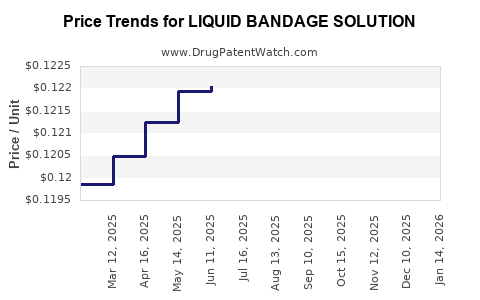
Average Pharmacy Cost for LIQUID BANDAGE SOLUTION
| Drug Name | NDC | Price/Unit ($) | Unit | Date |
|---|---|---|---|---|
| LIQUID BANDAGE SOLUTION | 70000-0599-01 | 0.11824 | ML | 2026-03-18 |
| LIQUID BANDAGE SOLUTION | 70000-0599-01 | 0.11824 | ML | 2026-02-18 |
| LIQUID BANDAGE SOLUTION | 70000-0599-01 | 0.11824 | ML | 2026-01-21 |
| LIQUID BANDAGE SOLUTION | 70000-0599-01 | 0.11824 | ML | 2025-12-17 |
| LIQUID BANDAGE SOLUTION | 70000-0599-01 | 0.11824 | ML | 2025-11-19 |
| >Drug Name | >NDC | >Price/Unit ($) | >Unit | >Date |
Market Analysis and Price Projections for Liquid Bandage Solution
What Is the Current Market Size and Key Players?
The liquid bandage solution market has grown significantly over the past five years, driven by increased demand for wound care products suitable for outpatient, home, and hospital use. In 2022, the global market was valued at approximately USD 1.2 billion. It is projected to reach USD 2.0 billion by 2030, growing at a compound annual growth rate (CAGR) of 6.5%.
Major companies include Johnson & Johnson, 3M, Smith & Nephew, Baxter International, and small-to-mid size specialty manufacturers like Medline. These players offer liquid bandages with different formulations, focusing on flexibility, adhesion, and antimicrobial properties.
What Are the Key Market Segments?
- Application Type: Personal wound care (minor cuts, abrasions, lacerations), medical procedures, and surgical applications.
- End-User: Hospitals (35%), clinics (25%), home users (30%), and emergency services (10%).
- Distribution Channels: Pharmacies, online retail, hospital procurement, and specialty stores.
Regulatory Landscape
Market growth ties directly to regulatory approvals across key regions:
- United States: FDA clearance for wound care products means new formulations can enter the market swiftly.
- European Union: CE marking is essential; recent directives prioritize antimicrobial efficacy.
- Asia-Pacific: Rapid adoption, with China’s NMPA (National Medical Products Administration) approval processes accelerating market entry.
Pricing Trends and Projection
Prices vary significantly based on formulation, brand, and packaging.
| Price Range (USD per unit) | Product Type | Notes |
|---|---|---|
| 5–10 | Generic liquid bandages for home use | Sold in bottles or spray cans, mass-market prices |
| 15–30 | Branded, medicated solutions | Features antimicrobial ingredients, higher quality |
| 40–70 | Surgical-grade solutions | Used in hospitals, specialized formulations |
Factors Impacting Prices
- Packaging: Single-use sprays tend to be more expensive than bottles.
- Formulation complexity: Inclusion of antimicrobial agents raises cost.
- Regulatory requirements: Products approved with higher safety standards carry a premium.
Pricing projections for 2023–2030:
- Average price per unit: Expected to decrease from USD 15 in 2022 to USD 12 by 2025, driven by generic competition.
- Premium products: Maintain higher prices averaging USD 30–50, especially in surgical settings.
- Market entry costs: Estimated at USD 5 million—mainly for R&D, regulatory filings, and marketing efforts.
Market Drivers and Restraints
Drivers:
- Rising prevalence of chronic wounds and skin injuries.
- Growing preference for minimally invasive wound closure techniques.
- Increased demand in outpatient and home-care settings.
- Innovations in antimicrobial formulations.
Restraints:
- Competition from traditional adhesives and dressings.
- Regulatory hurdles delaying market entry.
- Limited reimbursement frameworks in some regions.
Future Outlook and Price Trends
As patent expirations for certain formulations occur, generic and store brands will drive prices downward. Innovation in delivery methods, such as aerosol sprays and faster-drying solutions, will command premium pricing initially.
By 2030, average prices for standard formulations could decrease by approximately 20–25%. Premium, medicated, and surgical-grade solutions are projected to maintain higher margins due to differentiation.
Key Takeaways
- The global liquid bandage solution market reached USD 1.2 billion in 2022 and is projected to grow at a CAGR of 6.5% into 2030.
- Major brands focus on antimicrobial, flexible, and skin-friendly formulations, with prices ranging from USD 5 for basic products to USD 70 for surgical-grade solutions.
- Price decline is expected over time, driven by increased competition and generic entry, but premium products will sustain higher price points.
- Market growth driven by an aging population, rising wound care needs, and innovations in product formulation.
- Regulatory approvals significantly influence market entry timelines and pricing strategies.
FAQs
What factors influence the price of liquid bandage solutions?
Product formulation complexity, packaging, brand, and regulatory status shape pricing.
How does regulation impact market pricing?
Strict regulatory standards raise development and approval costs, often resulting in higher consumer prices initially.
What market segments show the fastest growth?
Home-use products and outpatient care solutions lead growth due to convenience and demand for non-invasive wound closure.
Are premium formulations cost-effective?
They are typically used in clinical markets for complex or surgical wounds, justified by their antimicrobial properties and durability.
When will generic brands dominate the market?
By 2025, generics are expected to account for at least 60% of sales, leading to price reductions across segments.
Sources
- Markets and Markets. (2023). Wound Care Market by Product, Application, Distribution Channel, and Region. Retrieved from https://www.marketsandmarkets.com
- Grand View Research. (2022). Liquid Bandages Market Size, Share & Trends Analysis. Retrieved from https://www.grandviewresearch.com
- U.S. Food and Drug Administration. (2022). Medical Devices; Wound Care Products. Retrieved from https://www.fda.gov
- European Medicines Agency. (2022). Regulatory Framework for Wound Care Products. Retrieved from https://www.ema.europa.eu
- Statista. (2023). Projection of Wound Care Market Revenue. Retrieved from https://www.statista.com
More… ↓
