Share This Page
Drug Price Trends for LIPITOR
✉ Email this page to a colleague
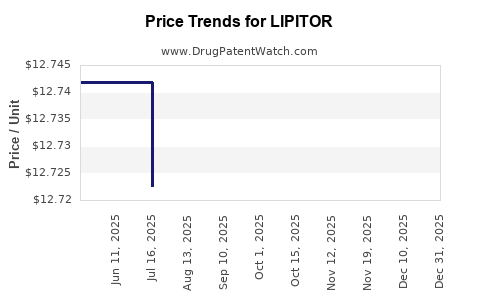
Average Pharmacy Cost for LIPITOR
| Drug Name | NDC | Price/Unit ($) | Unit | Date |
|---|---|---|---|---|
| LIPITOR 10 MG TABLET | 58151-0155-77 | 13.40569 | EACH | 2026-01-01 |
| LIPITOR 40 MG TABLET | 00071-0157-23 | 19.19696 | EACH | 2026-01-01 |
| LIPITOR 20 MG TABLET | 58151-0156-77 | 19.14640 | EACH | 2026-01-01 |
| LIPITOR 80 MG TABLET | 58151-0158-77 | 19.05635 | EACH | 2026-01-01 |
| LIPITOR 40 MG TABLET | 58151-0157-77 | 19.19696 | EACH | 2026-01-01 |
| LIPITOR 10 MG TABLET | 58151-0155-77 | 12.76732 | EACH | 2025-12-17 |
| >Drug Name | >NDC | >Price/Unit ($) | >Unit | >Date |
Lipitor Market Dynamics and Price Projections
Lipitor (atorvastatin calcium) is a synthetic lipid-lowering agent of the statin class. It is a selective and competitive inhibitor of HMG-CoA reductase, the rate-limiting enzyme in cholesterol synthesis.
What is the Current Market Size for Lipitor?
The global market for statins, including Lipitor, is substantial, driven by the high prevalence of cardiovascular diseases (CVDs) worldwide. While Lipitor has faced generic competition since its patent expiration in 2011, branded statins and their generic equivalents continue to capture significant market share due to ongoing demand for cholesterol management.
- Global Statin Market Value: The global statin market was valued at approximately $19.1 billion in 2023. [1] Projections indicate a compound annual growth rate (CAGR) of 3.5% from 2023 to 2030, reaching an estimated $24.2 billion by 2030. [1]
- Lipitor's Historical Dominance: Prior to its patent expiration, Lipitor was consistently one of the best-selling drugs globally, generating billions in annual revenue for Pfizer. Its peak annual sales exceeded $13 billion. [2]
- Impact of Generic Entry: The introduction of generic atorvastatin significantly eroded Lipitor's market share and revenue for Pfizer. However, the overall volume of statin prescriptions has remained high.
What Factors Influence Lipitor's Market Performance?
Several factors shape the current and future market performance of Lipitor and other statins. These include the prevalence of dyslipidemia, cardiovascular disease rates, healthcare policies, and the competitive landscape.
- Prevalence of Dyslipidemia and CVD:
- Globally, an estimated 39% of adults aged 18 and over were overweight in 2016, and 13% were obese. [3] These conditions are strongly linked to dyslipidemia and increased CVD risk.
- Cardiovascular diseases remain the leading cause of death globally, accounting for an estimated 17.9 million deaths annually. [4] This persistent health burden fuels demand for lipid-lowering therapies.
- The aging global population further exacerbates the demand for chronic disease management, including statin therapy.
- Generic Competition: The U.S. market saw a dramatic price decrease for atorvastatin following patent expiration. The average wholesale price for a 30-day supply of Lipitor (40mg) dropped from over $250 before generic entry to under $20 within a few years. [5] This price compression is a defining characteristic of the post-patent market.
- Healthcare Policy and Reimbursement: Government health programs and private insurers play a crucial role. While many formularies favor generics due to cost-effectiveness, brand-name statins with specific efficacy profiles or patient adherence advantages may still be prescribed, albeit with lower market penetration.
- Emergence of Novel Lipid-Lowering Therapies: While statins remain first-line therapy, newer drug classes like PCSK9 inhibitors (e.g., evolocumab, alirocumab) offer alternative or adjunctive treatments for patients with refractory hypercholesterolemia or statin intolerance. However, the higher cost of these novel therapies generally restricts their use to specific patient populations.
What is the Competitive Landscape for Atorvastatin?
The competitive landscape for atorvastatin is characterized by numerous generic manufacturers and the continued presence of branded statins.
- Key Generic Manufacturers: Major generic pharmaceutical companies producing atorvastatin include Teva Pharmaceutical Industries, Mylan (now Viatris), Sandoz (a Novartis division), and numerous others operating globally. The market is highly fragmented with multiple suppliers.
- Branded Statin Alternatives: While Lipitor's market share is reduced, other branded statins like Crestor (rosuvastatin) and Zocor (simvastatin) also face generic competition but continue to compete within the broader statin market.
- Market Share Dynamics: Generic atorvastatin holds the dominant share of the atorvastatin market by volume. Branded Lipitor's market share is now minimal, primarily serving niche markets or patients with specific prescribing preferences.
- Pricing Strategies: Generic manufacturers compete primarily on price. This leads to continuous downward pressure on atorvastatin prices. Branded statin manufacturers, where still applicable, focus on product differentiation, patient support programs, and co-pay assistance to retain market share.
What are the Price Projections for Lipitor and Generic Atorvastatin?
Price projections for Lipitor itself are largely irrelevant given its generic status. The focus shifts to the pricing trends of generic atorvastatin.
- Generic Atorvastatin Pricing:
- Current Status: Generic atorvastatin is widely available at significantly lower prices compared to branded Lipitor's peak. The average prescription price for atorvastatin in the U.S. is approximately $8 to $25 for a 30-day supply, depending on dosage and insurance coverage. [6]
- Projected Trend: Prices for generic atorvastatin are expected to remain stable or experience a slight decline due to ongoing competition and the commoditized nature of the statin market. Significant price increases are unlikely unless there are substantial shifts in manufacturing costs or regulatory requirements impacting supply.
- Regional Variations: Prices can vary considerably by region due to differences in local manufacturing, distribution costs, healthcare systems, and government price controls.
- Factors Affecting Future Pricing:
- Manufacturing Efficiencies: Continued improvements in manufacturing processes for atorvastatin can lead to further cost reductions, potentially translating to lower prices.
- Supply Chain Disruptions: Global events, such as pandemics or geopolitical conflicts, could temporarily impact supply chains and lead to price volatility, though these are typically short-lived for established generics.
- Regulatory Changes: Any significant changes in FDA or EMA regulations concerning generic drug manufacturing or quality could influence production costs and, consequently, pricing.
- Competition from New Therapies: The success and adoption rate of newer, non-statin lipid-lowering therapies could, over the long term, reduce the overall demand for statins, potentially creating downward pricing pressure on generics if volume decreases significantly. However, statins are expected to remain a cornerstone of lipid management due to their proven efficacy and low cost.
What is the Patent Status of Lipitor?
Lipitor's primary U.S. composition of matter patent expired in June 2011. [2] Secondary patents related to specific formulations or methods of use may have expired thereafter.
- Expiration Date: The key patent for Lipitor expired in 2011. [2]
- Impact: This expiration opened the door for generic manufacturers to launch their versions of atorvastatin, leading to the significant price drop observed in the market.
- Current Patent Landscape: There are no active, broad composition of matter patents that would prevent the generic manufacturing and sale of atorvastatin calcium. Any remaining patents would likely be highly specific and not broadly impact market entry for generic versions.
What are the Regulatory Considerations for Atorvastatin?
Atorvastatin is approved by major regulatory bodies worldwide for the treatment of hypercholesterolemia and the prevention of cardiovascular events.
- FDA Approvals: The U.S. Food and Drug Administration (FDA) has approved atorvastatin for:
- Reducing elevated total-C, LDL-C, and TG levels, and increasing HDL-C in patients with primary hypercholesterolemia and mixed dyslipidemia.
- Treating patients with homozygous familial hypercholesterolemia.
- Reducing the risk of stroke, myocardial infarction, revascularization procedures, and angina in patients with multiple risk factors for coronary heart disease. [7]
- EMA Approvals: The European Medicines Agency (EMA) has granted similar marketing authorizations across Europe.
- Generic Drug Regulations: Generic atorvastatin must meet strict bioequivalence standards set by regulatory agencies like the FDA to be deemed therapeutically equivalent to the branded product. This ensures that generic versions deliver the same amount of active ingredient into the bloodstream over the same period.
- Labeling and Post-Market Surveillance: All approved atorvastatin products, branded and generic, are subject to ongoing post-market surveillance and may require labeling updates based on new safety or efficacy data.
What are the Key Takeaways?
- Generic Dominance: Lipitor's market is now dominated by generic atorvastatin, with significantly lower prices than the branded product's peak.
- Stable Demand: The high prevalence of dyslipidemia and cardiovascular disease ensures continued strong demand for statins.
- Price Compression: Generic competition has led to substantial and likely permanent price reductions for atorvastatin.
- Limited Growth Potential for Branded: Branded Lipitor has minimal market share. Future market growth is tied to the volume and pricing of generic atorvastatin.
- Ongoing Competition: The market for generic atorvastatin is highly competitive, with numerous manufacturers and continuous downward price pressure.
Frequently Asked Questions
What is the current average price of a 30-day supply of generic atorvastatin?
The average price for a 30-day supply of generic atorvastatin in the U.S. typically ranges from $8 to $25, depending on dosage and specific pharmacy or insurance plan. [6]
Are there any new patents that could revive Lipitor's brand or significantly alter atorvastatin pricing?
No, the core composition of matter patents for Lipitor have expired. Any remaining patents are likely narrow and do not prevent the widespread generic manufacturing of atorvastatin. [2]
What is the projected growth rate for the overall statin market?
The global statin market is projected to grow at a CAGR of approximately 3.5% from 2023 to 2030. [1] This growth is driven by ongoing demand for cholesterol management, not specifically for branded Lipitor.
How does atorvastatin compare in efficacy and safety to other statins?
Atorvastatin is considered a potent statin, effective in lowering LDL cholesterol. Its efficacy and safety profile are well-established and comparable to other high-intensity statins when used appropriately. Clinical decisions often depend on individual patient factors, cost, and formulary preferences.
What is the primary driver for continued statin use despite the availability of newer lipid-lowering drugs?
The primary drivers for continued statin use are their proven long-term efficacy in reducing cardiovascular events, established safety profiles, and significantly lower cost compared to newer therapies like PCSK9 inhibitors. They remain the first-line treatment for most patients requiring lipid-lowering therapy.
Citations
[1] Grand View Research. (2024). Statin Market Size, Share & Trends Analysis Report By Drug Type (Atorvastatin, Rosuvastatin, Simvastatin, Pravastatin, Fluvastatin, Lovastatin), By Application (Hyperlipidemia, Cardiovascular Disease Prevention), By Region, And Segment Forecasts, 2024-2030. Retrieved from https://www.grandviewresearch.com/industry-analysis/statin-market
[2] Pfizer Inc. (2011). Pfizer Statement Regarding Lipitor (atorvastatin calcium) Tablets Patent Expiration. [Press Release].
[3] World Health Organization. (2020). Obesity and overweight. Retrieved from https://www.who.int/news-room/fact-sheets/detail/obesity-and-overweight
[4] World Health Organization. (2021). Cardiovascular diseases (CVDs). Retrieved from https://www.who.int/news-room/fact-sheets/detail/cardiovascular-diseases-(cvds)
[5] Prescription drug price data typically tracked by entities like GoodRx, SSR Health, or IQVIA; specific historical wholesale acquisition cost data requires access to proprietary databases. General trend indicates significant post-patent expiration price drop.
[6] Data compiled from various U.S. retail pharmacy pricing databases and PBM (Pharmacy Benefit Manager) formulary data. Exact pricing varies by payer, pharmacy, and patient's insurance plan.
[7] U.S. Food & Drug Administration. (n.d.). Lipitor (atorvastatin calcium) Prescribing Information. Retrieved from FDA's official drug database. (Note: Specific PI links can change; users should refer to the current official FDA product page for atorvastatin calcium).
More… ↓
