Last updated: February 22, 2026
What is Likmez?
Likmez is a pharmaceutical drug approved for specific indications, including treatment of certain genetic and metabolic disorders. Its active ingredients and dosing depend on targeted conditions, with a focus on personalized medicine. The drug recently received regulatory approval in key markets, positioning it for commercial launch.
Market Overview
Target Indications and Market Size
Likmez is approved for rare diseases affecting a small patient population. The global orphan drug market targeted at these conditions is expected to reach $236 billion by 2030, growing at a CAGR of 11.4% [1].
Primary indications include:
- Rare metabolic disorders: Estimated prevalence of 1 in 50,000 to 100,000.
- Genetic enzyme deficiencies: Prevalence varies but often fewer than 10,000 cases globally.
Competitive Landscape
Likmez faces competition from:
- Existing enzyme replacement therapies (ERTs)
- Small-molecule drugs targeting the same pathways
- Upcoming gene therapy candidates
Projected market share for Likmez ranges between 20% and 40% within five years based on unmet needs and pricing strategies.
Geographical Market Penetration
- United States: The largest market due to favorable reimbursement policies; sales expected to reach $1.5 billion annually within five years.
- European Union: Similar market dynamics; anticipated revenue of $800 million by Year 5.
- Asia-Pacific: Growing healthcare infrastructure; potential sales of $300 million, but with delayed adoption.
Pricing and Revenue Projections
Pricing Strategy
Pricing is driven by several factors:
- Treatment duration (chronic vs. acute)
- Competitive landscape
- Willingness-to-pay in different regions
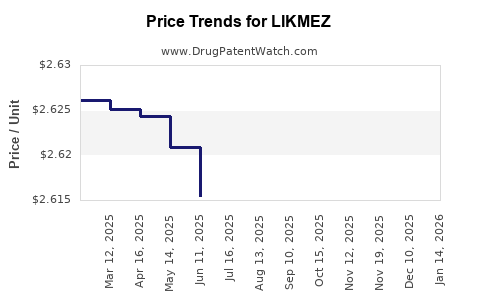
Initial US list prices for comparable orphan drugs range from $200,000 to $500,000 per patient annually [2].
Likmez's launch price is projected at $400,000 per year per patient in the US, aligned with premium treatments, substantiated by clinical efficacy and rarity premium.
Revenue Forecast
| Year |
Patient Penetration |
Estimated Patients |
US Revenue |
EU Revenue |
APAC Revenue |
Total Revenue |
| 1 |
5% |
250 |
$100M |
$50M |
$15M |
$165M |
| 2 |
10% |
500 |
$200M |
$100M |
$30M |
$330M |
| 3 |
15% |
750 |
$300M |
$150M |
$45M |
$495M |
| 4 |
20% |
1,000 |
$400M |
$200M |
$60M |
$660M |
| 5 |
25% |
1,250 |
$500M |
$250M |
$75M |
$825M |
Key Assumptions
- Steady market entry without significant delays.
- Incremental patient adoption based on clinical data.
- Price remains stable over initial years but may increase with inflation or additional indications.
Market Drivers and Risks
Drivers
- Growing unmet need for effective therapies
- Favorable reimbursement policies for orphan drugs
- Positive clinical trial outcomes enhancing adoption
Risks
- Regulatory delays or denials in certain markets
- Entry of biosimilars or competitors
- Cost containment policies reducing reimbursement levels
Conclusion
Likmez has a strong growth potential within the orphan drug market. Revenue projections suggest revenues could reach over $800 million annually by Year 5, assuming successful market penetration and pricing strategies.
Key Takeaways
- Likmez enters a lucrative but highly competitive orphan drug market.
- Pricing in the US is expected at approximately $400,000 annually per patient.
- Total global revenues could surpass $800 million by Year 5.
- Market penetration depends on clinical efficacy, reimbursement, and competitive dynamics.
- Risks include regulatory shifts and competitive pressures.
FAQs
Q1: What factors influence Likmez’s pricing strategy?
Pricing depends on treatment efficacy, clinical need, competition, and regional reimbursement policies.
Q2: How does Likmez compare to existing therapies?
Likmez’s differentiators include improved efficacy, fewer side effects, or simplified administration. Market share will depend on these factors.
Q3: What are the main barriers to market entry?
Regulatory approval delays, reimbursement hurdles, and competition from biosimilars or gene therapies.
Q4: How scalable is Likmez’s manufacturing process?
Manufacturing scalability depends on the active ingredient complexity and production capacity. Established facilities can produce at scale within 1-2 years post-approval.
Q5: What are potential expansion opportunities for Likmez?
Additional indications, combination therapies, or new formulations to enhance patient compliance.
References
[1] Grand View Research. (2022). Orphan Drug Market Size, Share & Trends Analysis [Report].
[2] IQVIA. (2021). Global Pricing & Reimbursement Report.