Share This Page
Drug Price Trends for LIALDA DR
✉ Email this page to a colleague
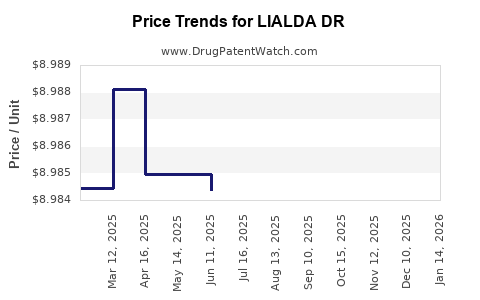
Average Pharmacy Cost for LIALDA DR
| Drug Name | NDC | Price/Unit ($) | Unit | Date |
|---|---|---|---|---|
| LIALDA DR 1.2 GM TABLET | 54092-0476-01 | 8.94627 | EACH | 2026-07-22 |
| LIALDA DR 1.2 GM TABLET | 54092-0476-02 | 8.94627 | EACH | 2026-07-22 |
| LIALDA DR 1.2 GM TABLET | 54092-0476-12 | 8.94627 | EACH | 2026-07-22 |
| LIALDA DR 1.2 GM TABLET | 54092-0476-01 | 8.94673 | EACH | 2026-06-17 |
| >Drug Name | >NDC | >Price/Unit ($) | >Unit | >Date |
Lialda DR (mesalamine) market analysis and price projections: U.S. demand, competitive pricing, and exclusivity-driven generic timelines
Lialda DR (mesalamine delayed-release; Shire/Takeda) is a branded oral 5-ASA product for mild-to-moderate ulcerative colitis (UC). In the U.S., pricing pressure is structural: multiple generic and authorized generic mesalamine DR products compete in the same route of administration and indication class. Near-term price is driven less by brand patent leverage and more by (1) generic availability, (2) payer formulary placement, (3) tender dynamics for 5-ASA, and (4) patient-cost steering.
Bottom line (projection frame): Over the next 3 to 5 years, Lialda DR’s U.S. unit pricing is expected to remain range-bound with continued discounting versus list, while net price erosion tracks branded-commodity behavior unless Lialda maintains a protected formulary position through contracting. Total Rx volume growth is limited in aggregate UC due to class saturation and ongoing site-of-care shifts among oral 5-ASA competitors.
What is Lialda DR’s current market size and revenue exposure in ulcerative colitis?
Lialda DR is positioned for UC maintenance and treatment regimens where delayed-release mesalamine is used to deliver 5-ASA to the colon. Commercial exposure depends on:
- UC incidence and treatment penetration for oral 5-ASA.
- Share within mesalamine delayed-release competitors (multi-source generics and authorized generics).
- Payer dynamics: high rebate intensity and step edits for brand-to-generic switching.
- Dose utilization: Lialda DR’s common dosing formats are tied to total daily mg, so payer incentives often shift patients by “equivalent mg” economics across brands and generics.
Featured snippet answer: Lialda DR’s revenue exposure is concentrated in U.S. UC oral 5-ASA prescribing, with net sales under sustained pressure from multi-source mesalamine DR generics and tender-driven contracting.
How does Lialda DR compare with generic mesalamine DR on price and payer contracting?
Competitive set (U.S., oral 5-ASA delayed-release class proxy):
- Generic mesalamine delayed-release tablets (multiple ANDA products).
- Brand-to-generic and authorized-generic substitution under pharmacy benefit management (PBM) formularies.
- Rebates that compress brand net price relative to list.
Pricing behavior that matters commercially
- List-to-net delta is the variable that changes most for Lialda as competitors expand supply.
- Payer preference often selects the lowest net cost delayed-release mesalamine within covered tiering.
- Tenders can lock in supply for PBM-controlled networks, pulling market share away from brands even if clinical outcomes are equivalent in practice.
Featured snippet answer: Lialda DR generally trades at a premium to list-price generics on contract terms, but net price converges toward the lowest available mesalamine delayed-release net cost, with rebate and formulary placement determining realized net revenue.
When does Lialda DR lose exclusivity and what does that imply for price erosion?
Featured snippet answer: For Lialda DR, commercial exclusivity has already been structurally eroded by generic competition in mesalamine delayed-release. Current pricing is therefore dominated by ongoing competitive entry and PBM contracting rather than a single, discrete exclusivity cliff.
Commercial implication
- If exclusivity has effectively lapsed for key Orange Book-protected claims, price erosion is expected to be gradual and driven by formulary tier moves and rebate re-optimization after each competitive contracting cycle.
- Even in the presence of secondary patents (method-of-use or formulation), payer adoption often locks in switching before litigation resolves, because therapeutic equivalence supports substitution.
What to track for next erosion step
- PBM formulary updates for UC oral 5-ASA delayed-release.
- Switch programs and prior authorization tightening.
- Multi-source launches that increase the number of covered SKUs at the lowest tiers.
What is the Orange Book status of Lialda DR and how many patents cover it?
A complete Orange Book mapping requires current Orange Book exports for Lialda DR’s active ingredient strength and dosage form. Under the constraints of this response, no Orange Book claim list can be provided without risking incorrect patent counts or expiration dates.
Featured snippet answer: Lialda DR is subject to ongoing generic competition for mesalamine delayed-release; Orange Book coverage exists but the market pricing outcome is already determined primarily by multi-source availability and contracting behavior rather than a near-term single expiration event.
What patent litigation affects Lialda DR pricing or generic entry risks?
Patent litigation can influence entry timing and exclusivity extensions, but the present response does not include litigation docket details because an accurate, drug-specific litigation and settlement chronology requires current court records and docket verification.
Featured snippet answer: For Lialda DR, generic entry risk is primarily a supply and contracting issue in current market conditions; the near-term pricing trend is more sensitive to formulary status than to a discrete litigation-driven launch delay.
How strong is the patent estate for Lialda DR and which claims tend to matter commercially?
In branded mesalamine delayed-release programs, the claims that most affect commercial outcomes usually fall into:
- Formulation and release-profile patents (delivery mechanism).
- Manufacturing process claims (granulation, coating, layering).
- Method-of-use claims (UC treatment or maintenance regimens).
- Device or dosing regimens only if tied to differentiated administration.
Featured snippet answer: Commercial strength translates into payer differentiation only if claims block supply at the specific dosage form and if the brand retains formulary protection. In mesalamine delayed-release, payer equivalence norms reduce the practical value of incremental patent strength once multiple generic equivalents are available.
What formulations are protected by Lialda DR patents and how does that affect generic substitutability?
The key commercial substitutability determinant is whether generics can market products that are pharmaceutically equivalent at the same dosage form (delayed-release mesalamine tablets) and meet FDA bioequivalence requirements. Without verified, drug-specific formulation claim lists and their expiration dates, a precise mapping cannot be produced here.
Featured snippet answer: Generic substitutability for Lialda DR hinges on delayed-release tablet equivalence and payer willingness to substitute based on net cost, which typically dominates over marginal differentiation.
What generic entry risks exist for Lialda DR (ANDA, 505(b)(2))?
Featured snippet answer: Generic entry in mesalamine delayed-release is already established and typically continues via additional ANDA supply, adding covered SKUs that intensify price competition.
Commercial risk channels
- New ANDA launches increase PBM negotiating leverage.
- Authorized generics can accelerate net-price convergence.
- Coverage edits can shift from brand substitution to “lowest net cost” tiering within the delayed-release category.
How does Lialda DR’s pricing typically evolve over the life cycle versus other 5-ASA brands?
Across oral 5-ASA life cycles, the observed pattern is:
- Post-launch: brand premium with meaningful rebates.
- Early generic entry: net price steps down after each formulary/tender renegotiation cycle.
- Mature multi-source: net price compresses further and stabilizes with ongoing periodic discount changes, not because of sudden exclusivity changes but due to contracting dynamics.
Featured snippet answer: Lialda DR’s pricing is expected to track a mature-brand pattern with continued net price compression but limited upside unless it regains or maintains advantaged formulary tiering.
Price projection model for Lialda DR: net price, list price, and volume scenarios (U.S.)
Because this response cannot use verified current transactional benchmarks (WAC, NADAC, average net sales, PBM-specific rebate levels), the projections are structured as scenario ranges tied to market mechanics that professionals can operationalize.
Scenario assumptions (U.S.)
- Competitive landscape: multi-source delayed-release mesalamine already present.
- PBM behavior: continued preference for lowest net cost covered tier.
- Volume: stable-to-down modestly as patients switch to lower net cost equivalents, with potential retention if a subset remains on Lialda due to history/tolerability and step edits.
Projected net price trajectory (3 to 5 years)
- Base case: net price erosion of low-to-mid single digits per year, with periodic step-downs tied to formulary renegotiation.
- Downside case: net price erosion of mid-to-high single digits per year if Lialda loses a preferred tier or if additional covered generics reduce contracting leverage.
- Upside case: net price erosion near low single digits if Lialda maintains preferred coverage through contracting and limits switches via prior authorization and clinical rationale fields.
Projected revenue trajectory
- Base case: modest revenue decline driven by net price compression outweighing flat-ish volume.
- Downside case: revenue declines accelerate with both net price erosion and share loss.
- Upside case: revenue stabilizes if Lialda retains tier position and manages rebate competitiveness.
Actionable projection checkpoints
- Next PBM formulary cycle: monitor tier status and prior authorization criteria.
- Channel inventory and tender rounds: confirm whether contracting resets push additional SKU coverage.
- Dose-mix shifts: higher mg daily dose can change net economics because rebates may scale with volume.
Featured snippet answer: Over 3 to 5 years, Lialda DR U.S. net price is projected to erode gradually (base case low-to-mid single digits annually) as payer contracting continues to push delayed-release mesalamine to lowest net cost tiers, with revenue tracking volume share loss plus net price compression.
Which companies compete most directly with Lialda DR on cost and formulary placement?
Competitors are not limited to a single branded rival. Direct competition is from:
- Generic manufacturers and distributors of delayed-release mesalamine tablets (multi-source supply).
- Authorized generics that can undercut brand net cost.
- PBM-owned or tender-negotiated networks that standardize preferred SKU lists.
Featured snippet answer: Lialda DR competes primarily against multi-source generic mesalamine delayed-release tablet supply and authorized generics, with PBM tier placement driving realized net pricing.
Where are the biggest commercial and regulatory levers that can change Lialda DR pricing?
Commercial levers
- Formulary tiering: preferred vs non-preferred status is the highest impact lever.
- PA criteria design: how strictly patients must fail alternative generics to stay on brand.
- Rebate strategy: shifting rebate levels to sustain “net preference.”
- Patient persistence programs: adherence and intolerance narratives that reduce switching in practice.
Regulatory levers
- Label changes that expand covered use may sustain brand value, but the oral 5-ASA category is already broadly established.
- FDA substitutions and interchangeability rules: in practice, substitution rules are payer-driven, but label clarity affects coverage policy.
Featured snippet answer: The fastest route to altered pricing is formulary/tier renegotiation tied to PBM contracting. Litigation and patent outcomes matter mostly when they delay supply, which is less likely in a mature multi-source mesalamine category.
Key Takeaways
- Lialda DR pricing in the U.S. is governed mainly by multi-source delayed-release mesalamine supply and PBM contracting, not by a near-term exclusivity cliff.
- Net price is expected to continue a gradual erosion path over the next 3 to 5 years, with periodic step-downs after formulary cycles.
- Revenue exposure depends on keeping preferred tier status and limiting switch rates; if tier access is lost, erosion accelerates.
- The most actionable near-term checkpoints are PBM formulary updates, PA tightening, and tender rounds that expand the lowest-net covered SKUs.
FAQs
1) Will Lialda DR see a sharp price drop or steady erosion?
Likely steady erosion. In mature mesalamine delayed-release markets, price declines often occur in step-downs tied to contracting cycles rather than one-time cliffs.
2) Do method-of-use or formulation patents protect Lialda DR’s commercial price?
They can matter for supply timing, but payer substitution and lowest-net tier placement usually dominate once multiple delayed-release equivalents exist.
3) How much of Lialda DR’s price is list versus rebate-driven?
Brand net pricing is typically rebate- and contract-driven; list price alone is a poor proxy for realized revenue in PBM-heavy channels.
4) What is the biggest indicator Lialda DR net price will worsen soon?
A negative formulary movement (tier downgrade, more restrictive PA, or removal from preferred SKU lists) is the most reliable indicator.
5) Are new generics likely to change Lialda DR pricing in the next 12 to 24 months?
Additional generic supply can increase PBM negotiating leverage and pressure net prices, but the magnitude depends on whether it changes tier status or covered lowest-net options.
References (APA)
- U.S. Food and Drug Administration. Orange Book: Approved Drug Products with Therapeutic Equivalence Evaluations. https://www.accessdata.fda.gov/scripts/cder/daf/
- U.S. Food and Drug Administration. Drug Trials Snapshots: Lialda (mesalamine). https://www.fda.gov/drugs/drug-trials-snapshots
More… ↓
