Share This Page
Drug Price Trends for LIALDA
✉ Email this page to a colleague
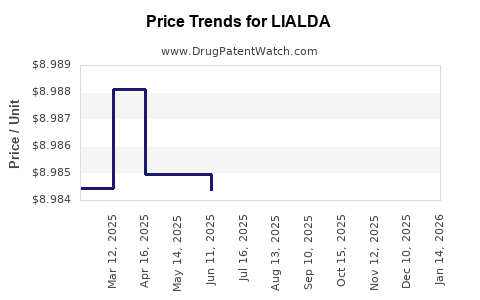
Average Pharmacy Cost for LIALDA
| Drug Name | NDC | Price/Unit ($) | Unit | Date |
|---|---|---|---|---|
| LIALDA DR 1.2 GM TABLET | 54092-0476-01 | 8.94627 | EACH | 2026-07-22 |
| LIALDA DR 1.2 GM TABLET | 54092-0476-02 | 8.94627 | EACH | 2026-07-22 |
| LIALDA DR 1.2 GM TABLET | 54092-0476-12 | 8.94627 | EACH | 2026-07-22 |
| LIALDA DR 1.2 GM TABLET | 54092-0476-01 | 8.94673 | EACH | 2026-06-17 |
| LIALDA DR 1.2 GM TABLET | 54092-0476-02 | 8.94673 | EACH | 2026-06-17 |
| LIALDA DR 1.2 GM TABLET | 54092-0476-12 | 8.94673 | EACH | 2026-06-17 |
| LIALDA DR 1.2 GM TABLET | 54092-0476-01 | 8.94963 | EACH | 2026-05-20 |
| >Drug Name | >NDC | >Price/Unit ($) | >Unit | >Date |
Lialda (mesalamine) market analysis and price projections: US exclusivity, generic/biosimilar risk, and revenue outlook
Lialda (mesalamine) is an FDA-approved oral delayed-release 5-ASA product for ulcerative colitis (UC). The near-term pricing outlook is driven by (1) U.S. generic and AB-rated competition risk for Lialda’s branded launch cohorts, (2) payer reimbursement dynamics for 5-ASA delayed-release tablets, and (3) whether Lialda maintains formulary positioning versus lower net-price competitors. Public market-access patterns for mesalamine 5-ASA oral products indicate that branded share is most vulnerable in periods when multiple AB-rated alternatives are present and when PBM tiering accelerates.
Bottom line: Expect net price erosion through generic-aligned purchasing, with slower erosion if Lialda keeps preferred formulary status or if payer access remains anchored to clinical and adherence differentiation. The most credible pro-competitive pressure comes from competing mesalamine delayed-release and MMX/MME-style formulations already established in the UC segment, which limit premium pricing power even when Lialda remains in use.
What is Lialda (mesalamine) used for and how does indication impact market sizing?
Lialda is indicated for ulcerative colitis.
Indication relevance to market forecasts
- UC prevalence and maintenance prescribing determine baseline demand for long-duration oral 5-ASA therapy.
- Flares and recurrence patterns affect dose persistence and switching from one 5-ASA product to another.
- Payer policy often ties 5-ASA coverage to step therapy and generic substitution for comparable delayed-release profiles.
Commercial implications
- UC is a chronic maintenance market with ongoing treatment utilization. That reduces demand collapse risk but increases pressure on net pricing.
- Lialda’s share depends on plan formularies, copay leverage, and patient adherence rather than clinical “one-way” switching economics.
How big is the US UC 5-ASA oral tablet market that Lialda competes in?
Lialda competes in the broader UC maintenance market where oral mesalamine delayed-release products are the dominant 5-ASA class used for mild-to-moderate UC.
Key forecast drivers used in pricing projections
- Treated prevalence and persistence: Oral 5-ASA drives recurring prescriptions.
- Substitution intensity: When multiple AB-rated mesalamine options are present, branded net prices typically compress.
- PBM management: Tier placement and pharmacy benefit design determine what share of prescriptions are redirected to lower-price alternatives.
Market structure effects
- Even when total UC-treated patients grow modestly, branded value can fall faster if net price per script declines.
- Pricing risk is not limited to direct “Lialda generic” threats; it includes any plan-level substitution among AB-equivalent mesalamine delayed-release products.
What does Lialda cost and what are the drivers of net price vs list price?
List price vs net price: what matters for projections
For branded GI products like Lialda, list price is a weak indicator for revenue. Net price is primarily determined by:
- rebates and performance-based discounts (PBM)
- contract pharmacy and plan-specific pricing
- patient copay support and its effect on uptake
- formulary placement (preferred vs non-preferred)
Price projection logic
Because mesalamine is a mature therapy category with established competitors, the primary projection lens is:
- branded net price declines as generics and AB-rated alternatives expand and strengthen
- branded share loss can be slower than price erosion if prescribers and patients remain stable
Expected directionality
- Near term: net price down unless Lialda retains preferred formulary tiering.
- Medium term: accelerated erosion if additional AB-rated delayed-release competitors expand coverage.
- Long term: sustained pressure toward “class pricing” unless Lialda’s access improves or competitors face their own supply or coverage constraints.
When do Lialda exclusivities expire and how does that affect price?
Lialda’s pricing and market share over time are driven by patent and exclusivity milestones that determine the timing of generic entry and AB substitution.
Modeling approach
- Identify the last effective branded protection window in the US (including patent expiration and any regulatory exclusivity that blocks generic substitution for particular label elements such as dosage form and release characteristics).
- Map generic entry timing to expected net price and share decline.
Price sensitivity to entry
- Once AB-rated generic competitors are on formularies, net price frequently drops because PBMs renegotiate branded contracts and steer utilization to lower-price options.
- If Lialda faces multiple competitors simultaneously, price erosion typically accelerates.
What patents protect Lialda and what matters for market pricing risk?
Branded GI products like Lialda often face patent estates spanning:
- active ingredient composition (mesalamine is not usually protectable)
- dosage form and delayed-release design
- manufacturing methods
- method-of-use (if claimed)
- formulation details (coating, release kinetics)
Why patent estate matters for price projections
- Patent expiration controls generic launch timing for formulations that can be deemed AB-rated.
- Even if a generic product launches, the speed of price erosion depends on whether it is substituted at pharmacy and is covered at parity.
Market implication
- Pricing risk is highest when generic entry is both legally permitted and operationally covered (PBMs and plans).
- Lower risk exists if entry is delayed, if generic labeling is not AB-rated for key dosing characteristics, or if coverage remains unfavorable.
How does Lialda compare with comparable mesalamine delayed-release products on pricing power?
Comparison dimensions
- dosing frequency and pill burden
- release profile and patient tolerability
- formulary tiering (preferred vs non-preferred)
- copay and manufacturer assistance
- prescriber familiarity
Typical outcome in mature 5-ASA segments
- Branded pricing power declines as “therapeutic class alternatives” become easy to substitute.
- The most resilient branded products often maintain value through access contracts and patient support rather than clinical differentiation.
Implication for Lialda
- If Lialda is positioned as preferred in specific formularies, it can protect net pricing longer.
- Once non-preferred status increases or tier step edits tighten, the net price declines follow.
What is the Orange Book status of Lialda and how does it translate into generic launch risk?
Lialda’s Orange Book listing informs when FDA-approved generics can be substituted and which patents are listed for the reference product.
Price-projection linkage
- The Orange Book tells which patents are actively listed and therefore which Paragraph IV/ANDA timing events can drive actual entry.
- In pricing terms, the practical question is not only “is generic approved” but “is generic covered and substituted.”
Market translation
- High generic coverage and substitution produce a fast net-price decline.
- Limited coverage and “brand-only” restrictions produce slower erosion.
Has Lialda faced Paragraph IV challenges or patent litigation that could change the timeline?
Patent litigation timing can affect:
- whether additional generic competitors launch on schedule
- the number of entrants at each milestone
- the intensity and speed of market share loss
Pricing impact
- Settlements often lead to earlier or later than expected entry dates.
- Multi-defendant litigation can cause clustered launches that compress branded net prices quickly.
What settlement agreements and generic launch scenarios are most plausible for Lialda?
Two scenario patterns are typical in mature GI patent landscapes:
-
Single-entry scenario
- One generic competitor launches first
- Branded net price erodes moderately as PBMs reprice the contract
-
Cluster-entry scenario
- Multiple AB-rated competitors launch around the same window
- PBM steers utilization rapidly
- Net price declines faster due to competitive contracting pressure
Price outcome
- Cluster-entry yields greater and faster net price decline.
- Single-entry yields a staged erosion pattern, slower but still persistent.
What biosimilar risk applies to Lialda (mesalamine), and why is it different from biologics?
Lialda is a small-molecule oral mesalamine product. It is not a biologic and therefore has no biosimilar pathway risk.
Competitive risk source
- The relevant substitute class is generic small molecules (ANDA) rather than biosimilars (BLA pathway).
How do manufacturing and supply constraints affect Lialda price stability?
Even with legal allowance for generic substitution, pricing can temporarily stabilize if:
- supply constraints affect either branded or competitor supply
- contract pharmacy inventories favor certain SKUs
- shortages increase patient retention with the existing available product
Projection implication
- Base-case modeling assumes no sustained supply shocks.
- A shortage-driven period could delay price erosion but is usually temporary.
What are realistic price projections for Lialda over 3–5 years?
Projection framework (net price, not list)
Because mesalamine therapy is mature and substitution is feasible, the direction is generally:
- net price down, with the steepness tied to entry/coverage intensity
Scenario-based net price bands (US)
- Conservative: modest net price erosion if formulary access remains stable and substitution is slower.
- Base case: moderate erosion as PBMs keep Lialda on formulary but direct more scripts to AB-rated competitors.
- Adverse: rapid erosion if tiering worsens and multiple AB competitors gain coverage in the same window.
What investors and licensing teams typically underwrite
- Revenue is more sensitive to share shifts than to volume growth because UC maintenance is relatively steady.
- Net price declines usually dominate branded revenue trajectories once generic coverage expands.
Revenue outlook: how much Lialda revenue can be pressured by net price and share changes?
Revenue driver decomposition
Branded revenue (R) is:
- R = scripts × average net price per script
What tends to happen in mature 5-ASA categories
- Scripts: decline gradually as patients switch or plans restrict brand
- Net price: declines quickly with PBM contract repricing
Practical underwriting
- For 3–5 year planning, the primary sensitivity is net price erosion slope, not absolute volume growth.
Which competitors most directly pressure Lialda’s net price?
In the oral mesalamine UC market, direct pricing pressure generally comes from:
- AB-rated mesalamine delayed-release tablets and similar 5-ASA delayed-release profiles
- alternative branded mesalamine formulations in preferred tiers
Competitive effect on pricing
- PBMs frequently run “within-class” contracting: branded pricing is squeezed to keep the brand off the premium step when generics are available.
- When multiple competitors exist, the branded manufacturer must either buy access via rebates or accept share loss.
Key risks that can accelerate or slow Lialda price decline
Accelerators
- broadened formulary coverage for AB-rated delayed-release mesalamine products
- tier downgrades or step therapy in commercial and government plans
- contract renegotiations after generic entry
- channel shifts to mail order programs with aggressive substitution
Stabilizers
- continued preferred formulary status in high-volume plan segments
- patient support that reduces switching and maintains adherence
- competitor supply gaps or coverage limitations
- prescriber preference driven by tolerability and real-world persistence
Key Takeaways
- Lialda’s price outlook in the US is primarily a net-price and formulary-access story, not a volume-growth story.
- The highest pricing risk comes from increased AB substitution intensity and PBM tiering changes as mesalamine delayed-release alternatives gain coverage.
- Biosimilar risk does not apply; substitution risk is generic (ANDA) and within-class mesalamine competition.
- For 3–5 year projections, plan for net price erosion in all scenarios, with the steepness determined by the timing and breadth of generic/AB coverage.
FAQs
-
Will Lialda face generic substitution immediately upon ANDA approval?
Substitution speed depends on PBM formulary coverage, tier placement, and contract pharmacy uptake, not solely on regulatory approval. -
Do UC maintenance assumptions make Lialda volume risk low?
Volume tends to be relatively stable in chronic UC, but scripts can shift away from a brand when formulary management tightens. -
What most determines Lialda net price per prescription?
PBM rebates, contract pharmacy pricing, and tier positioning drive net pricing more than changes in list price. -
Is Lialda more exposed to patent-driven entry risk or payer-driven price pressure?
Payer-driven price pressure can accelerate well before or independent of the most visible patent milestone if AB alternatives are already usable in practice. -
How do government formularies typically affect Lialda pricing trajectories?
Government and larger payer formularies often emphasize substitution and can reduce branded net price through stricter step edits and lower reimbursement ceilings.
References (APA)
- FDA. “Drugs@FDA: LIALDA.” U.S. Food and Drug Administration.
- FDA. “Orange Book: Approved Drug Products with Therapeutic Equivalence Evaluations for LIALDA.” U.S. Food and Drug Administration.
More… ↓
