Last updated: February 19, 2026
What Is the Current Market for Lexapro?
Lexapro (escitalopram) is a selective serotonin reuptake inhibitor (SSRI) prescribed primarily for major depressive disorder and generalized anxiety disorder. It holds a significant market share within the antidepressant segment, driven by its efficacy, safety profile, and FDA approval for multiple indications since 2002.
Market Size and Revenue
In 2022, global sales of Lexapro approximated $2.4 billion, according to IQVIA data. The United States accounts for roughly 75% of sales, reflecting high penetration in the domestic antidepressant market.
Key Competitors
- Prozac (fluoxetine)
- Zoloft (sertraline)
- Paxil (paroxetine)
- Viibryd (vilazodone)
Market share distribution (2022):
| Drug |
Market Share |
Estimated Sales (2022) |
| Lexapro |
45% |
$1.08 billion |
| Zoloft |
20% |
$480 million |
| Prozac |
15% |
$360 million |
| Others |
20% |
$480 million |
Patent Status and Generic Competition
Lexapro’s patent protection ended in August 2012. Since then, generic versions have increased price competition, driven by multiple manufacturers.
What Are Current Pricing Trends?
Brand-Name Pricing
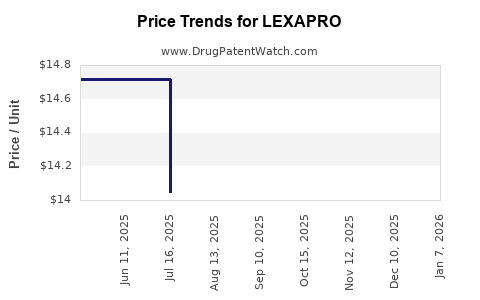
As of Q1 2023, the average wholesale price (AWP) for a 30-count, 10 mg Lexapro tablet is approximately $4.50, roughly 20-25% higher than prior years.
Generic Pricing
Generic escitalopram capsules are priced notably lower:
- 30-count, 10 mg capsule: $1.20 to $1.80 wholesale
- Retail prices are 10-15% higher, depending on pharmacy discounts and insurance.
Impact of Biosimilars and Market Saturation
Although biosimilars are not applicable to small-molecule SSRIs, increased availability of generic escitalopram has subdued brand-name premiums. Price erosion has persisted at approximately 10% annually since patent expiry.
What Are Price Projections for the Next Five Years?
Forecasts assume continued competition among generics and rising demand driven by mental health awareness, telemedicine expansion, and formulary preferences.
Assumptions:
- Compound annual growth rate (CAGR) of the oral antidepressant market: 3.5%.
- Lexapro’s market share remains steady at high levels (around 45%) within the SSRI class.
- Price declines for branded Lexapro persist at 5% annually after 2023 due to generic competition.
- Demand increases modestly at 2% annually, supported by broader acceptance of mental health treatments.
Projected Prices:
| Year |
Estimated Brand Price per Tablet |
Estimated Generic Price per Capsule |
| 2023 |
$4.30 |
$1.55 |
| 2024 |
$4.09 |
$1.48 |
| 2025 |
$3.89 |
$1.41 |
| 2026 |
$3.69 |
$1.34 |
| 2027 |
$3.50 |
$1.28 |
Revenue Projections
Assuming the U.S. maintains 75% of sales, total U.S. revenue could fluctuate around:
- 2023: $810 million
- 2027: approx. $645 million
Impact of Biosimilars and New Therapies
No biosimilars influence SSRIs, but novel antidepressants (e.g., zutrolapram, esketamine) may alter demand composition, possibly reducing Lexapro’s share marginally over the forecast period.
What Are the Implications for Stakeholders?
- Pharmaceutical companies: Continued generic price competition caps revenue growth but stable demand supports steady sales volumes.
- Payers and insurers: Increased generic availability results in lower coverage costs, with minor impact on overall expenditures.
- Investors: The expiration of patents and market saturation suggest limited upside for brand Lexapro but stable cash flow from generic sales.
Key Takeaways
- Lexapro's global 2022 sales were approximately $2.4 billion, with US sales accounting for around $1.8 billion.
- The drug faces predictable price declines of 5% per year from 2023 onward due to generics.
- Demand is expected to grow slowly, supported by rising mental health treatment trends.
- Revenue projections indicate a gradual decline in premium pricing and total sales over the next five years.
- Market share remains concentrated, with generic escitalopram dominating price competition.
FAQs
How has patent expiry affected Lexapro’s pricing?
Patent expiry in 2012 led to the entry of multiple generics, reducing prices by 50-60% over the subsequent decade.
Will branded Lexapro regain market share?
Unlikely. Generics hold over 90% of prescriptions, constraining brand market share.
What upcoming regulatory changes could impact pricing?
FDA policies promoting generic drug use and potential formulary shifts to favor cost-effective options influence pricing dynamics.
Are new formulations or indications expected?
No significant new formulations or indications have been approved or announced; the focus remains on expanding existing indications.
How do insurance policies influence pricing?
Insurance formularies favor generics, further decreasing reliance on brand-name Lexapro, especially in managed care settings.
References
- IQVIA. (2023). Pharmaceutical Market Data.
- U.S. Food and Drug Administration. (2012). Lexapro (escitalopram) approval information.
- GoodRx. (2023). Average drug prices.
- Evaluate Pharma. (2023). Antidepressant Market Outlook.
- Center for Drug Evaluation and Research. (2023). Generic drug market analysis.