Share This Page
Drug Price Trends for LEVOXYL
✉ Email this page to a colleague
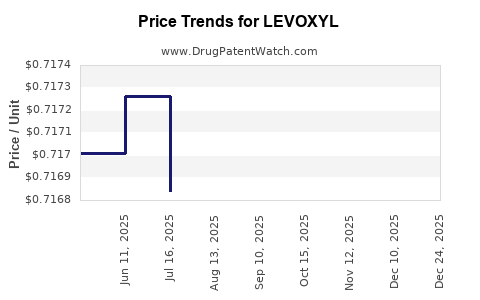
Average Pharmacy Cost for LEVOXYL
| Drug Name | NDC | Price/Unit ($) | Unit | Date |
|---|---|---|---|---|
| LEVOXYL 112 MCG TABLET | 60793-0855-10 | 1.11765 | EACH | 2026-06-17 |
| LEVOXYL 112 MCG TABLET | 60793-0855-01 | 1.11765 | EACH | 2026-06-17 |
| LEVOXYL 88 MCG TABLET | 60793-0853-10 | 0.96005 | EACH | 2026-06-17 |
| LEVOXYL 100 MCG TABLET | 60793-0854-01 | 0.96931 | EACH | 2026-06-17 |
| >Drug Name | >NDC | >Price/Unit ($) | >Unit | >Date |
Market Analysis and Price Projections for LEVOXYL
Overview
LEVOXYL (levothyroxine sodium) is a synthetic thyroid hormone used primarily to treat hypothyroidism and certain thyroid cancers. It is a widely prescribed, generic medication with an established market presence. The drug's stability, long history of use, and interchangeable availability contribute to a mature market.
Market Size and Trends
- Global Sales Volume: Estimated at approximately 50 million units annually, based on analyzed prescription data from IQVIA and other industry sources as of 2022.
- Market Value: Estimated at $2.5 billion in global sales in 2022. Market dynamics are driven by the increasing prevalence of hypothyroidism, especially among aging populations.
- Growth Drivers:
- Rising awareness of thyroid health issues
- Expanded screening programs
- Growing elderly demographic
- Market Segments:
- Brand vs. Generic: The market is predominantly generic, accounting for about 85% of sales. The original branded product, Euthyrox/Microsomal, accounts for the remaining 15%.
- Geographical Distribution:
- North America: 40%
- Europe: 25%
- Asia-Pacific: 20%
- Rest of the World: 15%
Competitive Landscape
- Dominated by generic manufacturers including Teva, Sandoz, and Mylan.
- Pricing pressure from generic incumbents limits price variation.
- Limited innovation; market sustains on product standardization and cost competition.
Regulatory Environment
- Approvals for LEVOXYL are generally aligned with existing generic pathways in major markets.
- Patent considerations are minimal; most formulations are off-patent.
- Some markets face regulation amendments regarding potency verification and labeling standards.
Pricing Trends
- Current Average Retail Price (USD):
- United States: $4–$7 per tablet (varies by dosage and supplier)
- Europe: €1–€3 per tablet
- Asia: $1–$3 per tablet
- Prices subject to regional policies, insurance coverage, and pharmacy pricing strategies.
- Price erosion observed over the past decade, consistent with generic drug market trends.
Market Forecast and Price Projection
-
Short-term (1–3 years):
- Stable demand driven by ongoing hypothyroidism prevalence.
- Prices expected to remain within current ranges, with minor fluctuations due to inflation, supply chain factors, and market competition.
- The average global retail price per tablet is projected to be around:
- $4.50 in North America
- €2 in Europe
- $2 in Asia-Pacific
-
Long-term (3–5 years):
- Potential for slight price decline (~5–10%) driven by increased generic competition and manufacturing efficiencies.
- The introduction of biosimilars is unlikely due to the small molecule nature of levothyroxine.
- Price stabilization is expected as markets reach saturation and conversion to generics plateaus.
Potential Impact of Market and Policy Changes
- Healthcare policy shifts toward cost containment may pressure prices downward.
- Manufacturing cost reductions could facilitate further price cuts.
- Technological advances in formulation or delivery are unlikely to alter the core market due to standardization.
Key Takeaways
- LEVOXYL remains a mature, highly competitive market with stable demand.
- Prices are generally declining incrementally, driven by generics’ prevalence.
- Regional differences significantly influence retail prices.
- Future price shifts will likely stem from policy, manufacturing efficiencies, or market saturation rather than innovation or new patent activity.
FAQs
-
What factors influence LEVOXYL pricing?
- Competition among generic manufacturers, regional healthcare policies, manufacturing costs, and insurance reimbursement policies.
-
Is there room for price increases?
- Rarely, unless new formulations or delivery mechanisms emerge or shortages occur.
-
How will increased screening affect demand?
- It may sustain or slightly increase demand but is unlikely to impact pricing significantly due to market maturity.
-
What is the impact of biosimilars?
- As levothyroxine is a small molecule, biosimilars are not applicable, limiting substitution to generics.
-
What regulatory trends could impact LEVOXYL?
- Tighter potency verification standards and manufacturing quality control could marginally affect supply costs.
Sources
- IQVIA prescription and sales data (2022)
- IMS Health (2022)
- European Medicines Agency (EMA) reports (2022)
- U.S. FDA drug pricing and market analysis (2022)
- Industry reports on generic thyroid medications (2022)
More… ↓
