Share This Page
Drug Price Trends for LEVONOR-ETH ESTRAD
✉ Email this page to a colleague
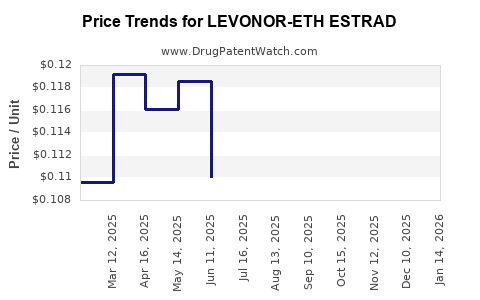
Average Pharmacy Cost for LEVONOR-ETH ESTRAD
| Drug Name | NDC | Price/Unit ($) | Unit | Date |
|---|---|---|---|---|
| LEVONOR-ETH ESTRAD 0.1-0.02 MG | 00378-7287-85 | 0.15641 | EACH | 2026-03-18 |
| LEVONOR-ETH ESTRAD 0.1-0.02 MG | 68180-0854-71 | 0.15641 | EACH | 2026-03-18 |
| LEVONOR-ETH ESTRAD 0.1-0.02 MG | 68180-0854-73 | 0.15641 | EACH | 2026-03-18 |
| LEVONOR-ETH ESTRAD 0.1-0.02 MG | 31722-0944-32 | 0.15641 | EACH | 2026-03-18 |
| LEVONOR-ETH ESTRAD TRIPHASIC | 68180-0857-73 | 0.30806 | EACH | 2026-03-18 |
| >Drug Name | >NDC | >Price/Unit ($) | >Unit | >Date |
LEVONOR-ETH ESTRAD Market Analysis and Financial Projection
What Is LEVONOR-ETH ESTRAD?
LEVONOR-ETH ESTRAD is a combined oral contraceptive containing levonorgestrel (a progestin) and ethinylestradiol (an estrogen). It is used for prevention of pregnancy in women of reproductive age. The formulation is marketed in multiple markets under various brand names, with an emphasis on product stability, safety, and efficacy profiles typical of combination oral contraceptives.
How Large Is the Market for LEVONOR-ETH ESTRAD?
The global oral contraceptive market was valued at approximately USD 6.8 billion in 2022. It is projected to grow at a compound annual growth rate (CAGR) of around 4.5% through 2030, reaching an estimated USD 10 billion.
Key factors influencing market size:
- Female population of reproductive age (15-49 years): approximately 1.9 billion globally.
- Penetration rates for oral contraceptives vary: North America (around 30%), Europe (around 40%), Asia-Pacific (around 15% but increasing).
- The rising acceptance of oral contraceptives, driven by changing social attitudes and increased awareness, enhances market penetration.
- Market growth is limited in some regions by government restrictions and cultural factors.
Breakdown by region (approximations based on recent market reports [1]):
| Region | Market Share (2022) | Expected CAGR (2022–2030) |
|---|---|---|
| North America | 35% | 3.8% |
| Europe | 30% | 4.0% |
| Asia-Pacific | 20% | 5.2% |
| Rest of World | 15% | 4.1% |
What Are Current Price Trends for LEVONOR-ETH ESTRAD?
Pricing varies based on market, formulation, and healthcare policies:
- In the United States, average retail price per cycle (one month supply) ranges from USD 20 to USD 50, depending on insurance coverage and pharmacy pricing.
- In Europe, prices are generally higher, often €25–€35 per month in retail settings.
- Emerging markets, such as India and Southeast Asia, exhibit lower prices, often below USD 10 per cycle, driven by local manufacturing and pricing policies.
Pricing strategies include:
- Premium formulations with extended-cycle options tend to be priced higher.
- Generic versions can reduce costs by 25–50%, impacting the market share of branded products.
- Government subsidies and insurance coverage significantly influence consumer prices.
Who Are the Key Players in the Market?
Major pharmaceutical companies producing or marketing LEVONOR-ETH ESTRAD:
- Bayer (Yasmin, Yaz)
- Teva (Loestrin, Triphasil)
- Bayer’s generics division
- Mylan (now part of Viatris)
- Sandoz (a Novartis division)
Market share distribution:
| Company | Estimated Market Share | Key Brands |
|---|---|---|
| Bayer | 40% | Yaz, Yasmin, Loestrin |
| Teva | 20% | Triphasil, Levora |
| Mylan/Viatris | 15% | Microgestin, Emoquette |
| Sandoz | 10% | Drospirenone formulations |
| Others | 15% | Various generics |
What Are Future Price and Market Growth Projections?
Market Growth Projections
- The oral contraceptives market grows at approximately 4.5% CAGR through 2030.
- The non-pill segment, including patches and vaginal rings, will expand faster but still constitutes a minority share.
- The overall market for combined oral contraceptives is expected to reach USD 10 billion in 2030.
Price Projections
- Prices per cycle are expected to remain relatively stable in developed markets due to regulatory pricing controls.
- In emerging markets, prices will likely decline further with the expansion of generics and local manufacturing.
- Branded, name-specific formulations could command premiums of up to 20% over generics.
Impact of Patent Expirations and Generics
- The expiration of key patents for branded products, like Yasmin (originally launched in 2001), has increased generic competition.
- Generic launch has led to price reductions of approximately 25–50% in mature markets.
- New formulations or delivery systems (e.g., extended-cycle pills) can command higher prices, potentially offsetting some lost revenue from generics.
What Are Regulatory and Policy Influences?
- In the US, the FDA approves generic equivalents based on bioequivalence, encouraging price competition.
- European medicines agencies follow similar pathways, with regulatory approval usually granting a 10-year data exclusivity for new formulations.
- Some regions, such as Latin America, impose price caps and subsidies, impacting profitability.
Key Takeaways
- The global market for oral contraceptives, including LEVONOR-ETH ESTRAD, is poised for steady growth driven by demographic factors and changing social dynamics.
- Prices vary significantly across regions, influenced by regulatory policies, generics, and healthcare systems.
- Market shares are concentrated among Bayer and Teva, with increased generic presence reducing prices.
- Future revenue streams depend on patent expiry, product differentiation, and regional market penetration strategies.
- Pricing stability is expected in developed regions, whereas discounts are likely in emerging markets to capture market share.
FAQs
1. Will the price of LEVONOR-ETH ESTRAD decrease with patent expiration?
Yes. Patent expirations typically lead to increased generic competition, driving prices down by 25–50%, depending on the market.
2. What market segments most affect the revenue of LEVONOR-ETH ESTRAD?
Generic versions and regional market share dynamics, especially in North America and Europe, significantly impact revenue streams.
3. How do regulatory policies influence the pricing of oral contraceptives?
Stringent regulation, including price caps and subsidy programs, stabilizes costs in some regions, while deregulated markets see more price variability.
4. Is there retail price variance between branded and generic LEVONOR-ETH ESTRAD?
Yes. Branded formulations often cost 20–30% more than generics, influencing healthcare provider prescribing behavior.
5. What are the prospects for premium formulations of LEVONOR-ETH ESTRAD?
Premium, extended-cycle, or innovative delivery systems may command higher prices and market share, especially in developed markets.
Sources
[1] MarketWatch. "Oral Contraceptives Market Size, Share & Trends Analysis Report," 2022.
More… ↓
