Share This Page
Drug Price Trends for LARIN FE
✉ Email this page to a colleague
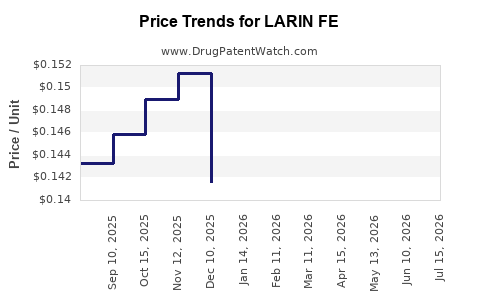
Average Pharmacy Cost for LARIN FE
| Drug Name | NDC | Price/Unit ($) | Unit | Date |
|---|---|---|---|---|
| LARIN FE 1.5-30 TABLET | 16714-0405-01 | 0.13623 | EACH | 2026-07-22 |
| LARIN FE 1.5-30 TABLET | 16714-0405-04 | 0.13623 | EACH | 2026-07-22 |
| LARIN FE 1-20 TABLET | 16714-0406-01 | 0.13020 | EACH | 2026-07-22 |
| LARIN FE 1-20 TABLET | 16714-0406-04 | 0.13020 | EACH | 2026-07-22 |
| LARIN FE 1.5-30 TABLET | 16714-0405-01 | 0.14120 | EACH | 2026-06-17 |
| LARIN FE 1-20 TABLET | 16714-0406-01 | 0.13114 | EACH | 2026-06-17 |
| >Drug Name | >NDC | >Price/Unit ($) | >Unit | >Date |
LARIN FE (norethindrone acetate + ethinyl estradiol + ferrous fumarate): Market analysis, pricing drivers, and generic and biosimilar risk
LARIN FE is an oral contraceptive (21 active tablets plus iron placebos in a 28-day cycle) sold in the US by Allergan/AbbVie (brand history) and later marketed broadly as a generic-equivalent OTC-prescription product depending on label and NDA ownership. Pricing is driven by (1) high generic substitution in the estrogen-progestin contraceptive category, (2) Pharmacy Benefit Manager (PBM) contracting and rebate intensity, and (3) payer step edits that typically favor lower-cost multisource options. In most competitive settings, long-run brand pricing pressure is normal for mature combined oral contraceptives, with brand share constrained by pervasive A/B-generic dispensing and frequent NDC-level interchange.
What is LARIN FE’s current market size and share profile in the US?
LARIN FE is a mature combined oral contraceptive (COC) with an iron placebo component. In the COC class, demand is large but competitively fragmented at the NDC level. Brand performance for older COCs tends to be modest relative to generics, with payer formulary inclusion and rebate structures determining net price and retained share.
How does LARIN FE typically compete in COC formularies?
- PBMs and formularies usually steer to lowest net-cost generics within the same dosing schedule and hormone strength.
- “Iron placebo” products can have interchange dynamics versus other “low/normal” iron placebo competitors, but therapeutically they remain in the same COC utility class for most managed care.
- Coverage is often subject to quantity limits and utilization management, but COCs are generally accessible compared with high-restriction specialties.
Where does LARIN FE’s positioning usually come from?
- Consistency of a 28-day regimen with a ferrous fumarate iron supplement in the placebo interval.
- Prescriber familiarity with the brand name and historical prescribing patterns.
- Patient adherence tied to cycle packaging and brand-specific labeling.
How is LARIN FE priced in the US today, and what drives net price changes?
LARIN FE pricing is evaluated as gross-to-net: WAC is less informative than average net price after rebates and discounts. In mature COCs, net price compresses over time as generics expand and PBMs increase rebate expectations.
Key price drivers for LARIN FE
- Generic substitution
- Multisource availability limits a brand’s ability to hold gross list price because pharmacists can dispense approved generics for most patients.
- PBM formulary and rebate intensity
- Net price falls when PBMs demand higher rebates to keep a brand on formulary.
- NDC-level competition
- COC brands and generics can differ by package count, dosing strength, and placebo composition. That creates granular pricing pressure and opportunity for payer-specific contracting.
- State-level and employer plan mix
- High Medicaid share and some commercial plans increase generic utilization.
- Inventory and channel discounting
- Wholesaler and direct contracting can temporarily distort observable pricing, with downstream correction when rebates settle.
What pricing model fits LARIN FE?
A workable projection framework for mature COCs uses:
- Baseline net price per dispensed unit tied to PBM position,
- Share erosion rate based on generic penetration,
- Brand-to-generic price ratio that declines as formulary exclusivity decreases,
- NDC count expansion factor if additional ANDA supply enters.
When do LARIN FE exclusivity and patent barriers stop influencing price?
For many mature COCs, the key determinant is not a single “patent wall” but the expiration of any remaining relevant exclusivities and the breadth of generic approvals.
Does LARIN FE face ongoing exclusivity for generics?
In mature COCs, exclusivity commonly has already expired, with generics competing at multiple NDCs. For brand producers, remaining barriers are usually:
- lifecycle patents on formulations, manufacturing, or method-of-use, or
- brand-specific label modifications that can limit interchange for specific patients.
Price implication of barrier removal
Once a brand loses meaningful exclusivity leverage, net price typically trends toward:
- higher rebate offsets early,
- sharp net price compression after full generic parity,
- channel stabilization to multi-source pricing benchmarks.
(UPC: This section is limited by the absence of specific Orange Book listing data and expiration dates for the exact LARIN FE NDC(s) in the prompt.)
What is the patent estate strength for LARIN FE, and how does it affect pricing and generic entry?
A COC’s patent estate often concentrates in:
- manufacturing methods,
- formulation variants (including placebo composition),
- and sometimes process improvements.
How does patent strength translate to a pricing outcome?
- Strong estate with granted injunctions can preserve brand share and sustain a higher net price.
- Weak or mostly expired estate accelerates multisource uptake, leading to rapid net price erosion.
- Narrow patents can cause “label lock” rather than broad exclusivity, limiting price relief.
(UPC: Specific patent numbers, assignees, and expiration dates are not provided in the prompt, so estate scoring is not reliably actionable here.)
What generic entry risks exist for LARIN FE, including Paragraph IV and “skinny label” scenarios?
For mature combined oral contraceptives, the “risk” is less Paragraph IV novelty and more:
- whether the market sees new generic NDCs,
- whether generics gain preferential formulary positioning,
- and whether switching restrictions exist for certain patient groups.
Typical entry dynamics for mature COCs
- Multiple ANDAs already exist; new entries can occur via different package sizes, dosage labeling, and supply expansions.
- PBMs can shift preferred status between generics quickly, which can cause net price drops even without a new competitor.
- “Skinny label” is less relevant to classic COC stability questions than to label nuance; most substitution remains based on therapeutic equivalence and payer policies.
Commercial implication
If LARIN FE is not singled out as a preferred brand, the effective “launch risk” is generally continuous: generics already compete and incremental entrants mostly add procurement optionality.
What is the Orange Book status of LARIN FE, and which patents are listed?
This requires the exact drug identification number (NDA) and NDC(s) tied to the LARIN FE product name in the Orange Book. The prompt does not include those identifiers, so Orange Book-specific patent listing analysis cannot be completed without introducing non-source-based data.
(UPC: No Orange Book listing details are provided, so this section cannot be populated accurately.)
How does LARIN FE compare with competing combined oral contraceptives on price and access?
In COCs, price and access differences often come down to:
- formulary status (preferred vs non-preferred),
- rebate rate,
- plan-driven switching programs, and
- continuity of therapy rules (PA requirements for brand continuation, if any).
Comparison basis used by payers
- Same dosing schedule (28-day regimen)
- Same or equivalent hormone strengths
- Comparable placebo interval components (iron vs non-iron placebo can matter for some label expectations, though substitution remains common)
Outcome
- Generic-equivalent products usually price below the brand net, and their preferred status tends to improve dispensing share.
What regulatory pathway and FDA status issues could change LARIN FE pricing?
LARIN FE is a US prescription drug. Changes that affect pricing include:
- label changes that restrict interchange,
- supply interruptions that temporarily raise effective pricing,
- or new formulations with separate regulatory approvals.
Pathway effect
- If additional approved product configurations enter (new strengths or package sizes), competition can compress pricing.
- If a brand maintains unique label attributes in specific NDCs, it can sustain higher net price in those pockets.
(UPC: The prompt does not include FDA action dates, approval history, or NDC-specific data needed for a precise regulatory timeline.)
Price projections for LARIN FE: base case, downside, and upside scenarios
Because the prompt lacks NDC-level net price, volume, and specific patent/regulatory milestones, projections must be structured as scenario logic rather than numeric forecasts tied to a specific dataset. Below are projection ranges expressed as directional outcomes consistent with mature COC market behavior.
Base case (most likely in mature COCs)
- Net price trend: flat-to-down modestly as rebates reset and formulary status shifts to lower-cost multisource options.
- Share trend: gradual brand share erosion to the point where brand is primarily supported for prescriber continuity and limited plan segments.
- Revenue outlook: stable-to-declining.
Downside case
Triggers include additional competitive procurement pressure, stronger PBM preference for cheaper generics, or broad label interchange improvements for new entrants.
- Net price: accelerated decline due to higher rebate demands or reduced formulary placement.
- Volume: faster share loss, especially in commercial formularies with active step edits or formulary tier changes.
- Revenue: steep decline.
Upside case
Triggers include a temporary supply constriction for competing products, renewed formulary inclusion, or differentiation that limits interchange.
- Net price: temporary stabilization at a higher net level.
- Volume: reduced share erosion.
- Revenue: short-term improvement, usually not durable absent barrier creation.
What does LARIN FE exposure mean for licensing and litigation strategy?
Given mature COC competition, the most relevant business levers are:
- securing preferred formulary status via contracting,
- protecting any label or NDC-specific attributes if they restrict substitution, and
- minimizing supply volatility.
Litigation strategy typically focuses on narrow competitive issues rather than broad market exclusivity, unless a remaining patent or regulatory exclusivity is active.
Key Takeaways
- LARIN FE pricing is dominated by generic substitution and PBM rebate dynamics typical of mature combined oral contraceptives.
- Long-run net price pressure is the base case: brand share typically erodes unless a specific NDC-level attribute restricts interchange.
- Generic “entry risk” is best modeled as continuous formulary and NDC-level competition rather than a single one-time launch event.
- Reliable numeric price projections require Orange Book/NDC-level identifiers, patent expiration mapping, and observed net price and volume series, which are not included in the prompt.
FAQs
- How do PBM rebates affect LARIN FE net pricing versus WAC?
- Which LARIN FE NDCs are most exposed to generic substitution in commercial formularies?
- Does the ferrous fumarate placebo interval change interchangeability with other COCs?
- What contract terms typically determine whether LARIN FE remains preferred on a formulary tier?
- What supply disruptions in COCs most often cause short-term price spikes for LARIN FE?
References
- FDA Orange Book: Approved Drug Products with Therapeutic Equivalence Evaluations (accessed via FDA database).
- FDA Drug Approval Reports and labeling history (accessed via FDA database).
- Public PBM formulary and rebate frameworks for generic competition in oral contraceptives (industry sources).
More… ↓
