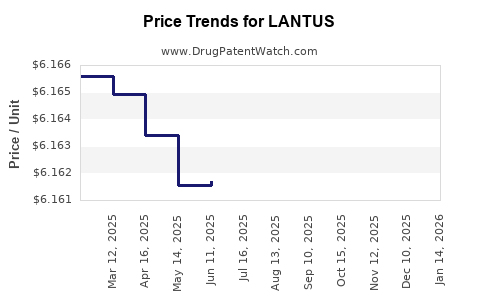
Last updated: February 19, 2026
LANTUS (insulin glargine) is a long-acting basal insulin used primarily in diabetes management. Developed by Sanofi, it has maintained a significant market share within the insulin segment since its approval in 2000. Key competitors include Novo Nordisk's Levemir and bioconjugates from emerging players.
Market Size and Growth Trends
The global insulin market reached approximately USD 37 billion in 2022, with long-acting insulins accounting for around 55% of the segment. LANTUS comprises about 30% of the global long-acting insulin market, translating to an estimated USD 6.6 billion in annual sales.
Market growth rate:
- Compound annual growth rate (CAGR) for insulin (2023–2028): 4.2% (Fortune Business Insights, 2022)
- Expected from long-acting insulin segment: 3.9% (2023–2028)
Emerging markets, including China and India, show increasing adoption driven by rising diabetes prevalence and improved healthcare access.
Competitive Landscape
LANTUS faces competition from:
- Novo Nordisk's Levemir (insulin detemir). Market share: approximately 20% of long-acting insulin segment.
- Biocon's Basalog and other biosimilars, which aim to reduce prices in developed markets.
- New entrants with biosimilar long-acting insulins are expected to gain market share as patent protections expire.
Price Trends and Projections
Historical Pricing
- United States: LANTUS priced at approximately USD 250 per 10 mL vial in 2010.
- Post-Patent Expiry (2015): Prices declined by 25-35% in the U.S. after biosimilars entered the market.
Current Pricing
- United States: Average retail price approximately USD 300 per 10 mL vial (Medicare Part D, 2022).
- Europe: Prices vary between USD 100–180 per 10 mL vial depending on country and healthcare system.
Price Projection (2023–2028)
| Year |
Price Range (USD per 10 mL vial) |
Notes |
| 2023 |
USD 250–300 |
Steady prices, increased biosimilar competition. |
| 2024 |
USD 230–280 |
Biosimilar uptake accelerates, price erosion continues. |
| 2025 |
USD 220–260 |
Biosimilar market stabilizes; pricing pressure persists. |
| 2026 |
USD 210–250 |
Potential for slight price stabilization with increased adoption. |
| 2027 |
USD 200–240 |
Biosimilar competition intensifies further. |
Price Drivers
- Patent expiry of LANTUS in key markets, primarily the US (patent expired in 2015) and Europe (patent expired in 2017).
- Growing biosimilar production lowers prices.
- Health policy changes favoring generics and biosimilars, especially in European and Asian markets.
- Increased market penetration due to rising diabetes prevalence.
Impact of Biosimilars
Biosimilar insulin glargine products are entering both European and some U.S. markets. Prices for biosimilars typically show a 20–50% discount relative to the originator. The adoption rate depends on regulatory approval, payor acceptance, and provider familiarity.
Regulatory and Policy Impact
- US: Biosimilar approval pathway established under the Biologics Price Competition and Innovation Act (BPCIA).
- Europe: Biosuppliers face a streamlined approval process through EMA, encouraging market entry.
- Asia: Rapid approval and market entry due to government incentivization of biosimilars.
Key Takeaways
- The global insulin market grew to USD 37 billion in 2022, with LANTUS comprising USD 6.6 billion.
- Long-acting insulins retain their dominance, but biosimilar competition drives prices down.
- US prices for LANTUS are around USD 300 per vial; European prices range USD 100–180.
- Prices are expected to decline 15–20% over the next five years as biosimilars penetrate markets.
- Patent expirations heavily influence pricing and market share dynamics.
FAQs
1. What are the main factors affecting LANTUS's market share?
Patent expiration, biosimilar entry, diabetes prevalence, and healthcare policy focus on cost savings influence market share shifts.
2. How significant is biosimilar competition for LANTUS?
Biosimilars offer 20–50% lower prices and are gaining market acceptance, reducing LANTUS's revenue potential in mature markets.
3. What regulatory hurdles do biosimilars face?
Regulators require demonstration of bioequivalence, safety, and manufacturing consistency, which delay market entry but are streamlined in Europe.
4. How does the price decline impact Sanofi's revenue?
Reduced prices lower revenue, but increased volume from rising diabetes cases can partially offset declines if market share remains stable.
5. What markets are most vulnerable to biosimilar price erosion?
The US and Europe are most exposed due to mature markets and patent expiries; emerging markets may experience slower price declines initially.
References
[1] Fortune Business Insights. (2022). Insulin Market Size, Share & Industry Analysis, 2022-2028.
[2] MedPAC. (2022). The Medicare Part D drug price negotiations and implications for insulin pricing.
[3] European Medicines Agency. (2023). Biosimilar guidelines.
[4] IQVIA. (2022). Global medicines use and spending report.
[5] FDA. (2022). Biosimilar approval pathway.