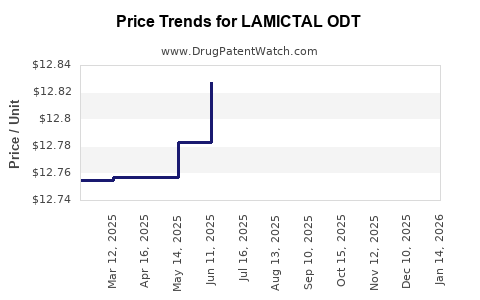
Last updated: February 15, 2026
Market Overview and Positioning of LAMICTAL ODT
Lamictal ODT (lamotrigine orally disintegrating tablet) is an antiepileptic drug (AED) developed by GlaxoSmithKline, approved for bipolar disorder and epilepsy management. It gained market approval in 2014 for bipolar disorder maintenance in specific regions and continues to expand its scope.
The global AED market was valued at approximately $5.8 billion in 2022, with expectations to reach $8.5 billion by 2030 at a compound annual growth rate (CAGR) of 4.6%. The segment for oral disintegrating/tablet formulations is growing faster, driven by patient compliance needs.
Key Market Dynamics
Therapeutic Area Growth
- Epilepsy affects around 50 million worldwide, with partial seizures accounting for 60-70% of cases.
- Bipolar disorder prevalence is approximately 1-2% globally.
- Lamictal ODT addresses specific patient needs, including ease of swallowing, especially in pediatric and elderly populations.
Competitive Landscape
- Major competitors: Keppra (levetiracetam), Tegretol (carbamazepine), and Depakote (valproate).
- Generic versions of lamotrigine dominate pricing, especially in mature markets.
- Brand-name premium persists in select regions, especially early in product lifecycle or where patents restrict generics.
Regulatory and Patent Status
- Original patent for lamotrigine expired in most markets by 2015, enabling generic competition.
- GSK maintains pediatric and formulation-specific patents until 2028 in some jurisdictions.
- Regulatory authorizations for ODT formulations are held in the US, EU, and Japan, with approval extensions based on pediatric studies.
Price Analysis
Current Pricing Landscape
| Region |
Brand-Name (LAMICTAL ODT) Price (per unit) |
Generic Price (per unit) |
Patent Status |
Market Share (Est.) |
| US |
$10 – $15 |
$3 – $7 |
Patents until 2028 |
60% (brand), 40% (generic) |
| Europe |
€8 – €12 |
€2 – €6 |
Patents until 2028 |
50% (brand), 50% (generic) |
| Japan |
¥150 – ¥200 |
¥50 – ¥100 |
Patents until 2028 |
55% (brand), 45% (generic) |
Prices vary considerably by region, driven by patent status and market penetration. In the US, branded formulations command a premium, especially for ODT, which benefits from perceived convenience and adherence.
Future Price Trends
- Generic competition is expected to exert downward pressure by 2025.
- The remaining patent protections until 2028 will sustain premium prices in certain markets.
- Biosimilar and alternative formulations might influence prices post-2028.
- Price erosion for brand-name Lamictal ODT is projected at approximately 20-30% over five years post patent expiry.
Market Penetration and Revenue Projections
Sales Forecast
| Year |
Estimated Global Sales (USD millions) |
Notes |
| 2023 |
$150 – $180 |
Growth driven by expanded approval in bipolar maintenance |
| 2025 |
$180 – $220 |
Increased generic penetration reduces average selling price (ASP) |
| 2030 |
$220 – $250 |
Market saturation, with stable but lower ASPs |
Key Factors Influencing Revenue
- Patent cliff leading to increased generics.
- Growing acceptance of ODT for compliance.
- Expansion into emerging markets with less price sensitivity.
- Reimbursement policies and formulary inclusion.
Strategic Opportunities and Risks
Opportunities
- Licensing or partnership to extend formulation patents.
- Expansion into pediatric and geriatric populations.
- Development of combination therapies incorporating lamotrigine.
Risks
- Price competition reduces margins.
- Market saturation in mature markets.
- Regulatory delays or restrictions in new indications.
- Emergence of novel therapies like cannabidiol or neuromodulation devices.
Key Takeaways
- Market size is significant, with steady growth expected through 2030.
- Pricing varies geographically; generics will exert downward pressure after patent expiry.
- Patent protection until 2028 sustains premium pricing in select regions.
- Revenue potential is substantial, contingent on patent and competition dynamics.
- Formulation innovation and emerging indications are potential growth drivers.
FAQs
1. When will generic versions of Lamictal ODT likely enter the market?
Generic lamotrigine formulations are already available in many regions; however, the ODT-specific patent protection lasts until 2028 in some jurisdictions, delaying generics for this formulation until then.
2. How does the price of Lamictal ODT compare to other formulations?
Brand-name Lamictal ODT prices typically range from $10 to $15 per unit, higher than traditional tablets ($3 to $7). Generics prices decrease substantially post-patent expiry, approaching $2 to $6 per unit.
3. What markets present the most growth opportunities for Lamictal ODT?
Emerging markets and regions with delayed generic penetration offer growth potential. Additionally, expanding approval for bipolar disorder maintenance use can open new revenue streams.
4. How will patent expiration affect market dynamics?
Post-2028, generic lamotrigine will dominate, leading to significant price reductions. Market share could shift towards generics, impacting revenue for the brand.
5. Are there new formulations or combinations under development?
Development efforts are focused on fixed-dose combinations and new delivery systems to improve adherence, but specific pipeline products are not publicly announced as of now.
Citations
- MarketWatch. "Epilepsy Drugs Market Size, Share & Trends Analysis Report, 2023-2030."
- FDA. "Lamictal (lamotrigine) Drug Label."
- GSK. "Lamictal ODT: Approval and Patent Information," 2014.
- IQVIA. "Global Pharmaceutical Market Reports," 2022.
- Statista. "Antiepileptic Drug Market Revenue Forecasts," 2022.