Last updated: February 19, 2026
Lactulose, a synthetic disaccharide, is primarily used as a laxative and for the management of hepatic encephalopathy. The global market is driven by the increasing prevalence of gastrointestinal disorders, an aging population, and rising awareness of liver disease management.
What are the key therapeutic applications of lactulose?
Lactulose's primary therapeutic applications stem from its non-absorbable nature and its ability to alter the colonic environment.
- Laxative: As an osmotic laxative, lactulose draws water into the colon, softening stool and stimulating peristalsis. This mechanism is effective for treating chronic constipation and occasional constipation.
- Hepatic Encephalopathy (HE): In patients with liver cirrhosis, lactulose is a cornerstone therapy for HE, a neuropsychiatric complication. It works by reducing ammonia absorption in the gut. Lactulose is metabolized by colonic bacteria into organic acids, lowering the colonic pH. This lowers the concentration of non-ionized ammonia (NH3), which is more readily absorbed into the bloodstream, and promotes the conversion of NH3 to the less permeable ionized ammonium ion (NH4+).
What is the current market size and growth forecast for lactulose?
The global lactulose market is projected to grow at a compound annual growth rate (CAGR) of approximately 4.5% to 5.0% over the next five to seven years. The market size was estimated to be between USD 700 million and USD 850 million in 2023.
| Metric |
Value (USD Million) |
Growth Projection (CAGR) |
Forecast Period |
| Market Size |
700 - 850 (2023) |
4.5% - 5.0% |
2024 - 2030 |
Key drivers include:
- Aging Population: The global population is aging, with a higher proportion of individuals over 65. This demographic is more susceptible to gastrointestinal issues like constipation and liver diseases. The United Nations projects that the number of people aged 65 years or over is projected to increase from 10% in 2022 to 16% in 2050.
- Prevalence of Gastrointestinal Disorders: Chronic constipation affects an estimated 15% of the global population. The increasing incidence and diagnosis of such conditions directly impact lactulose demand.
- Increased Awareness and Diagnosis of Liver Diseases: A rise in cases of cirrhosis, hepatitis, and non-alcoholic fatty liver disease (NAFLD) fuels the demand for HE management therapies like lactulose. The World Health Organization (WHO) estimates that viral hepatitis alone causes 1.3 million deaths per year globally.
- Availability of Generic Formulations: The presence of multiple generic manufacturers has made lactulose more accessible and affordable, contributing to market expansion.
What are the major market segments for lactulose?
The lactulose market can be segmented by formulation, application, distribution channel, and region.
Segmentation by Formulation
- Oral Solutions/Syrups: This is the dominant formulation due to ease of administration, particularly for chronic use and HE management.
- Powders: Less common but used in specific dietary supplements or for compounding.
- Enemas: Primarily used for acute fecal impaction or preparation for medical procedures.
Segmentation by Application
- Constipation: Accounts for the largest share of the market.
- Hepatic Encephalopathy: A significant and growing segment driven by increased liver disease prevalence.
- Other Applications: Including irritable bowel syndrome (IBS) management and as a prebiotic ingredient in some food products.
Segmentation by Distribution Channel
- Hospital Pharmacies: Prescribed for inpatients, particularly those with HE.
- Retail Pharmacies: For over-the-counter (OTC) and prescription sales for constipation.
- Online Pharmacies: A growing channel for direct-to-consumer sales.
Segmentation by Region
- North America: A mature market with high prescription rates and significant OTC usage. Driven by a large aging population and prevalent GI disorders.
- Europe: Similar to North America, with strong demand from an aging demographic and established healthcare systems.
- Asia Pacific: Exhibits the fastest growth potential due to increasing disposable incomes, rising healthcare awareness, and a growing incidence of lifestyle-related diseases and liver conditions.
- Latin America and Middle East & Africa: Emerging markets with increasing access to healthcare and growing demand for chronic disease management.
What are the key competitive landscape factors and major players in the lactulose market?
The lactulose market is characterized by a moderate level of competition, with a mix of branded and generic manufacturers. The presence of several key players ensures a competitive supply.
Major Market Players:
- Sanofi S.A.: A significant player with its branded lactulose products.
- Teva Pharmaceutical Industries Ltd.: A leading generic pharmaceutical company with lactulose offerings.
- Bayer AG: Offers lactulose-containing products in some markets.
- Abbott Laboratories: Has a presence in the GI and liver disease therapeutic areas.
- Fresenius Kabi AG: A key supplier, particularly in hospital settings and for HE management.
- Nestlé S.A.: Involved through its health science division and prebiotic ingredients.
- Mylan N.V. (now Viatris Inc.): A major generic manufacturer with a broad portfolio.
- Aarti Drugs Ltd.: An Indian-based manufacturer with a strong presence in Active Pharmaceutical Ingredient (API) production.
- Taj Pharmaceuticals Ltd.: Another prominent Indian pharmaceutical company.
Key Competitive Factors:
- Pricing: The availability of generics makes price a critical differentiator.
- API Manufacturing Capabilities: Secure and cost-effective sourcing of lactulose API is vital.
- Regulatory Approvals: Compliance with regulatory standards in different geographies.
- Distribution Networks: Efficient supply chain management to reach various sales channels.
- Product Portfolio Breadth: Offering different pack sizes and formulations.
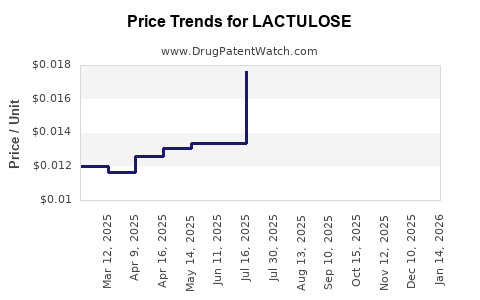
What are the price trends and projections for lactulose?
Lactulose prices are influenced by manufacturing costs, raw material availability (primarily lactose), market competition, and regulatory policies.
Current Price Range (Indicative):
- Generic Oral Solutions (e.g., 15ml sachet, 300ml bottle): USD 3.00 - USD 15.00 per unit, depending on volume, brand, and region.
- Active Pharmaceutical Ingredient (API): Fluctuates, but generally ranges from USD 5.00 to USD 15.00 per kilogram, depending on purity and supplier.
Price Projections:
The global average selling price (ASP) for lactulose is expected to remain relatively stable, with minor fluctuations. A slight increase in ASP is anticipated, driven by:
- Rising Manufacturing Costs: Incremental increases in energy, labor, and compliance costs.
- Raw Material Volatility: While lactose is widely available, price swings can occur due to agricultural factors affecting milk production.
- Premiumization of Formulations: Development of specialized or enhanced delivery systems for lactulose could command higher prices, though this is less common for the core indication.
- Increased Demand in Emerging Markets: As healthcare access improves in regions like Asia Pacific, demand for more consistent and quality-assured products may slightly elevate pricing in those segments.
Overall, significant price inflation is unlikely due to the mature nature of the drug, strong generic competition, and its status as an essential medicine for specific conditions. Expect an average annual price increase in the range of 1.0% to 2.5% globally over the forecast period.
What are the key challenges and opportunities in the lactulose market?
The lactulose market presents both hurdles and avenues for growth.
Challenges:
- Competition from Newer Laxatives: Newer classes of laxatives, including prescription-grade biologics and combination therapies, offer alternative mechanisms and may impact market share in certain segments.
- Regulatory Scrutiny: Stringent regulations regarding manufacturing standards and product quality require continuous investment in compliance.
- Price Pressures: Intense competition among generic manufacturers leads to significant price erosion.
- Patient Compliance: The taste and frequency of administration for lactulose can affect long-term patient adherence, particularly for chronic constipation.
Opportunities:
- Expanding Applications: Research into lactulose as a prebiotic and its role in gut microbiota modulation could open new market segments.
- Emerging Markets Growth: Untapped potential in developing economies with increasing chronic disease burdens and improving healthcare infrastructure.
- Combination Therapies: Potential for synergistic effects when combined with other gastrointestinal or liver support medications.
- Improved Formulations: Development of more palatable or extended-release formulations to enhance patient compliance.
- Focus on Hepatic Encephalopathy: The growing burden of liver disease worldwide presents a significant and increasing demand for effective HE management.
Key Takeaways
The global lactulose market, valued between USD 700-850 million in 2023, is projected to grow at a CAGR of 4.5-5.0% through 2030. This growth is primarily driven by the aging global population, the rising prevalence of gastrointestinal disorders like constipation, and increasing awareness and diagnosis of liver diseases, leading to greater demand for hepatic encephalopathy treatments. The market is dominated by oral solutions and syrups, with constipation and hepatic encephalopathy as the leading applications. North America and Europe represent mature markets, while the Asia Pacific region offers the highest growth potential. The competitive landscape is characterized by a mix of branded and generic players, with pricing and API manufacturing capabilities being critical factors. Lactulose prices are expected to remain relatively stable, with minor annual increases of 1.0-2.5% due to rising manufacturing costs and raw material volatility, tempered by intense generic competition. Challenges include competition from newer laxatives and price pressures, while opportunities lie in expanding applications, growth in emerging markets, and potential for improved formulations.
Frequently Asked Questions
- What are the primary raw materials for lactulose synthesis?
Lactulose is synthesized from lactose, a disaccharide found in milk. The process involves alkaline isomerization of lactose.
- How does lactulose's mechanism of action differ from stimulant laxatives?
Lactulose is an osmotic laxative, drawing water into the colon. Stimulant laxatives, in contrast, work by directly irritating the intestinal lining to stimulate muscle contractions.
- Are there specific dosage recommendations for lactulose in hepatic encephalopathy?
Dosage for hepatic encephalopathy is highly individualized and typically starts with 20-30 grams (30-45 mL) administered 3 to 4 times daily, with the dose titrated to achieve 2-3 soft bowel movements per day.
- What is the typical shelf life of lactulose oral solutions?
Standard lactulose oral solutions typically have a shelf life of 24 to 36 months when stored at room temperature, protected from light. Specific product packaging and manufacturer guidelines should be consulted.
- Can lactulose be used by individuals with diabetes?
Lactulose contains a small amount of fermentable carbohydrate. While it is generally considered safe, individuals with diabetes should monitor their blood glucose levels and consult with their healthcare provider, as the metabolism of lactulose by gut bacteria can produce small amounts of short-chain fatty acids, which can theoretically influence glycemic control.
Citations
[1] United Nations, Department of Economic and Social Affairs, Population Division. (2022). World Population Ageing 2022.
[2] World Health Organization. (2023). Hepatitis.
[3] National Institute of Diabetes and Digestive and Kidney Diseases. (2022). Constipation in Adults.