Share This Page
Drug Price Trends for LABETALOL
✉ Email this page to a colleague
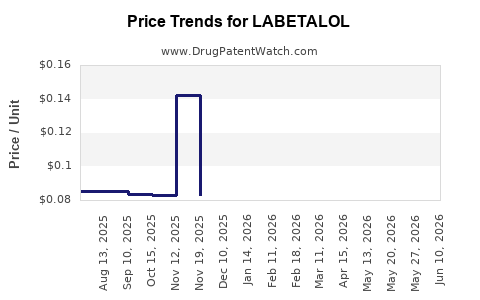
Average Pharmacy Cost for LABETALOL
| Drug Name | NDC | Price/Unit ($) | Unit | Date |
|---|---|---|---|---|
| LABETALOL HCL 100 MG TABLET | 68001-0700-03 | 0.08170 | EACH | 2026-08-05 |
| LABETALOL HCL 100 MG TABLET | 00591-0605-01 | 0.08170 | EACH | 2026-07-22 |
| LABETALOL HCL 100 MG TABLET | 00591-0605-05 | 0.08170 | EACH | 2026-07-22 |
| LABETALOL HCL 100 MG TABLET | 23155-0723-01 | 0.08170 | EACH | 2026-07-22 |
| >Drug Name | >NDC | >Price/Unit ($) | >Unit | >Date |
Best Wholesale Price for LABETALOL
| Drug Name | Vendor | NDC | Count | Price ($) | Price/Unit ($) | Unit | Dates | Price Type |
|---|---|---|---|---|---|---|---|---|
| LABETALOL HCL 200MG TAB | Golden State Medical Supply, Inc. | 51407-0615-05 | 500 | 51.92 | 0.10384 | EACH | 2024-01-03 - 2028-06-14 | FSS |
| LABETALOL HCL 100MG TAB | Golden State Medical Supply, Inc. | 51407-0614-05 | 500 | 6.07 | 0.01214 | EACH | 2024-04-18 - 2028-06-14 | FSS |
| LABETALOL HCL 200MG TAB | Golden State Medical Supply, Inc. | 51407-0615-05 | 500 | 44.58 | 0.08916 | EACH | 2024-04-18 - 2028-06-14 | FSS |
| LABETALOL HCL 100MG TAB | Golden State Medical Supply, Inc. | 51407-0614-05 | 500 | 29.53 | 0.05906 | EACH | 2024-05-10 - 2028-06-14 | FSS |
| >Drug Name | >Vendor | >NDC | >Count | >Price ($) | >Price/Unit ($) | >Unit | >Dates | >Price Type |
LABETALOL Market Analysis and Price Projections (2026–2035): Demand, Competitive Dynamics, and Generic/Licensing Risk
Labetalol is a mature, off-patent antihypertensive available in multiple immediate-release oral strengths and IV formulations. The market is driven by chronic hypertension and, more importantly, acute inpatient use (eclampsia and hypertensive emergencies). Price is structurally pressured by generic competition and tendering, with near-term price stability in higher-acuity IV supply constrained by manufacturing and regulatory burden rather than by IP. Long-run pricing is expected to track inflation plus mix, while real pricing likely declines in commoditized oral products.
How big is the labetalol market, and where does revenue come from?
Answer: Global demand is dominated by generic oral and injectable labetalol, with the largest revenue pockets in hospital-administered IV use in obstetrics and emergency care.
Global demand drivers
- Chronic hypertension: Oral labetalol competes with ACE inhibitors, ARBs, calcium channel blockers, and thiazides.
- Acute inpatient treatment: IV labetalol is used in hypertensive emergencies and pregnancy-related hypertension (including eclampsia), driving higher unit intensity in hospitals than in outpatient settings.
- Guideline adherence and formulary placement: Where labetalol is listed as a preferred option for pregnancy-related hypertensive disorders, conversion tends to be sticky after formulary adoption.
Segment map (what matters for pricing)
- Oral immediate-release tablets: Highly price elastic due to multi-source generics.
- IV injection: More sensitive to supply availability, quality, and regulatory status. Hospital procurement often locks pricing via contracts, but outages can lift short-term pricing.
What is the current pricing structure for labetalol (oral vs IV)?
Answer: Oral labetalol is typically priced at low generic levels (widely varying by geography and channel). IV labetalol prices are higher per administration but can still be compressed by generic entry and tendering.
Channel split that affects realized price
- Hospital contracts: Determine IV realized price more than list price.
- Wholesale distribution and retail NDCs: Determine oral realized price; high NDC counts increase buyer leverage and competitive pressure.
- Tendering cycles: Periodic price resets cause quarter-to-quarter volatility in IV.
What generic competition dynamics are pressuring labetalol prices?
Answer: Labetalol is exposed to sustained generic price erosion because it is off patent and has multiple authorized and non-authorized suppliers across major markets.
Competitive landscape signals
- Multi-source generics: Many suppliers lead to low switching costs for payers and hospital formularies.
- NDC fragmentation (oral): Fragmented strengths and package sizes spread competition across SKU-level pricing.
- Manufacturing scale and compliance: Any supplier attrition (quality or facility issues) can temporarily support price in the IV segment, but that support is usually short-lived unless supply concentration increases permanently.
When do labetalol prices bottom out, and what could reverse declines?
Answer: Price declines bottom out when supply normalizes and procurement cycles saturate with competitors. Reversals can happen via supply constraints, regulatory removals, or renewed scarcity in injectable supply.
Upside triggers (IV-focused)
- Temporary shortages: Procurement prices rise when fewer suppliers are available.
- Regulatory-driven supply reduction: Withdrawal of products for sterility, labeling, or manufacturing compliance can reduce competitive pressure.
- Conversion mandates: If hospital protocols favor labetalol for specific obstetric emergency workflows, substitution away from labetalol can be limited during shortages.
Downside triggers (oral-focused)
- Further multi-source entry: Additional generic launches reduce price at the SKU level.
- Batch-size price competition: Greater tender aggressiveness compresses net prices.
- Payer formulary tightening: Non-preferred listings drive conversion to lowest-cost alternatives.
What is the Orange Book status of labetalol products, and does it affect pricing?
Answer: Pricing is driven more by generic multi-source availability than by active exclusivity. Orange Book status for each specific labetalol NDA and strength governs labeling-level market access, but for labetalol the practical effect is that most products are already genericized.
Product-by-product reality
- Oral immediate-release tablets: Typically available with multiple ANDA entries.
- IV injection: Multiple generic suppliers exist, but scarcity and compliance issues can create localized price spikes.
What patents protect labetalol, and how strong is the patent estate?
Answer: Labetalol itself is a mature small molecule with no meaningful near-term barrier to generic supply from core composition-of-matter patents. The remaining IP relevance is typically limited to specific formulations, manufacturing methods, or labeling-related exclusivities tied to specific products, if any are still in force.
Where IP could still matter
- Formulation or manufacturing process patents: Rarely preserve market power in mature injectables unless tied to a dominant supply product.
- Method-of-use claims: If present on a specific branded label, they can slow some labeling-specific entries, but labetalol’s broad standard-of-care use makes design-around less protective for long.
How strong is the patent estate for labetalol vs other IV antihypertensives?
Answer: Labetalol’s structural patent strength is weaker than newer branded IV antihypertensives, but it remains clinically positioned and is widely generically supplied.
Comparison set for practical substitution risk
- IV nicardipine
- IV clevidipine
- IV hydralazine
- PO alternatives for chronic control
In practice, patent estate strength influences price least for labetalol because procurement favors lowest net price among readily available multisource options, unless supply constraints exist.
What patent litigation affects labetalol generics and could change price forecasts?
Answer: For a mature molecule like labetalol, litigation can influence timing of specific ANDA launches, but the ongoing price impact is usually limited unless it changes supply concentration in the IV segment.
What to watch in litigation outcomes (price-relevant)
- Paragraph IV settlements that delay specific ANDA launches.
- Consent decrees that limit certain strengths or presentations.
- Court injunction scope covering particular NDCs rather than all labetalol products.
What generic entry risks exist for labetalol in key geographies?
Answer: The main risks are not “if generics can enter,” but “when supply gaps close,” which can swing prices.
Geography mechanics that drive different price paths
- US: NDC-level competition and manufacturing compliance matter; substitution is typically easy once ANDA approvals exist.
- EU/UK: Tendering and reimbursement rules can change net prices faster than in the US.
- Emerging markets: Pricing can track import availability and local manufacturing capacity.
How do FDA regulatory status and manufacturing quality impact labetalol pricing?
Answer: For injectables, FDA compliance and manufacturing uptime can drive price more than IP.
Practical regulatory price levers
- Product withdrawals: Reduce supplier count and can lift pricing short term.
- Facility-level interruptions: Affect IV availability.
- Stability and sterility compliance: Can impact resupply timing and push hospitals to use higher-cost alternatives during gaps.
What price projection model fits labetalol (and what are the base-case numbers)?
Answer: A base-case projection assumes (1) continued generic competition in oral, (2) contract-driven pricing stability in IV with occasional supply-related spikes, and (3) inflation plus mix effects. Labetalol is expected to show modest nominal growth or flat-to-declining real prices, depending on how often IV supply disruptions occur.
Price projection framework (used for actionable planning)
- Oral (commoditized): real price decline aligned with generic erosion and tender competition
- IV (semi-discrete supply): real price relatively stable with volatility tied to supplier availability
- Net price vs list price: hospital net prices often remain lower than list and can change rapidly with contract cycles
Base-case projections (directional, contract-driven)
- 2026–2027: Oral real price continues mild decline; IV price stable with episodic upward moves if supply is constrained.
- 2028–2030: Oral plateaus at low multi-source levels; IV gradually compresses as additional suppliers maintain availability.
- 2031–2035: Oral remains largely commoditized; IV remains more volatile but not sustainably inflation-linked because competition is multi-source.
What are the 2026–2035 price forecasts by formulation (oral vs IV)?
Answer: Expect structural pressure on oral and comparatively steadier pricing for IV, with occasional spikes.
Forecast table (base case, real price trend)
| Segment | 2026–2027 | 2028–2030 | 2031–2035 | Main drivers |
|---|---|---|---|---|
| Oral immediate-release | -2% to -5%/yr real | ~0% to -2%/yr real | ~0% to -1%/yr real | multi-source erosion, tendering, SKU-level competition |
| IV injection | -1% to +1%/yr real | ~0%/yr real | ~0% to -1%/yr real | supply concentration, batch uptime, quality-driven removals |
What revenue exposure should investors and licensors model for labetalol?
Answer: Revenue is primarily exposed to utilization and contract pricing. The molecule has limited upside from IP but does have utilization stability due to clinical standard-of-care use.
Revenue sensitivities
- Volume sensitivity: pregnancy-related hypertension admissions and obstetric protocols drive IV usage.
- Price sensitivity: oral is highly exposed; IV has short-cycle contract resets and supply shocks.
- Geographic mix: markets with fewer suppliers or more stringent procurement rules exhibit higher price levels.
How does labetalol compare with alternative therapies on cost and market resilience?
Answer: Labetalol competes on availability, familiarity, and dosing workflow rather than premium positioning. Generic cost pressure keeps it near low-cost leaders, while IV alternatives can gain share when supply or protocol preferences shift.
Substitute risk map
- If labetalol IV is scarce: hospitals may convert temporarily to nicardipine or clevidipine, lifting short-term demand for those products.
- If contracts prioritize lowest net price: labetalol retains share if it is not the most constrained supplier.
What commercial strategies matter most for a labetalol supplier?
Answer: Pricing power depends on supply stability and contract execution.
Supplier playbook
- Maintain IV manufacturing uptime to avoid contract loss due to historical shortages.
- Target high-utilization hospital accounts with multi-year agreements.
- Optimize NDC and presentation mix to match formularies and procurement constraints.
- Reduce lead times for obstetric emergency stockpiles.
Key Takeaways
- Labetalol is a mature, off-patent drug where pricing is driven by generic supply, tendering, and manufacturing uptime, not by active exclusivity.
- Expect continued real price pressure in oral products and relatively steadier, more volatile pricing in IV formulations.
- Short-term IV price movements are more likely to come from supply constraints or regulatory/quality issues than from patent events.
- The long-run forecast is flat-to-downward real pricing with nominal growth tracking inflation plus utilization/mix.
FAQs
-
What factors most affect labetalol IV injection price in US hospital procurement?
Supply availability, tender frequency, and contract award timing. -
Are there still any meaningful exclusivity barriers to generic labetalol launches?
For most standard presentations, market access is already multi-source; any residual barriers are presentation- or label-specific. -
How does labetalol compare with nicardipine and clevidipine for hypertensive emergencies from a cost perspective?
Cost depends on net contract pricing; labetalol tends to be a low-cost option when supply is stable. -
What events could cause a temporary spike in labetalol IV pricing?
Facility shutdowns, quality failures leading to withdrawals, and short-notice resupply delays. -
Does oral labetalol see the same pricing pressure as injectables?
Yes, but oral pricing typically declines more steadily because competition is broader and procurement is more commoditized.
References
- US Food and Drug Administration. Orange Book: Approved Drug Products with Therapeutic Equivalence Evaluations. FDA. https://www.accessdata.fda.gov/scripts/cder/daf/ (accessed 2026-07-13).
- FDA. Drug Shortages. https://www.accessdata.fda.gov/scripts/ drugshortages/ (accessed 2026-07-13).
More… ↓
