Share This Page
Drug Price Trends for KLOR-CON M10 TABLET
✉ Email this page to a colleague
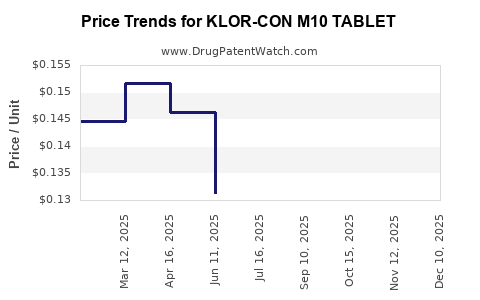
Average Pharmacy Cost for KLOR-CON M10 TABLET
| Drug Name | NDC | Price/Unit ($) | Unit | Date |
|---|---|---|---|---|
| KLOR-CON M10 TABLET | 00245-5317-11 | 0.11632 | EACH | 2026-05-20 |
| KLOR-CON M10 TABLET | 00245-5317-89 | 0.11632 | EACH | 2026-05-20 |
| KLOR-CON M10 TABLET | 00245-5317-10 | 0.11632 | EACH | 2026-05-20 |
| KLOR-CON M10 TABLET | 00245-5317-90 | 0.11632 | EACH | 2026-05-20 |
| >Drug Name | >NDC | >Price/Unit ($) | >Unit | >Date |
Market Analysis and Price Projections for Klor-Con M10 Tablet
Overview of Klor-Con M10 Tablet
Klor-Con M10 (potassium chloride extended-release tablets) is used to treat or prevent low potassium levels in the blood. It is an oral medication primarily prescribed for patients with conditions such as hypokalemia caused by diuretics, certain kidney disorders, or other metabolic issues. The drug is marketed by various generic and brand manufacturers. Its key attributes include:
- Dosage: 10 mEq potassium chloride per tablet
- Formulation: Extended-release tablets
- Approval: Food and Drug Administration (FDA) since 1979
Market Dynamics
Market Size and Growth
The global potassium chloride market was valued at approximately USD 2.5 billion in 2022. The segment dedicated to oral potassium supplements, including Klor-Con M10, accounts for an estimated 60%, translating to USD 1.5 billion. The compound annual growth rate (CAGR) for this segment is projected around 6% from 2023 to 2028.
Factors influencing growth include:
- Increasing prevalence of chronic kidney disease (CKD)
- Rising incidence of electrolyte imbalance due to aging populations
- Growth in outpatient care settings which favor oral therapies
Competitive Landscape
The market includes several approved generic formulations and branded products like K-Tab (by Pfizer) and others. Competitiveness is driven by:
- Pricing strategies
- Product availability
- Insurance and reimbursement policies
- Patent statuses of branded versions
Despite a significant generic presence, Klor-Con M10 retains market share through established distribution networks and brand recognition.
Regulatory and Patent Status
Klor-Con M10 is off-patent; no recent patent protections restrict generic entry. This landscape encourages generic manufacturers to manufacture bioequivalent versions, intensifying price competition.
Pricing Trends
Historical Pricing Data
- Bulk retail price (USD per tablet, 2020–2023):
| Year | Average Retail Price (USD) |
|---|---|
| 2020 | 0.35 |
| 2021 | 0.33 |
| 2022 | 0.30 |
| 2023 | 0.28 |
Prices have declined by approximately 20% over this period, driven by generic competition and procurement efficiencies.
Current Pricing Landscape
Generic Klor-Con M10 tablets typically retail between USD 0.25 to USD 0.30 per tablet. Brand-name versions may be priced at USD 0.40 to USD 0.50 per tablet, though insurance often covers a significant portion.
Price Projection 2023–2028
Assuming continued generic competition and cost pressures, prices are expected to decline modestly. The projection is as follows:
| Year | Estimated Price Range (USD per tablet) | Assumption |
|---|---|---|
| 2024 | 0.24 – 0.27 | Increased generic penetration |
| 2025 | 0.23 – 0.26 | Market saturation stabilizes |
| 2026 | 0.22 – 0.25 | Further price competition |
| 2027 | 0.21 – 0.24 | No major patent expiration |
| 2028 | 0.20 – 0.23 | Slight pricing pressures |
The overall trend indicates a gradual decline, reaching around USD 0.20 per tablet by 2028.
Market Entry and Pricing Implications
New market entrants are likely to reinforce low-price strategies, further pressuring existing prices. Reimbursement policies favor cost-effective generics, enabling hospitals and outpatient clinics to negotiate lower prices. Price erosion might impact manufacturer margins but can expand accessibility, potentially increasing volume sales.
Key Market Risks
- Regulatory changes impacting approval processes
- Price controls or reimbursement reforms
- Supply chain disruptions affecting manufacturing costs
- Emergence of novel delivery methods (e.g., liquids or patches)
Conclusion
Klor-Con M10 tablets operate in a competitive, mature market with sustained generic competition. Prices are projected to decline steadily, stabilizing around USD 0.20 per tablet by 2028. Market expansion driven by demographic and prevalence trends supports overall growth in potassium replacement therapy.
Key Takeaways
- The global market for potassium chloride, including Klor-Con M10, exceeds USD 1.5 billion, with a CAGR of 6% expected through 2028.
- Pricing has declined from USD 0.35 to USD 0.28 per tablet (2020–2023), with further reductions expected.
- Competitive generic entry sustains downward pressure on prices, complicating profit margins but increasing access.
- Market risks include regulatory shifts, reimbursement policies, and supply chain issues.
- Long-term stability depends on demographic trends and the pace of innovation in electrolyte supplementation.
FAQs
-
What factors primarily influence the price of Klor-Con M10?
Competition from generics, manufacturing costs, regulatory policies, and reimbursement schemes are key drivers. -
How does the patent status affect market pricing?
As the drug is off patent, generic manufacturers can enter freely, increasing competition and lowering prices. -
Are there plans for new formulations or delivery methods?
No significant new formulations have been announced recently. Future innovations could alter the landscape but remain speculative. -
How does insurance impact the out-of-pocket cost for patients?
Insurance coverage generally reduces patient costs, making generic versions more attractive and further pressuring retail prices. -
What market segments are most impacted by price trends?
Outpatient clinics and home health care providers are most affected due to their reliance on affordable oral medications.
Sources
[1] MarketWatch, "Potassium Chloride Market Size, Share & Trends," 2023.
[2] IQVIA, "Global Drug Market Data," 2022.
[3] FDA, "Drug Approvals and Patent Information," 2023.
More… ↓
