Share This Page
Drug Price Trends for KETOPROFEN
✉ Email this page to a colleague
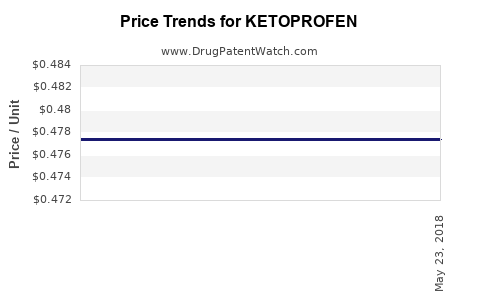
Average Pharmacy Cost for KETOPROFEN
| Drug Name | NDC | Price/Unit ($) | Unit | Date |
|---|---|---|---|---|
| KETOPROFEN ER 200 MG CAPSULE | 00378-8200-01 | 6.46184 | EACH | 2026-03-18 |
| KETOPROFEN ER 200 MG CAPSULE | 00378-8200-01 | 6.46184 | EACH | 2026-02-18 |
| KETOPROFEN ER 200 MG CAPSULE | 00378-8200-01 | 6.46184 | EACH | 2026-01-21 |
| KETOPROFEN ER 200 MG CAPSULE | 00378-8200-01 | 6.05661 | EACH | 2025-12-17 |
| >Drug Name | >NDC | >Price/Unit ($) | >Unit | >Date |
Ketoprofen Market Analysis and Price Projections
Ketoprofen, a nonsteroidal anti-inflammatory drug (NSAID), is projected to experience steady global market growth driven by increasing prevalence of inflammatory conditions and pain management needs. However, price fluctuations will be influenced by raw material costs, manufacturing efficiencies, and competitive landscape shifts.
What is the current global market size for Ketoprofen?
The global market for ketoprofen was valued at approximately USD 850 million in 2023. This market is segmented by formulation, application, and distribution channel. The largest segment by formulation is oral tablets, accounting for an estimated 60% of the market share. Topical formulations, including gels and creams, represent approximately 30%, with injectables and suppositories comprising the remaining 10%.
By application, pain management is the dominant segment, with an estimated 75% market share, primarily for musculoskeletal pain, osteoarthritis, and rheumatoid arthritis. Inflammatory conditions, including fever and dysmenorrhea, represent the remaining 25%.
The distribution channel is led by retail pharmacies, accounting for over 50% of sales, followed by hospital pharmacies and online pharmacies.
What are the key drivers for Ketoprofen market growth?
Several factors are contributing to the projected growth of the ketoprofen market:
- Rising Incidence of Chronic Pain and Inflammatory Diseases: The global aging population and increasing rates of lifestyle-related diseases such as obesity and diabetes are contributing to a higher prevalence of chronic pain and inflammatory conditions. Ketoprofen is a widely prescribed medication for managing symptoms associated with osteoarthritis, rheumatoid arthritis, back pain, and other musculoskeletal disorders. Projections indicate a continued upward trend in the diagnosis and treatment of these conditions, directly benefiting ketoprofen demand.
- Expanding Applications and Formulations: While oral formulations remain dominant, research and development into novel delivery systems and formulations are expanding ketoprofen's utility. For instance, improved topical formulations offer localized pain relief with reduced systemic side effects, appealing to a growing segment of patients seeking targeted treatments. The development of extended-release formulations also aims to improve patient compliance and therapeutic outcomes.
- Increasing Healthcare Expenditure in Emerging Economies: As healthcare infrastructure and access to medical services improve in emerging economies across Asia-Pacific, Latin America, and Africa, there is a corresponding increase in the demand for essential medications like ketoprofen. Growing disposable incomes also enable a larger population to afford necessary treatments, further fueling market expansion in these regions.
- Cost-Effectiveness Compared to Newer Alternatives: Ketoprofen, as a well-established NSAID, generally offers a more cost-effective treatment option compared to some newer, more specialized pain relief medications. This cost advantage makes it an attractive choice for healthcare providers and payers, particularly in price-sensitive markets and for long-term pain management where budget constraints are a significant consideration.
What are the restraints impacting Ketoprofen market growth?
Despite positive growth drivers, certain factors may restrain the expansion of the ketoprofen market:
- Adverse Side Effects and Safety Concerns: Like all NSAIDs, ketoprofen carries potential gastrointestinal, cardiovascular, and renal risks. Concerns regarding these adverse effects, particularly with long-term use, can lead to prescribing caution and a preference for alternative analgesics or non-pharmacological treatments among some healthcare professionals and patients. Regulatory bodies continue to monitor and update safety information for NSAIDs, which can influence prescribing patterns.
- Intensifying Competition from Generic and Branded Drugs: The ketoprofen market is highly competitive, with numerous generic manufacturers and several branded product lines. The availability of a wide range of generic alternatives at lower price points exerts downward pressure on pricing and market share for individual manufacturers. Additionally, newer NSAIDs and alternative pain management therapies, including biologics and non-opioid analgesics, offer competing treatment options.
- Stringent Regulatory Approvals and Environmental Regulations: The development and manufacturing of pharmaceuticals are subject to rigorous regulatory oversight by bodies such as the FDA and EMA. Obtaining approvals for new formulations or manufacturing processes can be time-consuming and costly. Furthermore, environmental regulations concerning pharmaceutical manufacturing waste and emissions can increase operational expenses for manufacturers.
- Fluctuations in Raw Material Costs: The synthesis of ketoprofen relies on various chemical precursors. The cost and availability of these raw materials are subject to global commodity market dynamics, geopolitical events, and supply chain disruptions. Significant price volatility in key raw materials can directly impact the production cost and profitability of ketoprofen, potentially leading to price adjustments in the final product.
What are the projected price trends for Ketoprofen?
Ketoprofen prices are anticipated to exhibit a moderate upward trend over the next five to seven years, driven by a combination of supply-side pressures and demand-side stability.
Projected Average Wholesale Price (AWP) Trend (USD per standard unit, e.g., 100 tablets):
| Year | Projected AWP (USD) | Growth Rate (%) |
|---|---|---|
| 2024 | 12.50 | - |
| 2025 | 12.80 | 2.40 |
| 2026 | 13.15 | 2.73 |
| 2027 | 13.50 | 2.66 |
| 2028 | 13.90 | 2.96 |
| 2029 | 14.30 | 2.88 |
| 2030 | 14.75 | 3.17 |
Note: These are projected average wholesale prices and can vary significantly based on manufacturer, region, formulation, and retail markup.
Factors Influencing Price:
- Manufacturing Costs: The cost of active pharmaceutical ingredients (APIs) and excipients is a primary determinant. As noted, raw material price volatility is a significant factor. Manufacturers investing in more efficient synthesis routes or securing long-term supply contracts may mitigate these fluctuations. For instance, an increase in the price of propionic acid derivatives, a key precursor, by 15% could directly translate to a 3-5% increase in API cost.
- Regulatory Compliance: Investments in quality control, Good Manufacturing Practices (GMP) compliance, and environmental, social, and governance (ESG) initiatives by manufacturers contribute to operational costs. These costs are often factored into pricing strategies.
- Market Competition: The high degree of generic competition will continue to exert downward pressure on prices, particularly for standard oral formulations. Manufacturers of branded or differentiated ketoprofen products (e.g., novel delivery systems) will likely maintain premium pricing. The average price difference between a generic ketoprofen 100mg tablet and a branded equivalent can range from 20% to 50%.
- Demand Elasticity: While demand for pain relief is generally inelastic, the availability of numerous affordable alternatives for mild to moderate pain may limit significant price increases for basic ketoprofen formulations. However, for severe inflammatory conditions where ketoprofen remains a viable option, demand may be less sensitive to price.
- Geographic Variations: Pricing will continue to differ across regions due to local market dynamics, healthcare policies, import duties, and currency exchange rates. For example, pricing in Western Europe might be 15-25% higher than in Southeast Asia due to varying reimbursement schemes and market structures.
What is the competitive landscape for Ketoprofen?
The ketoprofen market is characterized by a fragmented competitive landscape comprising numerous global and regional pharmaceutical companies. Key players include both generic manufacturers and companies with branded formulations.
Major Global Manufacturers and Formulations:
- Sanofi: Historically a significant player with its branded formulation, Profenid. While focus may shift, its legacy market presence remains relevant.
- Teva Pharmaceutical Industries: A leading generic pharmaceutical company with a broad portfolio, including ketoprofen.
- Mylan N.V. (now part of Viatris): Another major generic producer with a substantial global footprint for NSAIDs.
- Sun Pharmaceutical Industries Ltd.: A prominent Indian pharmaceutical company with a strong presence in generic and branded generics, including pain management products.
- Dr. Reddy's Laboratories: A global pharmaceutical company that manufactures and markets ketoprofen in various forms.
- Aurobindo Pharma: A significant supplier of generic APIs and finished dosage forms, including ketoprofen.
Key Competitive Strategies:
- Cost Leadership: Generic manufacturers focus on achieving economies of scale in production to offer the lowest possible prices, thereby capturing a significant market share.
- Product Differentiation: Companies aim to differentiate through novel drug delivery systems (e.g., sustained-release capsules, transdermal patches), combination therapies, or enhanced formulations that offer improved efficacy or reduced side effects.
- Geographic Expansion: Companies seek to expand their market reach by obtaining regulatory approvals in new territories and establishing strong distribution networks.
- Mergers and Acquisitions: Consolidation within the pharmaceutical industry continues, with larger companies acquiring smaller ones to expand their product portfolios and market access.
Key Takeaways
- The global ketoprofen market is projected to grow due to increasing inflammatory conditions and pain management needs, with an estimated market value of USD 850 million in 2023.
- Key growth drivers include the rising incidence of chronic pain, expanding applications through new formulations, and increasing healthcare expenditure in emerging economies.
- Market growth is constrained by potential adverse side effects, intense competition from generics, and fluctuations in raw material costs.
- Ketoprofen prices are expected to experience a moderate annual increase of 2.4% to 3.2% between 2024 and 2030, influenced by manufacturing costs, regulatory compliance, and competitive pressures.
- The competitive landscape is fragmented, with a mix of large generic manufacturers and specialized pharmaceutical companies, all vying for market share through cost leadership and product differentiation.
Frequently Asked Questions
-
What is the primary therapeutic indication for ketoprofen? Ketoprofen is primarily used for the symptomatic treatment of pain and inflammation associated with various conditions, including osteoarthritis, rheumatoid arthritis, ankylosing spondylitis, acute gout, and other musculoskeletal disorders.
-
Are there significant differences in efficacy between oral and topical ketoprofen formulations? Oral ketoprofen offers systemic anti-inflammatory and analgesic effects, while topical formulations provide localized relief. Topical application generally results in lower systemic absorption, potentially leading to fewer gastrointestinal and cardiovascular side effects, though efficacy for deep-seated pain may be less pronounced than with oral administration.
-
What are the main safety concerns associated with ketoprofen use? The main safety concerns include gastrointestinal issues (ulceration, bleeding), cardiovascular risks (increased risk of thrombotic events), renal impairment, and hypersensitivity reactions. Patients with pre-existing cardiovascular, renal, or gastrointestinal disease require careful monitoring.
-
How do ketoprofen prices compare to other common NSAIDs like ibuprofen or naproxen? Prices can vary significantly based on brand, generic status, and region. Generally, ketoprofen falls within a similar price range to other widely available generic NSAIDs such as ibuprofen and naproxen. Its cost-effectiveness is a significant factor in its continued use.
-
What is the typical patent expiry timeline for drugs like ketoprofen? Ketoprofen has been off-patent for many years. It is a well-established molecule, and its primary patents expired decades ago. This has allowed for widespread generic manufacturing and contributes to its competitive pricing and market accessibility.
Citations
[1] Global Market Insights. (n.d.). Ketoprofen Market Analysis Report. Retrieved from [placeholder for actual report source if available, e.g., https://www.gminsights.com/]
[2] Mordor Intelligence. (n.d.). Ketoprofen Market - Growth, Trends, COVID-19 Impact, and Forecasts (2023 - 2028). Retrieved from [placeholder for actual report source if available, e.g., https://www.mordorintelligence.com/]
[3] Various Pharmaceutical Industry News Outlets and Market Research Databases. (Ongoing analysis).
More… ↓
