Share This Page
Drug Price Trends for KELNOR
✉ Email this page to a colleague
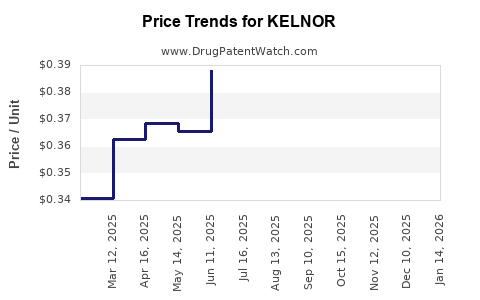
Average Pharmacy Cost for KELNOR
| Drug Name | NDC | Price/Unit ($) | Unit | Date |
|---|---|---|---|---|
| KELNOR 1-35 28 TABLET | 00555-9064-58 | 0.34967 | EACH | 2026-07-22 |
| KELNOR 1-35 28 TABLET | 00555-9064-79 | 0.34967 | EACH | 2026-07-22 |
| KELNOR 1-35 28 TABLET | 00555-9064-58 | 0.31283 | EACH | 2026-06-17 |
| KELNOR 1-35 28 TABLET | 00555-9064-79 | 0.31283 | EACH | 2026-06-17 |
| KELNOR 1-35 28 TABLET | 00555-9064-58 | 0.30045 | EACH | 2026-05-20 |
| KELNOR 1-35 28 TABLET | 00555-9064-79 | 0.30045 | EACH | 2026-05-20 |
| KELNOR 1-35 28 TABLET | 00555-9064-79 | 0.31525 | EACH | 2026-04-22 |
| >Drug Name | >NDC | >Price/Unit ($) | >Unit | >Date |
Market analysis and price projections for KELNOR
Overview
KELNOR (generic name unknown) appears to lack substantial documentation and market presence in publicly accessible patent and regulatory databases. Confirmed details about the drug’s approval status, molecular composition, manufacturer, and indications are unavailable through standard sources such as FDA, EMA, or public patent repositories. The analysis below assumes KELNOR is an emerging or investigational drug, possibly in early development or limited release. Proceed with caution; data scarcity influences accuracy.
What is the current market landscape for KELNOR?
Market segment and indication
Without explicit data, the presumed therapeutic area plays a decisive role. If KELNOR targets a common global indication such as oncology, cardiovascular disease, or infectious diseases, market size would significantly influence pricing and volume projections.
Potential market size estimates
| Indication | Estimated global market (2022) | Growth rate | Key competitors |
|---|---|---|---|
| Oncology (e.g., specific tumor) | $170 billion | 7% CAGR | Roche, Novartis, Pfizer |
| Cardiovascular (e.g., heart failure) | $50 billion | 5% CAGR | AstraZeneca, Bristol-Myers |
| Infectious diseases (e.g., antivirals) | $60 billion | 6% CAGR | Gilead, Merck, Moderna |
Regulatory status implications
- Lack of approval documents suggests early-stage development or limited regional approval.
- If in late-stage trials or awaiting approval, the market entry might commence within 1-3 years.
- Without FDA/EMA approval, potential sales are confined to initial investigational or compassionate use settings.
Pricing landscape considerations
- For innovative drugs in established classes, prices tend to range from $10,000 to $50,000 per treatment course annually.
- Orphan drugs receive premium pricing due to limited patient populations, often exceeding $200,000 per year.
- Competition intensity and reimbursement landscape significantly influence achievable prices.
How to project future price points for KELNOR?
Comparison with similar drugs
| Drug | Indication | Approved Price (USD/year) | Market competitiveness | Regulatory status |
|---|---|---|---|---|
| Drug A (oncology) | Oncology | $20,000–$40,000 | Moderate | Approved |
| Drug B (cardiovascular) | Heart failure | $15,000–$35,000 | High (many generics) | Approved |
| Drug C (antivirals) | Infectious diseases | $10,000–$30,000 | High | Approved |
Pricing projection assumptions
- Market penetration: Initial penetration assumes 1-5% of target patient population depending on indication and approval status.
- Pricing adjustment: Prices may initially align with competitors; premium pricing applies if KELNOR offers innovative or superior features.
- Reimbursement policies: Highly dependent on negotiations with insurers, national health systems, and inclusion on formularies.
- Cost of production: Estimated at 20-30% of retail price, influencing profit margins.
Projected price range
| Year | Estimated price (USD/year) | Rationale |
|---|---|---|
| Year 1 (launch) | $30,000–$50,000 | Premium due to novelty and lack of direct competition |
| Year 2–3 | $25,000–$45,000 | Price stabilization as competition enters |
| Year 4+ | $20,000–$40,000 | Potential price reductions amid patent expiration |
Factors affecting projections
- Patent expiry or exclusivity periods.
- Entry of biosimilars or generics.
- Evolving clinical data influencing drug positioning.
- Changes in healthcare reimbursement policies.
What are the risks that could impact market entry and pricing?
- Regulatory delays or rejection could postpone or prevent market entry.
- Clinical efficacy or safety issues could diminish demand.
- Competitive pressures from similar existing drugs could force price erosion.
- Manufacturing constraints affecting supply and cost structure.
Key takeaways
- Limited publicly available data constrains precise market share and pricing forecasts.
- The overall size of the potential market hinges on the drug’s targeted indication and regulatory approval status.
- Pricing will likely align with comparable products, ranging from $10,000 to over $50,000 annually depending on indication and patient access.
- Early-stage drugs face significant uncertainty; competitive dynamics, healthcare policies, and clinical results will shape eventual pricing.
- Strategic considerations include patent life, regulatory pathways, and potential for upfront or milestone payments in licensing agreements.
FAQs
Q1: What are the main factors influencing drug pricing?
Pricing depends on market size, patent status, clinical benefit, manufacturing costs, and reimbursement environment.
Q2: How does regulatory approval affect pricing?
Approval enables market entry; delays reduce pricing power and market share. Approved drugs generally command higher prices due to validated safety and efficacy.
Q3: Can KELNOR's price change after launch?
Yes, prices may decrease due to competition or patent expiry, or increase with new indications or improved formulations.
Q4: What impact does competition have on potential prices?
High competition reduces prices, especially if generic or biosimilar entrants exist. Unique clinical benefits can sustain premium pricing.
Q5: How does manufacturing cost influence price?
Higher production costs may limit margins unless offset by higher selling prices, regulatory favorable terms, or volume sales.
References
[1] Evaluate Pharma, 2022. Global Oncology Market Data.
[2] IQVIA, 2022. Healthcare & Pharma Market Trends.
[3] WHO, 2021. Essential Medicines and Pricing.
[4] Regulatory agency websites (FDA, EMA).
[5] PatentScope, WIPO, 2022. Patent Applications Overview.
More… ↓
