Last updated: February 12, 2026
What is JULUCA?
JULUCA (rilpivirine and cabotegravir) is an antiretroviral (ARV) combo designed for the treatment of HIV-1. It is administered via long-acting injectable formulations, with rilpivirine given monthly and cabotegravir every two months. Approved by the U.S. Food and Drug Administration (FDA) in January 2021, JULUCA offers an alternative to daily oral HIV therapy.
Market Overview
Current Market Size
The global HIV treatment market was valued at approximately $25 billion in 2022, projected to reach $35 billion by 2030, growing at a CAGR of 4.3% (CAGR based on industry reports). The segment for long-acting injectables includes therapies such as JULUCA and others like GSK’s Cabenuva.
Key Competitors
- Cabenuva (cabotegravir and rilpivirine): Developed by ViiV Healthcare, authorized in 2020.
- Descovy (emtricitabine and tenofovir alafenamide): Still in oral form, dominant in daily regimens.
- BIC/FTC/TAF: Bictegravir/emtricitabine/tenofovir alafenamide, used in daily pills.
Adoption Drivers
- Preference among patients for less frequent dosing.
- Improved adherence and reduced stigma.
- Advocacy for long-acting options, especially in marginalized populations.
Regulatory and Reimbursement Policies
- Approval is primarily in the U.S. and Europe.
- Insurance coverage varies; payers like CVS, UnitedHealthcare, and Anthem include JULUCA in formularies.
- Price and reimbursement negotiations influence market penetration.
Price Projections
Current Pricing
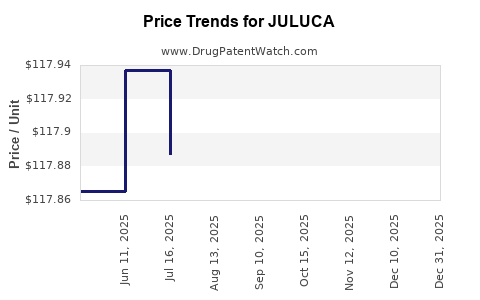
As of 2023, the wholesale acquisition cost (WAC) for JULUCA is approximately $3,600 per month, consistent with other long-acting injectables. This pricing compares to daily oral regimens that cost roughly $2,500–$3,000 annually per patient, taking into account medication and associated healthcare costs.
Short-term Outlook (2023–2025)
- Price stabilization expected for 2023–2024. The initial pricing reflects the high development costs, limited competition, and premium positioning.
- Market penetration limited by logistical challenges of injections (clinic visits) and patient preferences.
- Volume growth projected at 10-15% annually as awareness and access increase, depending on regional approval status.
Long-term Price Trends (2025–2030)
-
Potential price reductions of 10-20% expected by 2027, driven by:
- Production efficiencies.
- Competition from biosimilars or new entrants.
- Negotiation pressure from payers.
-
Emerging competitors or formulations could impact pricing if they offer more convenient or lower-cost alternatives.
Factors Influencing Price Dynamics
| Factor |
Impact |
Notes |
| Market competition |
Drives pricing down |
Entry of generics or biosimilars |
| Payer negotiations |
Can lower list prices |
Contracting, formulary decisions |
| Manufacturing costs |
Affect margins |
Increased scale will reduce costs |
| Regulatory environment |
Impacts approval and access |
Faster approvals could expand market |
Market Forecasts and Growth Potential
- By 2030, the long-acting ARV segment could account for approximately 30% of the total HIV treatment market, assuming continued growth in injectable adoption.
- The global rollout is expected mainly in high-income countries initially, with expanding access in emerging markets by 2026–2028.
Key Challenges and Opportunities
Challenges
- Limited clinic capacity for injections.
- Patient resistance to injectable therapy.
- High initial costs and reimbursement hurdles.
- Competition from oral regimens and future long-acting options.
Opportunities
- Expansion into broader patient populations, including those intolerant to oral therapy.
- Potential for combination with other long-acting agents.
- Increasing acceptance in underserved markets.
Key Takeaways
- JULUCA's current WAC is around $3,600/month, with prospects for modest price reductions as the market matures.
- Long-acting injectables are projected to grow as a share of HIV therapy, reaching roughly 30% of the market by 2030.
- Competition, payer negotiations, and manufacturing efficiencies will shape future pricing.
- Market growth depends heavily on patient acceptance, infrastructure availability, and regulatory landscape.
FAQs
1. How does JULUCA compare in price to daily oral HIV therapies?
JULUCA's monthly cost (~$3,600) is significantly higher than daily oral regimens, which typically cost $2,500–$3,000 annually, but its value proposition hinges on adherence and convenience.
2. What factors could lead to a price decline for JULUCA?
Entry of biosimilars, increased production efficiency, competition, and payer negotiations are primary drivers that may reduce prices.
3. Which markets are most promising for JULUCA?
High-income countries like the U.S., Canada, and parts of Europe lead adoption due to healthcare infrastructure. Emerging markets could follow once prices decline or as access expands.
4. What are the main barriers to adoption?
Clinic logistics, patient resistance to injections, higher upfront costs, and insurance coverage issues limit rapid adoption.
5. How significant is the long-acting ARV segment in the HIV market?
Projected to reach roughly 30% of the total HIV treatment market by 2030, reflecting growing preference for less frequent dosing options.
References
- IQVIA, "Global HIV Market Review," 2022.
- ViiV Healthcare, FDA approval documents for JULUCA, 2021.
- EvaluatePharma, "Long-Acting HIV Market Outlook," 2023.
- WHO, "HIV/AIDS Treatment Guidelines," 2022.
- MarketResearch.com, "Long-Acting HIV Therapeutics," 2023.