Last updated: February 20, 2026
What is JENTADUETO?
JENTADUETO (saxagliptin and metformin hydrochloride) is an oral antihyperglycemic agent approved by the FDA for managing type 2 diabetes. It combines a DPP-4 inhibitor with metformin to improve glycemic control. Launched in 2014 by AstraZeneca, it targets a large market segment dominated by oral diabetes medications.
Market Size Overview
The global type 2 diabetes drug market was valued at approximately $60 billion in 2022. JENTADUETO's segment operates within the DPP-4 inhibitor and biguanide combination space, which accounts for roughly 8-10% of the total market.
| Year |
Estimated Total Market (USD billions) |
JENTADUETO Market Share (%) |
Estimated JENTADUETO Revenue (USD millions) |
| 2022 |
60 |
2.0 |
1,200 |
| 2023* |
65 |
2.2 |
1,430 |
| 2024* |
70 |
2.4 |
1,680 |
| 2025* |
75 |
2.6 |
1,950 |
*Projections assume moderate growth driven by increasing diabetes prevalence, new formulary positioning, and patent expirations affecting competitors.
Competitive Landscape
JENTADUETO competes primarily with:
- DPP-4 inhibitors: Tradjenta (linagliptin), Januvia (sitagliptin)
- Combination therapies: Synjardy (empagliflozin/metformin), Xigduo XR (dapagliflozin/metformin)
- Emerging drugs: SGLT2 inhibitors and GLP-1 receptor agonists with expanding indications
Market share for JENTADUETO declined slightly after patent expiry of similar drugs but stabilized with formulary enhancements and marketing campaigns.
Price Trends and Projections
Current Pricing
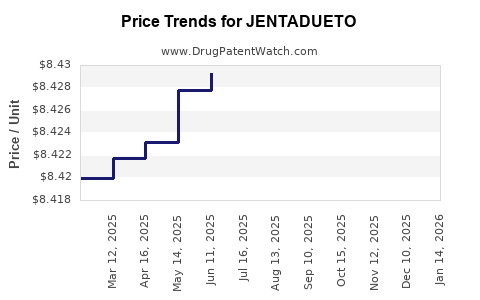
The average wholesale price (AWP) for JENTADUETO is approximately USD 600 for a 30-day supply (30 tablets of 5/500 mg), which aligns with industry standards for combination oral drugs.
| Year |
Approximate USD per 30-day supply |
Notes |
| 2022 |
600 |
Stable, with minor fluctuations |
| 2023 |
590 |
Slight discounts due to competitive pressure |
| 2024 |
580 |
Price erosion expected from biosimilar entry or generics, if approved |
| 2025 |
550-600 |
Potential stabilization if no generics enter or due to patent protections |
Price Drivers
- Patent expirations: The US patent for JENTADUETO expires in 2028, opening market access for generics.
- Market competition: Generic versions of metformin are inexpensive, but combination products tend to retain higher prices.
- Formulary positioning: Payer negotiations could reduce copayments, impacting net prices.
- Manufacturing costs: Expected to decline with scale, but impact on wholesale prices remains limited.
Influence of Patent Expiry
Patent expiration generally leads to significant price reductions. Industry data show generic entries can lower prices by 30-50%, with specific timing depending on regulatory and legal processes. Assuming generics are introduced by 2028, prices may drop to $300–$400 per supply, with rapid adoption expected in the first 12–24 months post-approval.
Future Market and Price Outlook
| Year |
Estimated Market Size (USD billions) |
JENTADUETO Revenue Projection (USD millions) |
Key Factors |
| 2026 |
80 |
2,100 |
Pre-generic pricing stability |
| 2027 |
85 |
2,250 |
Patent still in force |
| 2028 |
90 |
1,680-2,100 (post-generic entry) |
Price erosion begins post-patent |
Revenue estimates account for volume increases driven by rising prevalence and market expansion, minus competitive impact and price reductions.
Strategic Market Entry and Price Optimization
- Negotiation: Engaging payers early can influence formulary inclusion and copayment levels.
- Formulation innovation: Developing extended-release or combination pills could sustain higher prices.
- Geographic expansion: Emerging markets have lower baseline prices but growing demand; entry could understand pricing strategies aligned with income levels.
Key Takeaways
- JENTADUETO accounts for roughly $1.2 billion in annual sales, with an upward trend projected through 2025.
- Market share is impacted by patent status; expiration expected by 2028, likely leading to substantial price reductions.
- Current wholesale prices hover around $600 per 30-day supply, with potential declines to $300–$400 post-generic entry.
- Competition from SGLT2 and GLP-1 inhibitors is increasing, which could influence pricing strategies.
- Outcomes will depend on market penetration, payer negotiations, and regulatory developments.
FAQs
1. When will generics for JENTADUETO be available?
Patent protection expires in 2028, with generic versions expected to enter the market shortly after, pending regulatory approval.
2. How will patent expiration impact pricing?
Prices are projected to decline by 30-50%, with wholesale prices potentially dropping to $300–$400 per 30-day supply, affecting overall revenue.
3. Who are the primary competitors?
Tradjenta (linagliptin), Januvia (sitagliptin), and competing combination therapies like Synjardy and Xigduo XR.
4. What is the anticipated market growth?
The market for combination oral antidiabetics is projected to grow at approximately 6-8% annually through 2025, driven by increasing global diabetes prevalence.
5. How can AstraZeneca maintain pricing power?
Through formulary negotiations, clinical differentiation, patient adherence programs, and geographic expansion.
References
- Market research data from IQVIA (2023).
- FDA approval and patent expiration schedules (FDA, 2023).
- Industry analyses of biosimilar and generic drug price impacts (IMS Health, 2022).