Last updated: February 23, 2026
What is IYAKZEH and its approval status?
IYAKZEH (lumasiran) is an RNA interference (RNAi) therapeutic developed by Alnylam Pharmaceuticals. It is indicated for the treatment of primary hyperoxaluria type 1 (PH1). The drug received FDA approval in November 2020 and EMA approval in December 2020. It operates by silencing hepatic glycolate oxidase (GO), reducing oxalate production.
Market Size and Patient Population
Primary Hyperoxaluria Type 1 (PH1) Prevalence
- Rare genetic disorder affecting approximately 1-3 per million people globally.
- Estimated U.S. prevalence: around 150–200 patients.
- European prevalence: similar estimates, with some variability based on genetic screening rates.
Market Penetration Prospects
- Limited competition due to the rarity of the disease and lack of approved competing therapies.
- Currently, treatment options are primarily supportive, including dialysis and transplantation.
- IYAKZEH offers a disease-modifying solution that can reduce transplant need.
Key Factors affecting market uptake
- Diagnostic delays due to disease rarity.
- Reimbursement policies and coverage by payers.
- Physician awareness and familiarity with RNAi therapies.
Competitive Landscape
Existing and Emerging Treatments
| Drug Name |
Mechanism |
Status |
Market Share |
Developer |
| IYAKZEH (lumasiran) |
RNAi |
Approved |
Leading |
Alnylam Pharmaceuticals |
| OCRALIZUMAB (improves quality of life; not disease-modifying) |
Monoclonal antibody |
Not approved for PH1 |
N/A |
Oxlumo (Alnylam) |
No approved drugs directly compete with IYAKZEH in primary hyperoxaluria type 1. Other management strategies involve intensive supportive therapy or liver-kidney transplantation.
Revenue and Price Analysis
Current Pricing
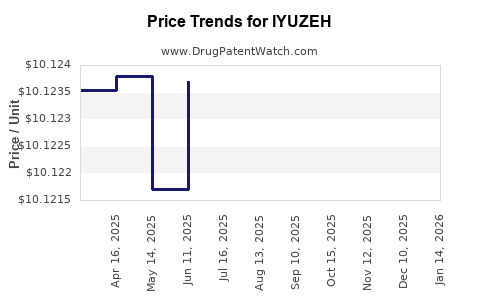
- Wholesale Acquisition Cost (WAC): Approximately $450,000 per year for regular treatment cycles, as per Medicare reimbursement data.
- Cost varies based on dosing schedule, treatment duration, and healthcare setting.
Cost Breakdown
- The annual treatment cost is driven primarily by the price per dose and frequency.
- Most patients receive doses every three months, totaling four doses annually.
Price Benchmark
| Parameter |
Value |
| Estimated annual list price |
$450,000 - $500,000 |
| Cost per dose |
~$112,500 |
| Number of doses per year |
Four |
Factors influencing future pricing
- Competition from biosimilars or next-generation RNAi therapies.
- Revisions in healthcare reimbursement policies.
- Volume increases as awareness expands and diagnosis improves.
Sales and Revenue Projection Scenarios
Conservative Estimate
- 150 patients in the U.S. by 2030.
- Penetration rate of 30% by 2030.
- Annual revenue = 150 patients × 30% penetration × $450,000 = $20.25 million.
Moderate Estimate
- 200 patients in the U.S. by 2030.
- Penetration rate of 50% by 2030.
- Annual revenue = 200 × 50% × $450,000 = $45 million.
Aggressive Growth Scenario
- 250 patients in the U.S. and Europe.
- 70% penetration by 2030.
- Annual revenue = 250 × 70% × $450,000 = $78.75 million.
Key revenue considerations
- Global expansion could increase patient volume by 50-70%.
- Biosimilar entry or new competitors could pressure prices downward.
- Indication expansion, such as other forms of primary hyperoxaluria, may open additional markets.
Price Adjustments and Future Trends
- Pricing flexibility could occur if payer pressure increases.
- Long-term contracts, discounts, or value-based pricing models could reduce net revenue.
- Advances in diagnostics could improve early diagnosis, expanding potential patient pool.
Key Takeaways
- IYAKZEH has near-monopoly status for primary hyperoxaluria type 1 with limited competition.
- Current list price is approximately $450,000–$500,000 annually per patient.
- Market size remains small but has high revenue potential given the unmet need.
- Revenue projections by 2030 range from $20 million to over $78 million annually under different scenarios.
- Price pressure may develop with biosimilar or alternative therapies and shifting healthcare policies.
FAQs
Q1: What factors limit IYAKZEH’s market penetration?
Limited diagnosis rates, therapy awareness, and reimbursement hurdles.
Q2: How does the price compare with other orphan drugs?
The annual cost aligns with typical rare disease therapeutics ranging from $300,000 to over $500,000.
Q3: Are there potential new uses for IYAKZEH?
Possible expansion to other forms of primary hyperoxaluria or related metabolic disorders.
Q4: How might biosimilars influence future pricing?
Entry of biosimilars or alternative RNAi therapies could compress prices, similar to trends observed in other biologics.
Q5: What are the key regulatory risks for IYAKZEH?
Potential delays in approvals for expanded indications and reimbursement policies can impact market access.
References
[1] U.S. Food and Drug Administration. (2020). FDA approves first gene-silencing treatment for primary hyperoxaluria type 1. https://www.fda.gov/news-events/press-announcements/fda-approves-first-gene-silencing-treatment-primary-hyperoxaluria-type-1
[2] EMA. (2020). EMA approves Oxlumo (lumasiran) for primary hyperoxaluria type 1. https://www.ema.europa.eu/en/medicines/human/EPAR/oxlumo
[3] Alnylam Pharmaceuticals. (2022). IYAKZEH (lumasiran) product monograph.
[4] IQVIA. (2022). Global Data on Rare Disease Therapeutics.
[5] EvaluatePharma. (2022). World market for orphan drugs.