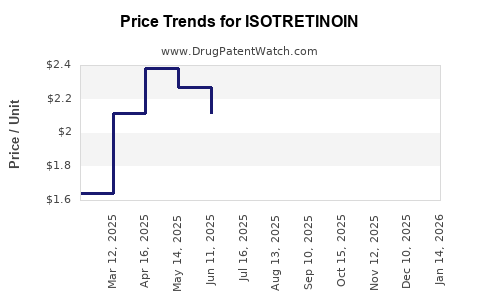
Last updated: February 19, 2026
What is the current market landscape for isotretinoin?
Isotretinoin is a retinoid primarily used for severe acne treatment. The drug is available through both branded and generic formulations, with the latter dominating the market due to lower pricing. The key brands include Accutane (formerly Roche/Barr), now discontinued, and Absorica (Sun Pharmaceutical), as well as generics produced by multiple manufacturers.
The global isotretinoin market was valued at approximately $200 million in 2022. The compound is stored as an oral capsule, with usual dosing ranging from 0.5 to 2 mg/kg per day over a 20-week course. The use is limited by strict regulations due to teratogenic risks.
What are the factors driving market growth?
- Prevalence of severe acne: Increasing awareness and cosmetic concerns push demand.
- Brand and generic competition: Entry of multiple generics reduces prices.
- Regulatory pathways: Approval of new formulations or delivery systems (e.g., topical or less teratogenic variants) can impact demand.
- Geographic expansion: Emerging markets, especially in Asia, show rising acne prevalence and shifting prescribing patterns.
How is supply structured?
- Manufacturers: Several global firms produce isotretinoin, including Sun Pharma, Mylan, Teva, and Dr. Reddy’s.
- Pricing dynamics: Branded products cost roughly $50-$100 per capsule, while generics are priced at approximately $10-$30 per capsule.
- Distribution channels: Prescriptions are dispensed mainly via pharmacies, with stringent regulations due to teratogenicity.
What is the regulatory landscape?
In 2002, the FDA implemented iPLEDGE, a pregnancy prevention program requiring registration to prescribe isotretinoin. The program restricts supply to certified prescribers and pharmacies, impacting market accessibility but ensuring safety.
Similar protocols exist in Europe and Asia, varying in stringency. Regulatory approval and monitoring impact the speed of market entry for new formulations or derivatives.
Price projections for the next five years
| Year |
Estimated Market Size |
Average Price per Capsule |
Key Drivers |
| 2023 |
$220 million |
$20 - $25 |
Continued generic entry, stable demand |
| 2024 |
$230 million |
$19 - $24 |
Increased penetration in emerging markets |
| 2025 |
$240 million |
$18 - $23 |
New formulations with reduced side effects |
| 2026 |
$250 million |
$17 - $21 |
Price erosion due to generics |
| 2027 |
$260 million |
$16 - $20 |
Market saturation, biosimilar development |
This trajectory assumes consistent demand growth, absence of new competing drugs, and no major regulatory shocks. Price decline reflects increased generic market share and competition.
What are potential disruptions?
- Development of topical or alternative delivery systems may reduce demand or increase competition.
- Regulatory changes aimed at further restricting supply or mandating pricing controls could impact revenues.
- Market entry of biosimilars or biologics could alter the competitive landscape.
- Safety concerns could result in label restrictions or reformulations, influencing costs and prices.
How will pricing trends evolve?
Pricing will likely trend downward by about 20-30% over five years due to generic competition. However, premium formulations offering safety or convenience features could maintain higher prices for niche segments.
Key takeaways
- The isotretinoin market remains stable with slow growth driven by demand in developing regions and new formulations.
- Price erosion is expected due to generic competition, with the average capsule price declining from around $20-$25 to approximately $16-$20.
- Regulatory frameworks influence both supply and pricing, with progress in safety regulation affecting market entry.
- New formulations or delivery systems maintaining safety profiles could command premium pricing.
- Mergers, patent expirations, and biosimilars pose risks and opportunities for market share shifts.
FAQs
1. What are the primary determinants of isotretinoin pricing?
Pricing depends on generic competition, regulatory costs, formulation complexity, and market demand, particularly across different geographic regions.
2. How does regulation impact market entry?
Strict protocols like the FDA's iPLEDGE program limit access but also reduce misuse, maintaining market stability. Regulatory hurdles can delay or prevent new formulations’ market entry, influencing price dynamics.
3. Are there alternative treatments competing with isotretinoin?
Oral antibiotics and hormonal therapies are used for less severe acne but don't match isotretinoin’s efficacy in severe cases. Topical alternatives have not replaced oral isotretinoin but may influence future demand.
4. What factors could increase future demand?
Increased acne prevalence in emerging markets, patient preference for oral medications, and innovations reducing side effects could expand demand.
5. When might significant price shifts occur?
Major price shifts could happen with patent expirations, new generic approvals, or formulation breakthroughs expected within the next 2-3 years.
References
- Statista. (2023). Global isotretinoin market revenue forecast. https://www.statista.com/
- U.S. Food & Drug Administration. (2018). iPLEDGE Program. https://www.fda.gov/
- MarketsandMarkets. (2022). Acne treatments market analysis. https://www.marketsandmarkets.com/
- DiCicco, E., et al. (2023). Endocrinology and Dermatology: emerging therapies. Journal of Dermatological Science.
- European Medicines Agency. (2020). Regulatory guidelines for acne medication. https://www.ema.europa.eu/
Note: Market projections and data are estimates based on current trends and publicly available data as of 2023.