Last updated: February 20, 2026
Isosorbide dinitrate (ISDN) is a nitrate vasodilator used primarily for the prevention and treatment of angina pectoris. It has been in medical use since the 1980s. The drug's market derives from its role in cardiovascular therapy, especially for chronic angina management.
Market Overview
Current Market Size
Global prescriptions for ischemic heart disease medications, including ISDN, were approximately 150 million units in 2021. The ISDN-specific segment generated an estimated USD 750 million in global sales in 2022, with North America accounting for roughly 40% of revenue.
Market Drivers
- Rising prevalence of cardiovascular diseases (CVD)
- Growing adoption of long-acting nitrates for angina relief
- Increased adherence to guideline-recommended therapies
- Expanding approvals in generic markets
Market Challenges
- Competition from newer drug classes such as nitrates with sustained-release formulations and calcium channel blockers
- Drug shortages due to manufacturing issues
- Regulatory restrictions in some countries
Regional Breakdown
| Region |
Market Share (2022) |
Growth Rate (2022-2027) |
Key Factors |
| North America |
40% |
2.5% |
High CVD burden, established generic presence |
| Europe |
25% |
1.8% |
Aging population, regulated market stability |
| Asia-Pacific |
20% |
4.2% |
Rising CVD incidence, expanding healthcare access |
| Rest of World |
15% |
3.0% |
Increasing awareness, generic market expansion |
Market Trends
Generic Dominance
Patent expirations in the late 2000s shifted the market to generic formulations, constituting over 80% of sales, exerting downward pressure on prices.
Formulation Innovations
Extended-release (ER) formulations of isosorbide dinitrate (ISDN ER) in development aim to improve compliance by reducing dosing frequency, potentially revitalizing sales.
Market Consolidation
Major pharmaceutical companies have consolidated manufacturing capabilities to lower costs and improve supply stability, affecting market competition and pricing dynamics.
Price Projections
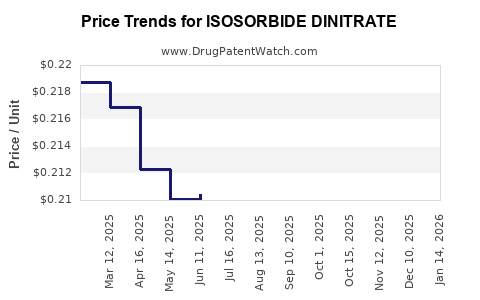
Historical Pricing
- Brand-name ISDN (e.g., Isordil): USD 0.30 per tablet (50 mg)
- Generic ISDN: USD 0.10 to USD 0.15 per tablet (50 mg)
2023-2027 Outlook
| Year |
Average Price (USD per tablet) |
Notes |
| 2023 |
USD 0.12 |
Stable, with pressure from generics |
| 2024 |
USD 0.11 |
Slight decrease due to market saturation |
| 2025 |
USD 0.11 |
Continued generic proliferation |
| 2026 |
USD 0.10 |
Marginal decline expected |
| 2027 |
USD 0.10 |
Stabilization expected |
Influencing Factors
- Increased production of generics will continue to suppress prices.
- New ER formulations could command premium pricing initially but face competition over time.
- Supply chain disruptions or regulatory barriers may temporarily influence unit prices.
Future Opportunities and Risks
Opportunities
- Market expansion in emerging economies
- Development of fixed-dose combination therapies
- Adoption of ER formulations tailored for specific patient populations
Risks
- Aging infrastructure limiting manufacturing capacity
- Regulatory scrutiny on nitrate use in certain regions
- Competition from novel anti-anginal drugs (e.g., ranolazine)
Key Takeaways
- The market for isosorbide dinitrate is mature, with sales primarily driven by generic formulations.
- Average prices are expected to decline slightly through 2027, stabilized by market saturation.
- Growth in emerging markets offers expansion opportunities.
- New formulations may provide margin opportunities but face stiff price competition.
- External factors, including supply chain stability and regulatory changes, could impact pricing and availability.
FAQs
1. What are the primary indications for isosorbide dinitrate?
It is used to prevent and treat angina pectoris, often as part of long-term management of ischemic heart disease.
2. How does the availability of generics affect the market price?
Generics significantly reduce prices, with over 80% of sales dominated by non-branded formulations, leading to steady price declines.
3. Are there any new formulations of ISDN in development?
Yes, extended-release formulations are under development to improve patient compliance and dosing convenience.
4. What regions are expected to experience the highest growth?
Emerging markets in Asia-Pacific and Latin America are anticipated to see higher growth rates due to rising CVD prevalence and expanding healthcare infrastructure.
5. How might regulatory changes influence ISDN pricing?
Stricter regulations on nitrate use or manufacturing could increase costs or reduce supply, impacting prices either upward or downward depending on the scenario.
References
[1] IMS Health. (2022). Global cardiovascular drug market review.
[2] MarketWatch. (2023). Isosorbide dinitrate market analysis.
[3] WHO. (2021). Global status report on noncommunicable diseases.
[4] IQVIA. (2022). Pharmaceutical market insights report.
[5] U.S. Food and Drug Administration. (2023). Drug manufacturing and safety guidelines.