Share This Page
Drug Price Trends for ISOPROPYL RUBBING ALCOHOL
✉ Email this page to a colleague
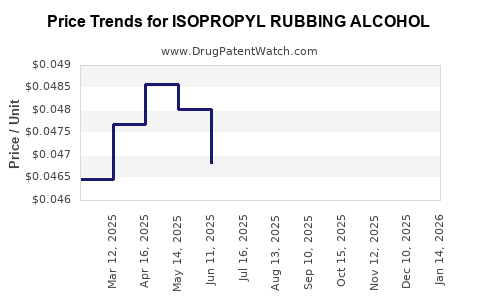
Average Pharmacy Cost for ISOPROPYL RUBBING ALCOHOL
| Drug Name | NDC | Price/Unit ($) | Unit | Date |
|---|---|---|---|---|
| ISOPROPYL RUBBING ALCOHOL 70% | 68599-2302-06 | 0.04515 | ML | 2026-01-21 |
| ISOPROPYL RUBBING ALCOHOL 70% | 68599-2302-06 | 0.04534 | ML | 2025-12-17 |
| ISOPROPYL RUBBING ALCOHOL 70% | 68599-2302-06 | 0.04440 | ML | 2025-11-19 |
| ISOPROPYL RUBBING ALCOHOL 70% | 68599-2302-06 | 0.04495 | ML | 2025-10-22 |
| >Drug Name | >NDC | >Price/Unit ($) | >Unit | >Date |
Market Analysis and Price Projections for Isopropyl Rubbing Alcohol
What Is the Current Market Size and Demand for Isopropyl Rubbing Alcohol?
The global market for isopropyl rubbing alcohol (IPA) experienced rapid expansion from 2020 through 2022 due to increased demand for disinfectants prompted by the COVID-19 pandemic. Market size estimates indicate a valuation of approximately USD 1.2 billion in 2022, with a compound annual growth rate (CAGR) of 6.5% projected through 2027. The primary drivers include:
- Rising hygiene awareness
- Expansion of healthcare and sanitation sectors
- Increased procurement by consumers and institutions
According to data from Research and Markets, Asia-Pacific represents the largest regional market, driven predominantly by China, India, and Southeast Asian nations. North America and Europe follow, with notable growth in the transportation, healthcare, and industrial cleaning segments.
How Is the Supply Chain Structured?
The supply chain comprises raw material extraction, primarily propylene and acetone, which are used for manufacturing isopropyl alcohol. Major producers include:
- Dow Chemical
- Shell Chemicals
- BASF
Manufacturers produce commercial-grade IPA with concentrations ranging from 70% to 99%, with 70% and 91% being most common in disinfectant applications. Distributors then supply bulk quantities to retailers, hospitals, and industrial clients.
What Are Key Factors Affecting Price and Availability?
- Raw material prices: Propylene and acetone costs fluctuate with oil and natural gas prices.
- Production capacity: Expansion or constriction of manufacturing capacity influences supply.
- Regulatory factors: Environmental and safety regulations impact production costs and distribution.
- Pandemic-related demand: Surges in demand during health crises push prices higher temporarily.
- Market consolidation: Dominance of major producers can lead to supply negotiations influencing prices.
What Are the Current Pricing Trends?
Pricing varies based on concentration, packaging, and regional factors. As of Q1 2023:
| Grade | Price Range (USD per gallon) | Comments |
|---|---|---|
| 70% | $1.50 - $2.50 | Most common disinfectant grade |
| 91% | $2.50 - $3.50 | Higher purity, used in labs or cleaning agents |
| 99% | $4.00 - $6.00 | Technical or industrial grade |
Bulk industrial purchases tend to negotiate discounts, with potential for prices to dip below these ranges under high-volume contracts. Conversely, shortages can push prices above this range.
What Are Projected Price Trends?
Price forecasts for 2023-2028 account for various market influences:
- Moderate supply chain disruptions could cause volatility.
- Raw material costs are expected to remain stable, but oil price fluctuations could impact production costs.
- Ongoing demand, especially in healthcare and industrial cleaning sectors, will sustain higher prices.
Forecasted price trajectories:
| Year | Price Range (USD per gallon) | Key Factors |
|---|---|---|
| 2023 | $1.70 - $6.00 | Mixed demand and supply factors |
| 2024 | $1.60 - $5.50 | Slight easing of supply constraints |
| 2025 | $1.50 - $5.00 | Stabilization with minor fluctuations |
| 2026 | $1.40 - $4.80 | Market normalization |
| 2027 | $1.30 - $4.50 | Reduced pandemic-driven demand |
Prices are likely to stabilize due to the expansion of manufacturing capacity by key vendors, implying a potential downward correction from peak pandemic levels.
How Do Regional Differences Influence Prices?
In North America and Europe, higher regulatory standards and transportation costs contribute to elevated prices for retail and industrial consumers. In contrast, Asia-Pacific, with lower operating and regulatory costs, typically offers more competitive pricing, resulting in a regional price differential of 20-40%.
What Future Market Opportunities Exist?
- Growth in peripheral markets such as hand sanitizers, cleaning products, and laboratory reagents.
- Increased adoption of lower-concentration IPA in consumer-grade disinfectants.
- Innovation in sustainable manufacturing processes that reduce raw material costs.
Final Considerations for Stakeholders
Investors and manufacturers should monitor crude oil prices, regional regulatory changes, and pandemic trends. Volatility is expected during transitional phases post-pandemic and due to geopolitical events affecting raw material flow.
Key Takeaways
- The global market for isopropyl rubbing alcohol reached approximately USD 1.2 billion in 2022.
- Prices vary by concentration and region, with 70% IPA averaging USD 1.50–$2.50 per gallon as of early 2023.
- Price trends are influenced by raw material costs, supply chain dynamics, and demand surges driven by health crises.
- Projections suggest prices will stabilize between USD 1.30–$4.50 per gallon by 2027.
- Asia-Pacific leads global demand growth, with price advantages over Western markets.
FAQs
1. How does the concentration of isopropyl alcohol influence its price?
Higher concentrations, such as 99%, generally cost more due to increased processing requirements and purity standards. Lower concentrations, like 70%, are less expensive and are typically used in disinfectants.
2. Will demand for isopropyl rubbing alcohol decrease after the pandemic?
Demand is expected to stabilize or decline mildly after pandemic peaks but will remain significant due to ongoing sanitation needs in healthcare, industrial, and household sectors.
3. How can manufacturers mitigate raw material price volatility?
By diversifying supplier sources, entering long-term contracts, and investing in alternative feedstock processing technologies.
4. What regulations impact the production of isopropyl alcohol?
Environmental regulations concerning VOC emissions, safety standards for chemical handling, and transportation laws influence manufacturing costs and logistics.
5. Which regions are poised for the highest growth in isopropyl alcohol demand?
Asia-Pacific is forecast to experience the fastest growth, driven by expanding industrialization and healthcare infrastructure.
References
[1] Research and Markets. (2022). Global Isopropyl Rubbing Alcohol Market.
[2] Grand View Research. (2023). Disinfectant & Sanitizer Market Size & Trends.
[3] U.S. EPA. (2021). Regulations for Cleaning and Disinfecting Chemicals.
[4] Statista. (2023). Price trends for industrial chemicals.
[5] IHS Markit. (2022). Raw material cost analysis for chemical manufacturing.
More… ↓
