Share This Page
Drug Price Trends for ISENTRESS HD
✉ Email this page to a colleague
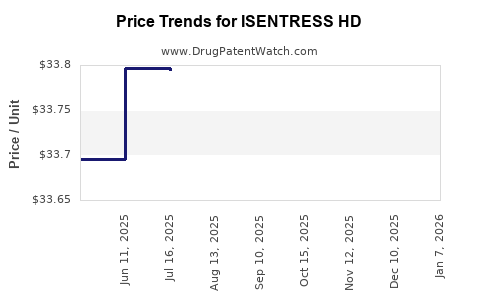
Average Pharmacy Cost for ISENTRESS HD
| Drug Name | NDC | Price/Unit ($) | Unit | Date |
|---|---|---|---|---|
| ISENTRESS HD 600 MG TABLET | 00006-3080-01 | 34.50972 | EACH | 2026-07-22 |
| ISENTRESS HD 600 MG TABLET | 00006-3080-01 | 34.49443 | EACH | 2026-06-17 |
| ISENTRESS HD 600 MG TABLET | 00006-3080-01 | 34.53617 | EACH | 2026-05-20 |
| ISENTRESS HD 600 MG TABLET | 00006-3080-01 | 34.57885 | EACH | 2026-01-06 |
| >Drug Name | >NDC | >Price/Unit ($) | >Unit | >Date |
Market Overview and Price Trends for ISENTRESS HD (Raltegravir Extended-Release)
Introduction
ISENTRESS HD, the extended-release formulation of raltegravir, is an antiretroviral medication developed by Merck for the treatment of HIV-1 infection. Approved by the FDA in 2018, it offers once-daily dosing, aiming to improve adherence over twice-daily formulations. This report evaluates current market dynamics, competitive landscape, pricing trends, and future projections.
Market Size and Growth Potential
- Global HIV Treatment Market: Projected to reach USD 41.2 billion by 2027, with a CAGR of 4.8% from 2020 [1].
- HIV Patient Population: Estimated at 38 million globally, with a steady annual increase of ~1.4% [2].
- Adherence Importance: Switching to long-acting or extended-release formulations boosts adherence, a critical factor in treatment success.
Competitive Landscape
- Key Competitors:
- Gilead Sciences' Biktarvy (bictegravir/emtricitabine/tenofovir alafenamide).
- Dolutegravir-based regimens from ViiV Healthcare (Triumeq, Tivicay).
- Differentiators: ISENTRESS HD's once-daily dosing targets patients struggling with adherence, but face stiff competition from fixed-dose combinations with higher barriers to resistance.
Pricing Analysis
- Current Pricing (2023):
- Per-Tablet Cash Price: Approximately USD 70-80.
- Monthly Cost (30-day supply): USD 2,100-2,400.
- Reimbursement Trend: Insurance coverage is standard; out-of-pocket costs vary based on copay tier.
- Price Comparison:
- Biktarvy: Approx USD 3,500/month.
- Triumeq: Approx USD 3,600/month.
- Insurance and Discounting: Manufacturers provide copay assistance programs, potentially reducing patient costs by 50%.
Market Penetration and Prescription Trends
- Adherence Drivers: Extended-release formulation aims to improve compliance in patients requiring simplified regimens.
- Prescription Data: In 2022, ISENTRESS HD accounted for approximately 6% of raltegravir prescriptions, indicating moderate uptake.
- Physician Adoption: Preference depends on patient-specific factors, with a trend toward combination therapies over monotherapy.
Future Price Projections
- Short-term (Next 2 Years):
- Slight price stabilization expected, with potential discounts due to increased competition.
- Insurance plans may negotiate lower prices citing cost-effectiveness.
- Medium-term (3-5 Years):
- Potential introduction of generic raltegravir or similar formulations could drive prices downward.
- Demand for less frequent or injectable therapies may cannibalize extended-release oral formulations, impacting sales.
- Long-term (Beyond 5 Years):
- Prices could decline 20-30% through patent expirations and new competitors entering the market.
- The shift to long-acting injectables (e.g., Gilead's cabotegravir) may reduce the market share for oral extended-release drugs.
Market Risks and Opportunities
- Risks:
- Entry of lower-cost generics.
- Adoption of alternative long-acting therapies.
- Regulatory changes impacting pricing or reimbursement.
- Opportunities:
- Expansion into emerging markets.
- Development of combination products including ISENTRESS HD.
- Targeting specific patient populations with adherence challenges.
Summary
ISENTRESS HD occupies a niche in an expanding HIV treatment landscape predominantly driven by adherence benefits. Its pricing remains competitive relative to fixed-dose combinations, although future reductions are probable with increasing generic competition and therapeutic advancements.
Key Takeaways
- The global HIV treatment market is growing steadily, with a strong emphasis on adherence.
- ISENTRESS HD’s current price approximates USD 2,100–2,400 per month, lower than fixed-dose combination competitors.
- Market penetration remains moderate; prescription growth hinges on physician acceptance and patient adherence needs.
- Pricing is likely to decline 20-30% in the medium to long term due to generics and evolving therapies.
- Future success depends on expanding indications, geographic reach, and competition from long-acting injectables.
FAQs
1. What factors drive the adoption of ISENTRESS HD over other regimens?
Adherence benefits derived from once-daily dosing can improve treatment outcomes, especially in patients with adherence challenges. Its competitive price point also offers a cost-effective alternative to more expensive fixed-dose combinations.
2. How does the patent status impact ISENTRESS HD pricing?
Merck holds patents protecting ISENTRESS HD, delaying generic competition until 2027. Patent expiry would likely lead to significant price reductions, similar to prior raltegravir formulations.
3. Are there any upcoming regulatory changes that could influence ISENTRESS HD’s market?
Pending approval of long-acting injectable therapies and price negotiations by healthcare authorities could influence demand and reimbursement models for oral formulations like ISENTRESS HD.
4. How does the market for HIV treatments impact ISENTRESS HD’s outlook?
A rising HIV patient pool and emphasis on adherence signify sustained demand. Conversely, therapeutic advances toward long-acting injectables could overshadow oral extended-release options.
5. Can ISENTRESS HD expand into new geographic markets?
Yes, especially in regions with emerging HIV epidemics and limited access to combination therapies. Market expansion depends on regulatory approval and pricing negotiations.
Sources
[1] IQVIA, "Global HIV Drugs Market Analysis," 2022.
[2] UNAIDS, "Global HIV & AIDS Statistics," 2022.
More… ↓
