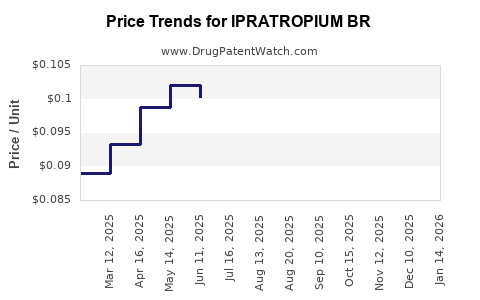
Last updated: February 16, 2026
Market Analysis and Price Projections for IPRATROPIUM BR
Market Overview
Ipratropium bromide (BR) is a bronchodilator primarily used in the treatment of Chronic Obstructive Pulmonary Disease (COPD) and asthma. The drug is administered via inhalers or nebulizers, targeting respiratory conditions affecting millions worldwide.
The global respiratory drugs market was valued at approximately $40 billion in 2022 and is projected to grow at a compound annual growth rate (CAGR) of 4-5% through 2030. Ipratropium bromide, as a generic or branded inhaler, accounts for a significant segment within this market, especially owing to its early entry and established efficacy.
Key Market Drivers
- Increasing prevalence of COPD: Approximately 200 million cases globally, driven by aging populations and environmental factors.
- Rising asthma incidences: Estimated at 262 million cases worldwide (WHO, 2021).
- Growth in generic inhaler adoption: Cost-effective alternatives driving market penetration.
- Patent expirations and regulatory approvals: Facilitating entry of generics, reducing prices.
Competitive Landscape
Major players include Teva Pharmaceuticals, Boehringer Ingelheim, and Mylan, offering both branded formulations (e.g., Atrovent) and generics.
- Brand name dominance: Atrovent (Boehringer Ingelheim) maintains a leading position; however, generic versions have increased accessibility.
- Pricing strategies: Branded inhalers are priced higher ($50-$70 per inhaler); generics are 20-40% cheaper.
- Market penetration: Generic versions have captured 60-70% of the inhaler segment in developed markets.
Pricing Dynamics
In the U.S., the average retail price per inhaler ranges between $40-$70, heavily influenced by insurance and pharmacy discounts. In Europe and emerging markets, prices are lower due to government interventions and market competition.
| Formulation |
Price Range (USD) |
Market Segment |
Regulatory Status |
| Branded |
$50-$70 |
Developed countries |
Patent expiration, optional |
| Generic |
$20-$40 |
Global, especially emerging markets |
Widely approved |
Price Projection (Next 5 Years)
Projected price trends assume increased generic competition and regulatory pressures. Price erosion is expected:
- 2023: $35-$65 per inhaler
- 2025: $25-$45 per inhaler (due to generic proliferation)
- 2030: $20-$30 per inhaler
The drop will be more pronounced in markets with strong generic policies and reimbursement schemes. Prices could stabilize or rebound if supply chain disruptions occur or new formulations emerge.
Market Challenges
- Patent cliff for branded formulations
- Regulatory hurdles in emerging markets
- Competition from inhalers with combination therapies (e.g., ipratropium combined with albuterol)
- Environmental concerns over inhaler propellants prompting device redesigns
Opportunities
- Developing fixed-dose combination inhalers (ipratropium + albuterol)
- Expanding into low- and middle-income countries
- Adoption of cost-saving procurement models
Key Takeaways
- Ipratropium bromide’s market size is growing with global COPD and asthma prevalence.
- Generic inhalers' adoption drives downward price pressure, especially in developed markets.
- Prices in 2023 range from $35 to $65 per inhaler; project to decline further by 2030.
- Competition from combination therapies and environmental regulations influences future market dynamics.
- The drug remains a critical component of respiratory treatment, with growth opportunities in emerging regions.
FAQs
1. What factors influence Ipratropium bromide pricing?
Market competition, patent expirations, regulatory environments, and regional reimbursement policies determine prices.
2. How do generic formulations impact the market?
Generics lower prices significantly, accounting for over 60% of inhaler sales in mature markets, increasing accessibility.
3. Are there upcoming regulatory changes affecting Ipratropium bromide?
Regulatory efforts focus on environmental impacts of inhalers and approval processes for combination therapies; no major reform specific to Ipratropium bromide announced.
4. What is the outlook for Ipratropium bromide in emerging markets?
Prices are lower due to relaxed patent protections and government procurement, providing growth opportunities but with margin pressure.
5. How might new formulations affect the market?
Fixed-dose combinations and environmentally friendly inhalers could disrupt pricing and market share dynamics.
References
- World Health Organization. (2021). Global surveillance, prevention, and control of chronic respiratory diseases.
- IQVIA*. (2022). Global Respiratory Drugs Market Report.
- Medscape. (2022). COPD Treatment Market Analysis.
- US Food and Drug Administration. (2022). Inhaler Devices Approvals.
- MarketWatch. (2023). Inhaler Market Price Trends & Forecasts.