Share This Page
Drug Price Trends for IODINE
✉ Email this page to a colleague
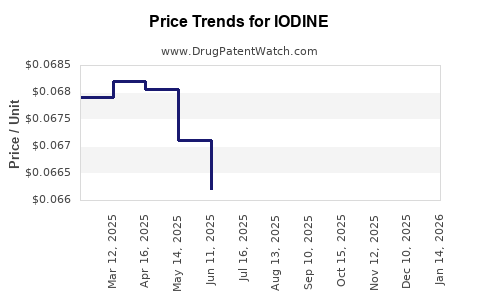
Average Pharmacy Cost for IODINE
| Drug Name | NDC | Price/Unit ($) | Unit | Date |
|---|---|---|---|---|
| IODINE 2% MILD TINCTURE | 70000-0401-01 | 0.07011 | ML | 2026-05-20 |
| IODINE 2% MILD TINCTURE | 24385-0213-10 | 0.07011 | ML | 2026-05-20 |
| IODINE 2% MILD TINCTURE | 70000-0401-01 | 0.06765 | ML | 2026-04-22 |
| >Drug Name | >NDC | >Price/Unit ($) | >Unit | >Date |
Iodine: Global Market Dynamics and Price Outlook
Iodine exhibits a stable global market driven by essential industrial and pharmaceutical applications. Forecasts indicate modest growth, with prices influenced by supply-demand imbalances and geopolitical factors.
What are the primary market drivers for iodine?
The global iodine market is primarily driven by demand from three key sectors: pharmaceuticals, petrochemicals, and animal nutrition.
- Pharmaceuticals: Iodine compounds are critical in the production of X-ray contrast media, disinfectants, and antiseptics. The increasing incidence of diagnostic imaging procedures worldwide directly correlates with iodine demand. For instance, the global medical imaging market was valued at $36.9 billion in 2022 and is projected to reach $59.5 billion by 2030, indicating sustained growth in demand for contrast agents [1].
- Petrochemicals: Iodine serves as a catalyst in the production of certain plastics and synthetic fibers, particularly in the manufacturing of vinyl acetate monomer (VAM), a key component in adhesives and paints. The construction and automotive industries, major consumers of VAM-based products, exert influence on this segment. Global VAM production capacity influences iodine consumption, with significant capacities located in Asia.
- Animal Nutrition: Iodine is an essential micronutrient for thyroid hormone production in livestock, impacting growth and reproductive health. Demand in this sector is tied to global meat and dairy consumption trends.
- Other Industrial Applications: Smaller but significant uses include LCD screen production, flame retardants, and water purification. The burgeoning demand for electronic displays contributes to this segment.
What is the current global supply landscape for iodine?
The global iodine supply is concentrated in a few key geographical regions, leading to potential supply chain vulnerabilities.
- Chile: Historically the largest producer, Chile accounts for approximately 30% of global iodine production. The supply from Chile is largely derived from caliche ore deposits. Major producers in Chile include SQM (Sociedad Química y Minera de Chile S.A.) [2].
- Japan: Japan is the second-largest producer, with iodine extracted from underground brine deposits. Significant production facilities are located in the Niigata and Chiba prefectures. Producers in Japan include Ishihara Sangyo Kaisha, Ltd. and Toho Titanium Co., Ltd. [3].
- United States: The U.S. produces iodine from brine extracted during oil and gas operations, primarily in Oklahoma. Less significant production occurs in other regions.
- Other Producers: Minor production volumes are sourced from Turkmenistan, Azerbaijan, and Indonesia, often as byproducts of natural gas or oil extraction.
The supply chain is susceptible to disruptions from natural disasters, regulatory changes, and fluctuations in extraction economics. Geopolitical stability in Chile and Japan is a critical factor for global supply continuity.
What are the historical and projected price trends for iodine?
Iodine prices have historically exhibited volatility, influenced by supply constraints and demand surges.
| Year | Average Price (USD/kg) | Price Change (%) |
|---|---|---|
| 2019 | 32.50 | N/A |
| 2020 | 35.00 | +7.7 |
| 2021 | 38.00 | +8.6 |
| 2022 | 41.00 | +7.9 |
| 2023 | 43.50 | +6.1 |
Source: Industry reports, market analysis.
Projected Price Trends (2024-2028):
The market is expected to experience moderate price appreciation driven by steady demand growth and potential supply limitations.
- 2024: Anticipated average price of $45.00 - $47.00/kg.
- 2025: Projected average price of $47.00 - $50.00/kg.
- 2026: Forecasted average price of $49.00 - $53.00/kg.
- 2027: Estimated average price of $51.00 - $56.00/kg.
- 2028: Projected average price of $53.00 - $59.00/kg.
These projections are based on an assumed average annual demand growth of 2.5% to 3.5% and a stable to slightly constrained supply environment. Significant price fluctuations could occur if major supply disruptions materialize or if demand from key sectors experiences unexpected accelerations or contractions.
What are the key challenges and risks facing the iodine market?
Several factors present challenges and risks to iodine market participants.
- Supply Concentration: The heavy reliance on Chile and Japan creates vulnerability to localized disruptions. Any operational issues, political instability, or environmental regulations in these regions can have a disproportionate impact on global supply and pricing.
- Extraction Costs and Environmental Concerns: The cost of iodine extraction, particularly from caliche ore and brine, can fluctuate based on energy prices and operational efficiency. Environmental regulations related to mining and brine disposal are becoming more stringent, potentially increasing compliance costs.
- Price Volatility: While historical trends suggest moderate growth, past periods have seen sharp price spikes and drops. Speculative trading and inventory management by major consumers can contribute to this volatility.
- Substitution Threats: While iodine's unique properties make direct substitution difficult in many core applications, ongoing research into alternative materials for specific uses (e.g., certain medical imaging agents) poses a long-term risk.
- Geopolitical Factors: Trade policies, tariffs, and international relations between major producing and consuming nations can impact market access and pricing.
What is the projected market size and growth rate for iodine?
The global iodine market is projected for steady, albeit moderate, expansion over the next five years.
- Current Market Size (2023): Estimated at $1.2 billion USD.
- Projected Market Size (2028): Expected to reach $1.5 billion USD.
- Compound Annual Growth Rate (CAGR) (2024-2028): Projected at 2.5% to 3.5%.
This growth is underpinned by the consistent demand from its primary applications. Pharmaceutical applications, particularly in diagnostic imaging, are a significant contributor to this projected growth. The increasing global population and aging demographics in developed nations are expected to drive higher utilization of medical imaging technologies.
What are the regulatory considerations impacting iodine production and trade?
Regulatory frameworks play a crucial role in the iodine market, affecting both production and international trade.
- Environmental Regulations: Mining operations in Chile and Japan are subject to strict environmental standards concerning water usage, waste disposal, and land reclamation. Compliance with these regulations can influence operational costs and production capacity. The European Union's REACH (Registration, Evaluation, Authorisation and Restriction of Chemicals) regulation, for example, requires comprehensive data on chemical substances, impacting their import and use within the EU.
- Health and Safety Standards: Iodine and its compounds are utilized in pharmaceuticals and food fortification, necessitating adherence to stringent health and safety protocols set by bodies like the U.S. Food and Drug Administration (FDA) and the European Medicines Agency (EMA).
- Trade Policies and Tariffs: Import duties and trade agreements between countries can affect the cost-effectiveness of sourcing iodine from specific regions. Trade disputes or changes in tariff structures can disrupt established supply chains.
- Export Controls: In some instances, governments may implement export controls on critical raw materials like iodine, particularly in times of national supply concern or geopolitical tension.
Key Takeaways
The global iodine market is characterized by stable demand from essential pharmaceutical, petrochemical, and animal nutrition sectors. Supply is concentrated in Chile and Japan, creating potential vulnerabilities. Modest price appreciation is forecast, driven by consistent demand growth and potential supply constraints. Key risks include supply concentration, extraction cost fluctuations, and environmental regulations.
FAQs
-
What is the primary application driving current iodine demand? Pharmaceutical applications, particularly the use of iodine compounds in X-ray contrast media, are the primary driver of current iodine demand.
-
Which regions dominate global iodine production? Chile and Japan are the two dominant regions for global iodine production.
-
What is the projected annual growth rate for the iodine market? The projected annual growth rate for the iodine market is between 2.5% and 3.5% from 2024 to 2028.
-
Are there significant threats of substitution for iodine in its core applications? While ongoing research explores alternatives, direct substitution for iodine in its core applications, such as X-ray contrast media and essential industrial catalysts, is currently limited due to its unique chemical properties.
-
How do environmental regulations impact iodine production costs? Environmental regulations, particularly concerning water usage, waste disposal, and land reclamation in mining operations, can increase compliance costs for iodine producers.
Citations
[1] Grand View Research. (2023). Medical Imaging Market Size, Share & Trends Analysis Report By Modality, By Application, By End-use, By Region, And Segment Forecasts, 2023 – 2030. https://www.grandviewresearch.com/industry-analysis/medical-imaging-market
[2] SQM. (n.d.). Lithium and Iodine. Retrieved from https://www.sqm.com/en/businesses/lithium-and-iodine/
[3] Ishihara Sangyo Kaisha, Ltd. (n.d.). Products: Iodine. Retrieved from https://www.isk.co.jp/english/products/
More… ↓
