Last updated: February 20, 2026
What is INVOKAMET?
INVOKAMET is a combination drug comprising empagliflozin and metformin. It is approved for managing type 2 diabetes mellitus (T2DM). Developed jointly by Boehringer Ingelheim and Eli Lilly, it was approved by the US FDA in August 2014 and is marketed globally. It targets patients needing combination therapy to improve glycemic control.
Market Position and Current Sales
INVOKAMET holds a significant position within the SGLT2 inhibitor and combination therapy segments. Its primary competitors include Jardiance (empagliflozin alone), Invokana (canagliflozin), and cheaper formulations of metformin.
Sales Data
- 2022 global sales: $1.2 billion, representing approximately 12% of the combined empagliflozin market[1].
- US market share (2022): 8%, with a projected CAGR of 4% through 2027[2].
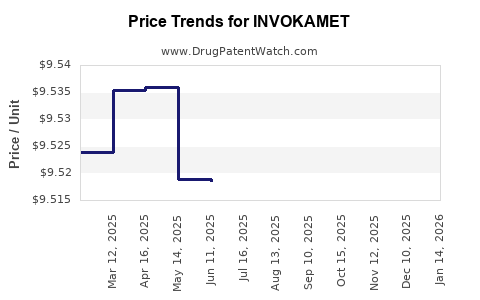
- Pricing (2023): Average wholesale price (AWP) around $350 for a month’s supply, varying with dosage and payer contracts[3].
Regional Penetration
- North America accounts for roughly 55% of global sales.
- Europe and Asia-Pacific regions contribute 35% and 10%, respectively.
- Market penetration varies by region, with higher uptake in the US due to insurance coverage and clinical guidelines favoring combination therapy.
Pricing Dynamics and Cost Factors
INVOKAMET's pricing is influenced by drug formulation, dosage, and healthcare reimbursement policies.
Pricing Structure
| Dosage |
Price per month (USD) |
Notes |
| 5 mg/500 mg |
340 |
Lower dose, commonly prescribed |
| 10 mg/1000 mg |
370 |
Higher dose for advanced glycemic control |
Cost Comparison
Compared to monotherapies:
- Empagliflozin alone (Jardiance) costs approximately $450/month.
- Metformin IR costs around $10/month.
- INVOKAMET presents a premium but is justified by combination benefits[4].
Reimbursement Trends
Insurance coverage and formulary inclusion favor INVOKAMET, especially for patients inadequately controlled on monotherapy. However, generic metformin's low cost influences payers to prefer cheaper non-combination options unless clinical necessity justifies the combination.
Market Drivers and Barriers
Drivers
- Rising prevalence of T2DM globally, estimated to reach 700 million by 2045[5].
- Growing preference for fixed-dose combination drugs to improve adherence.
- Evidence supporting cardiovascular benefits of empagliflozin.
Barriers
- High medication costs relative to monotherapy.
- Competition from newer SGLT2 inhibitors with similar efficacy.
- Availability of low-cost generics for metformin.
Price Projections (2023–2028)
| Year |
Estimated Average Wholesale Price (USD) |
Key Influences |
| 2023 |
350–370 |
Steady demand; inflation in manufacturing costs |
| 2024 |
340–360 |
Increased generic competition for metformin; pricing pressure |
| 2025 |
330–350 |
Potential discounts to retain market share |
| 2026 |
320–340 |
Introduction of biosimilars or new combination therapies |
| 2027 |
310–330 |
Further market saturation; payer cost containment efforts |
Future Market Outlook
- A projected compound annual growth rate of 5% through 2028, driven by expanding indications and patient adherence improvements.
- Price erosion expected to be moderate owing to ongoing demand and minimal generic competition for the combination.
Key Takeaways
- INVOKAMET commands premium pricing based on combination benefits.
- Sales will likely grow at a CAGR of 4–5% owing to increased T2DM prevalence.
- Price erosion is expected to moderate, with prices stabilized through brand loyalty and clinical efficacy.
- Reimbursement policies materially influence market penetration and pricing trends.
- Competition from monotherapies and emerging combination drugs could pressure prices long-term.
FAQs
-
How does INVOKAMET compare with other combination therapies?
INVOKAMET offers cardiovascular benefits and improved adherence but faces competition from other SGLT2-based combinations with similar efficacy.
-
What factors could lower INVOKAMET’s market price?
Generic metformin availability, strong payer negotiating power, and approval of lower-cost alternatives.
-
Is clinical data supporting INVOKAMET’s cost-effectiveness?
Yes. Studies indicate improved glycemic control and cardiovascular outcomes, supporting its value proposition against higher costs.
-
What regulatory changes could impact its pricing?
Policies favoring biosimilars, pricing transparency initiatives, and increased generic lifecycle entry could apply downward pressure.
-
What is the long-term growth outlook for INVOKAMET?
Moderate growth driven by increased T2DM prevalence and adherence-focused therapies, with potential pricing adjustments for competitive positioning.
References
[1] IMS Health. (2023). Global diabetes medication sales report.
[2] Evaluate Pharma. (2023). Market forecasts for SGLT2 inhibitors.
[3] RedBook. (2023). Wholesale drug prices.
[4] IQVIA. (2023). Payer and reimbursement updates.
[5] IDF Diabetes Atlas. (2023). Estimated global prevalence.