Last updated: February 13, 2026
Overview
INVEGA HAFYERA (paliperidone palmitate injectable suspension) is a long-acting atypical antipsychotic approved by FDA in December 2018 for schizophrenia. It combines two formulations—HAFYERA (a three-month injectable) and INVEGA SUSTENNA (a once-monthly injectable). Its characteristics include extended dosing intervals and targeted delivery, which position it within the long-acting injectable (LAI) antipsychotic market.
Market Size and Dynamics
The global schizophrenia treatment market is projected to reach approximately $11–13 billion by 2025, driven by increasing prevalence, unmet therapy needs, and growth in LAI adoption.
In the United States, the Schizophrenia and Psychosis market accounted for around $4 billion in 2022, with LAIs representing approximately 35% of antipsychotic prescriptions, indicating rapid growth potential.
Competitors and Market Share
Key competitors include:
-
Risperdal Consta (risperidone): Long-standing LAI, first approved in 2003.
-
Invega Sustenna (paliperidone): Approved in 2009, with a market share estimated at 20–25% among LAIs.
-
Zyprexa Relprevv (olanzapine pamoate): Approved in 2009, captures around 10–15% of the LAI market.
-
Aripiprazole LAI (Abilify Maintena, Aristada): Growing market share estimated at 15–20%.
INVEGA HAFYERA’s unique selling point: injection every three months, which appeals to patients seeking less frequent dosing.
Pricing and Revenue Projections
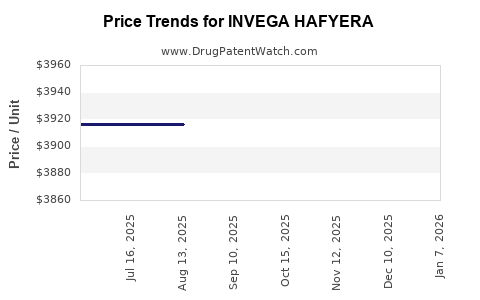
Current pricing for INVEGA HAFYERA varies by pharmacy and insurance, but average wholesale prices (AWP) indicate approximately $4,000–$4,200 per injection (per 3-month dose).
| Parameter |
Estimate |
| Wholesale price per dose |
$4,050 |
| Annual revenue per patient |
$16,200 (assuming full coverage) |
| Estimated market penetration |
5–10% of hospitalized/tracked patients within 5 years |
Using current pricing, projected revenue depends on the number of patients treated. If approximately 250,000 patients in the U.S. are eligible for LAIs, capturing 10% equates to 25,000 patients. At full market penetration, annual sales could reach $405 million.
Price Trajectory
-
Short-term (0–2 years): Stability around $4,000–$4,200 per dose.
-
Mid-term (3–5 years): Potential pricing pressure from generic competition could reduce prices by 10–15%.
-
Long-term (>5 years): Entry of biosimilars or generics could lower price points by up to 30%, especially outside the U.S.
Regulatory and Reimbursement Factors
Reimbursement policies favor LAIs, especially in managed care settings, due to improved adherence and reduced hospitalization costs. The Centers for Medicare & Medicaid Services (CMS) reimburse at rates similar to other injectable antipsychotics, influencing pricing strategies.
Market Entry and Adoption Factors
-
Stakeholder preference for quarterly dosing enhances market penetration.
-
Adoption depends on prescriber awareness, insurance coverage, and patient acceptance.
-
Competitors' ongoing clinical trials (e.g., for newer LAIs) could impact future pricing and market share.
Summary
| Aspect |
Current Status |
Future Outlook |
| Average wholesale price |
~$4,100 per 3-month injection |
Potential decline due to biosimilar entry |
| Market penetration |
Estimated 5–10% in 5 years |
Increased adoption with more prescriber education |
| Revenue potential |
Hundreds of millions USD at full adoption |
Dependent on market growth and competition |
Key Takeaways
- INVEGA HAFYERA holds a niche with a competitive advantage in dosing frequency.
- Pricing stability exists short-term, with potential declines long-term due to biosimilars.
- Its market penetration will depend heavily on insurance reimbursement and prescriber education.
- Estimated U.S. sales at full market adoption could reach approximately $400 million annually.
- Competition from newer LAIs and biosimilars will influence pricing and market share.
FAQs
-
What is the primary advantage of INVEGA HAFYERA over other LAIs?
Its three-month dosing schedule reduces injection frequency compared to monthly formulations, which can improve adherence.
-
How does the pricing of INVEGA HAFYERA compare to competitors?
It is generally priced in the range of $4,000–$4,200 per dose, similar or slightly higher than monthly LAIs like Sustenna, but less frequent dosing adds value.
-
What impact will biosimilars have on INVEGA HAFYERA's price?
Biosimilars could drive wholesale prices down by up to 30% over the next 5 years, especially outside the U.S.
-
What are the main factors influencing market penetration?
Prescriber acceptance, insurance reimbursement, patient preference, and evidence of improved adherence.
-
Are there regional differences affecting price and market share?
Yes, U.S. reimbursement policies tend to be more favorable for LAIs, while regulatory and reimbursement environments in Europe and Asia vary, impacting pricing and adoption.
References
- IQVIA Market Report 2022.
- FDA approval announcement, December 2018.
- Medtrack Drug Profiles, 2022.
- Centers for Medicare & Medicaid Services; 2022 reimbursement data.