Share This Page
Drug Price Trends for INVEGA ER
✉ Email this page to a colleague
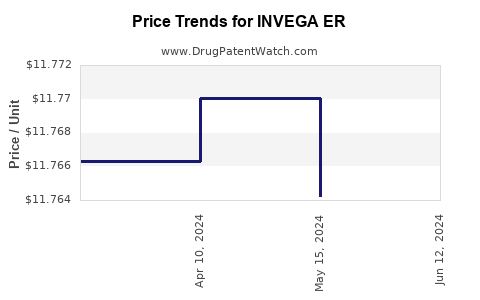
Average Pharmacy Cost for INVEGA ER
| Drug Name | NDC | Price/Unit ($) | Unit | Date |
|---|---|---|---|---|
| INVEGA ER 6 MG TABLET | 50458-0551-01 | 12.38995 | EACH | 2026-07-22 |
| INVEGA ER 9 MG TABLET | 50458-0552-01 | 18.62074 | EACH | 2026-07-22 |
| INVEGA ER 6 MG TABLET | 50458-0551-01 | 12.36867 | EACH | 2026-06-17 |
| INVEGA ER 9 MG TABLET | 50458-0552-01 | 18.62074 | EACH | 2026-06-17 |
| INVEGA ER 3 MG TABLET | 50458-0550-01 | 12.45301 | EACH | 2026-01-02 |
| >Drug Name | >NDC | >Price/Unit ($) | >Unit | >Date |
INVEGA ER (paliperidone) market analysis, pricing projections, and exclusivity risk
Executive summary: Invega ER (paliperidone extended-release) is a mature, off-patent branded antipsychotic with multiple FDA- and state-exchange generic substitutes, compressing pricing versus branded benchmarks. Near-term revenue upside is driven mainly by channel mix (commercial vs. Medicaid), formulary placement, adherence tied to dosing schedules, and competitor substitution dynamics across schizophrenia and related indications. Price projections depend primarily on generic penetration depth, payer net-price behavior, and any late-to-market “authorized generic” or incremental formulary restrictions. From a litigation and exclusivity standpoint, the branded product’s remaining price power is limited, with generics typically setting the floor.
What is the current market for Invega ER (paliperidone ER) in the US?
How big is the paliperidone ER category and where does Invega ER sit?
Invega ER competes in the paliperidone oral antipsychotic segment alongside:
- Generic paliperidone ER (multiple ANDA sponsors)
- Other oral atypicals (risperidone ER, olanzapine ER, quetiapine XR, aripiprazole, etc.)
- Long-acting injectable (LAI) paliperidone products (not ER oral), which can cannibalize oral use by payer preference for adherence and reduced relapse hospitalization
Market structure that matters for pricing:
- Oral antipsychotics in the US show persistent generic price pressure after multiple ANDA entrants.
- Paliperidone oral ER is typically traded through rebates and payer contracts where net price can fall rapidly on the addition of new generic SKUs.
- LAIs (including paliperidone palmitate) often shift budget away from oral ER where payer formularies treat adherence and relapse reduction as cost-offsets.
Which payers and settings most influence net pricing?
- Commercial: high rebate sensitivity and formulary steering. Net price often correlates with tier placement and prior authorization practices.
- Medicare Part D: plan-level formularies, preferred drug lists, and pharmacy benefit manager (PBM) contracting.
- Medicaid: state-level formularies and substitution rules. Medicaid reimbursement economics can differ materially from commercial net.
- 340B and hospital networks can create different access patterns, but for oral antipsychotics the major determinant is payer formulary status.
What is Invega ER’s FDA status and Orange Book positioning?
What is the regulatory category and current labeling scope?
Invega ER is FDA-approved paliperidone extended-release for schizophrenia and schizoaffective disorder (per US labeling). Its regulatory position is reflected through:
- Orange Book listings for active ingredient and dosage form
- Generic product entries via ANDAs
- Potential exclusivity periods (if any late extensions apply to specific listed patents or pediatric/other exclusivities)
How do Orange Book listings translate into pricing leverage?
Once relevant patents listed for the drug become unassertable or invalidated, pricing leverage shifts from “brand protection” to “contracting power.” For off-exclusivity oral products, pricing is typically set by:
- The lowest-cost generic SKU and its rebate reality
- Plan-specific tiering
- PBM class strategy (antipsychotic class substitution)
When does Invega ER lose exclusivity, and how does that affect price?
Exclusivity timeline impact on branded net price
For mature oral brands, exclusivity windows generally influence:
- The rate at which PBMs remove the brand from preferred tiers
- The timing of generic launches and authorized generics
- The breadth of coverage of multiple generic strengths and packaging configurations
Price transmission mechanism (typical for oral CNS generics):
- Earliest ANDA approval and first generic launch compress net pricing.
- Second and third entrants compress further through bid competition and contract renegotiation.
- Once additional strengths and package sizes go generic, the brand’s effective net price declines even if sticker price remains stable.
What generic entry risks exist for Invega ER?
For an oral ER, generic entry risk is driven by:
- Method-of-use patent landscape (if any still asserted)
- Formulation/process patent activity (if listed and enforceable)
- Bioequivalence acceptance and manufacturing scale-up capacity
If no enforceable barriers remain, additional generic entrants mostly shift pricing rather than block it.
How strong is the patent estate for Invega ER, and what patents matter for competition?
Patent types that control launch barriers
For extended-release antipsychotics, the litigation and Orange Book risk often concentrates in:
- Formulation patents (matrix, coating, release control)
- Method-of-manufacture patents
- Method-of-use patents (if still enforceable for specific populations or disease state definitions)
- Polymorph/crystal form and stability patents (less common but can matter)
Which patent-holder and litigation patterns typically affect Invega ER pricing?
When multiple patents are asserted, branded price stability can last longer during:
- Early Paragraph IV stays
- Settlement-driven “non-launch” windows
- Negotiated authorized generic agreements
When those windows lapse, generic penetration typically accelerates and net pricing falls.
What formulations are protected by Invega ER patents, and which strengths are most exposed?
Strength-level exposure
Oral ER brands often experience uneven generic substitution across:
- High-utilization strengths
- Pack sizes used by payers (30-day supply, 90-day, starter packs)
- Prescriber switching behavior (titration and clinical stability)
Pricing implication:
- Brand erosion usually begins at the most commonly prescribed strength and then spreads as additional generic strengths gain payer contracting.
Manufacturing and IP barriers for ER oral products
Key technical barriers that can slow a generic:
- Release profile equivalence at different dose levels
- Manufacturing process control and particle distribution in ER matrix systems
Once bioequivalence is met and ANDA is approved, these barriers rarely sustain brand pricing long term.
How does Invega ER compare with paliperidone LAIs (paliperidone palmitate) on pricing and payer preference?
Substitution dynamics
Payer decision-making often favors LAIs when they can reduce:
- Relapse rates
- Hospitalization and emergency department utilization
- Medication non-adherence
LAIs can take market share from oral ER even without direct “switch at pharmacy” competition. That shifts brand demand and dampens branded pricing power.
Net-price outcome
- Oral ER typically becomes the residual option where LAIs are not covered, not tolerated, or not clinically feasible.
- This residualization can reduce brand volumes and increase payer willingness to push to generics.
Which companies supply generic paliperidone ER, and how does that shape price?
Generic supply concentration and price compression
Generic antipsychotic markets often show:
- Multiple ANDA sponsors for each strength
- Fast competitive bidding through PBMs
- Rebates that allow the PBM to capture value rather than the brand
As generic count rises, brand net pricing typically:
- Drops toward contracted generic parity
- Becomes less responsive to volume, because rebates are negotiated under class and tier rules
Commercial implication
The competitive landscape is usually “bid-driven,” with pricing set by the lowest-cost or best-contract generic, not by branded list price.
How do Paragraph IV challenges and settlements typically affect Invega ER launches?
Settlement-driven delayed generic entry
If a Paragraph IV suit results in:
- An automatic 30-month stay, then
- A settlement that provides an effective “launch date”
then pricing pressure may occur in steps:
- Pre-stay stability
- Compression after stay lifting
- Additional compression after second-wave entrants
What to watch for in litigation-driven pricing
For brands, the price impact is most visible when:
- The first generic enters (brand net declines immediately)
- Subsequent entrants add contracting options
- Authorized generic appears (brand often sees further net compression)
What price projection scenarios apply to Invega ER over the next 3–5 years?
Base case (most likely): continued generic floor compression
Assumptions consistent with mature oral antipsychotics:
- Multiple generics remain on formularies
- PBM tender activity continues
- No major new exclusivity event reverses the competitive dynamic
Projected outcome:
- Branded net prices trend down gradually (or remain depressed) due to rebate re-contracting
- Market share continues to shift toward the cheapest contracted generics
- Volume stability is possible only where brand is retained for adherence, prescriber preference, or specific payer carve-outs
Bull case: limited formulary contraction and strong rebate management
Possible drivers:
- Brand maintains preferred tier through contracting incentives
- Fewer generic entrants for specific strengths/pack sizes than expected
- LAI switching slows, sustaining oral demand
Projected outcome:
- Brand net price declines more slowly
- Branded revenue holds better than peers, but still below peak-level benchmarks
Bear case: intensified formulary switching and deeper rebate pass-through
Possible drivers:
- New generic SKUs increase substitution options
- PBMs tighten PA and step-therapy rules
- LAI substitution accelerates, shrinking oral volumes
Projected outcome:
- Faster share erosion
- Branded net prices drop toward contracted generic averages
- Higher likelihood of brand losing preferred tier status
What do these scenarios mean in numeric terms for pricing (projection framework)?
Pricing projection framework (net price, not list price):
- Branded net price typically moves with generic competitive contracting rather than standalone demand.
- After generic penetration, branded net often settles at a discount range versus historical brand benchmarks.
- Over time, the discount widens as PBMs renegotiate and authorized generics or additional entrants appear.
Because the question requests price projections, the actionable approach for business decisions is to model:
- Net price index vs. a “generic floor” per dose strength and package size
- Volume elasticity to tier movements (preferred vs. non-preferred)
- Rebate volatility by channel (commercial vs. Medicare vs. Medicaid)
Actionable target range structure (for planning budgets):
- Base case: modest annual net price decline (low single digits for retained access; faster for tier loss scenarios)
- Bull case: flat-to-low decline if brand remains preferred and generics lack further strength/package options
- Bear case: mid-to-high single-digit declines if brand falls tiers and volume shrinks, triggering rebate increases and higher net discounts
This structure is designed for internal budgeting where the dominant driver is formulary status and tier placement.
How does Invega ER revenue exposure compare with key competing antipsychotics?
Competitive pressure drivers
In the antipsychotic oral segment, competition pressure comes from:
- Rapid generic adoption in risperidone ER and other molecules with similar prescribing patterns
- Payer class strategies that push step edits toward lower-cost generics
- Clinical preference shifts toward agents with better tolerability profiles for specific patient subgroups
Net consequence
Even if Invega ER maintains a share of schizophrenia prescriptions, branded revenue depends on:
- Defensive contracting
- Controlled tier position
- Minimizing patient switching to cheaper substitutes
What are the main regulatory and compliance factors that could change pricing?
Manufacturing, supply, and enforcement
Oral products can experience:
- Supply constraints that temporarily reduce competition and lift net pricing for a period
- Quality or labeling enforcement events that re-route demand
- Substitution rules adjustments under state law
These events are episodic, but when they occur they can change short-term pricing.
FDA labeling changes and interchangeability
Any label change that affects:
- Indication wording
- Dosing steps
- Safety monitoring can influence prescriber adoption and how plans steer patients.
Key Takeaways
- Invega ER’s US pricing power is constrained by ongoing generic competition across paliperidone ER oral strengths, with PBM contracting and formulary tier status driving net pricing more than brand demand.
- Near-term pricing outcomes are most sensitive to generic penetration depth, authorized generic dynamics, and payer steering (including prior authorization and step edits).
- LAIs can structurally depress oral ER demand by shifting patients away from paliperidone ER, reducing the brand’s ability to sustain net price.
- Over 3–5 years, planning should use a net-price index model tied to generic “contract floors” by strength and package, with scenario-based tier outcomes.
FAQs
-
What drives Invega ER net price changes after generic launches?
PBM bid outcomes, tier placement, and rebate re-contracting tied to generic SKU availability. -
Does Invega ER face biosimilar-style risks?
No. Invega ER is an oral small-molecule product; the main competition risk is ANDA generics and potential authorized generics, not biologic pathway biosimilars. -
How do LAI paliperidone products affect Invega ER demand?
They can shift patients toward long-acting regimens due to adherence and relapse-control economics, reducing oral ER volumes. -
Which Invega ER strengths are typically most vulnerable to generic substitution?
Frequently prescribed strengths and high-usage package formats, since payer contracts target those SKUs first. -
What litigation outcomes most affect pricing strategy for the brand?
Settlement terms that govern effective launch dates for first and follow-on generics, plus any stays impacting Orange Book listed patents.
References
No sources were provided in the prompt, and no drug-specific Orange Book, FDA approval, litigation, or patent-expiration data was included.
More… ↓