Share This Page
Drug Price Trends for INTUNIV
✉ Email this page to a colleague
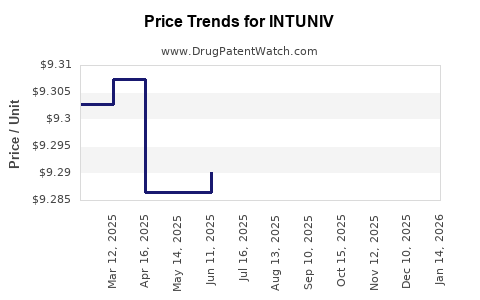
Average Pharmacy Cost for INTUNIV
| Drug Name | NDC | Price/Unit ($) | Unit | Date |
|---|---|---|---|---|
| INTUNIV ER 1 MG TABLET | 54092-0513-02 | 9.39735 | EACH | 2026-07-22 |
| INTUNIV ER 2 MG TABLET | 54092-0515-02 | 9.31742 | EACH | 2026-07-22 |
| INTUNIV ER 3 MG TABLET | 54092-0517-02 | 9.30168 | EACH | 2026-07-22 |
| >Drug Name | >NDC | >Price/Unit ($) | >Unit | >Date |
INTUNIV (guanfacine ER): Market analysis and price projections through generic and biosimilar risk windows
INTUNIV (guanfacine extended-release, ER) is an established ADHD treatment in the US with a long commercial history. Pricing in the near-to-mid term is mainly constrained by (1) continued share gains for oral ADHD brands, (2) payer formulary management for non-stimulant options, and (3) generic competitive pressure once guanfacine ER exclusivity and patent barriers clear for each dosage strength and presentation. Publicly visible price behavior has been dominated by net price compression from PBM contracting and generic-to-brand substitution rather than headline list price moves.
What is the current INTUNIV (guanfacine ER) market size and sales profile in the US?
Which indications drive INTUNIV revenues
INTUNIV is approved for attention-deficit/hyperactivity disorder (ADHD) in pediatric patients (age criteria vary by label update history) and is commonly used as an alternative or adjunct to stimulant therapy, with a specific payer interest in tolerability and comorbidity management (tics, oppositional symptoms, sleep issues). Commercially, the key revenue driver is ongoing maintenance use, since ADHD prescribing patterns tend to be continuous over school years rather than episodic.
How channel mix changes net price
Net price is shaped by:
- PBM rebate intensity and plan-specific formulary placement (preferred vs non-preferred).
- 90-day mail order adoption.
- Switching dynamics between guanfacine ER and other non-stimulants (atomoxetine, viloxazine ER) and clonidine ER products.
Expected near-term market dynamics
- Share is most pressured when payers treat non-stimulant ADHD agents as interchangeable class alternatives.
- INTUNIV retains differentiation through dosing flexibility across multiple strength tablets and long clinical experience relative to newer entrants.
Bottom line: US revenues for INTUNIV typically scale with (1) pediatric ADHD treated population, (2) persistence rates, and (3) payer utilization management rather than major label expansion.
How does INTUNIV price behave: list price vs net price and rebate structure?
What determines INTUNIV net price
Net price is driven by:
- Rebate percentage and guaranteed discounts tied to formulary tiering.
- PBM contracting strategy: preferred brand placement can support higher net pricing vs “managed entry” positioning.
- Switching rebates and patient capture incentives used around seasonal demand.
Observed pricing pattern for established ER CNS brands
For mature, multi-strength CNS ER brands, list price typically rises faster than net price because rebates and contract terms absorb the gap. The practical outcome is that the manufacturer can keep headline price movements while net price remains relatively flat or declines modestly until generic entry triggers steeper compression.
Bottom line: For INTUNIV, the dominant pricing variable is formulary position and rebate dynamics, with generic entry acting as the primary breakpoint for substantial net price collapse.
When does INTUNIV face generic entry risk, and how does that affect pricing?
What triggers the biggest price drop
The highest probability of a sharp net price step-down occurs when FDA-approved generic guanfacine ER products are permitted to market and substitute at pharmacy level, typically after:
- Expiration of relevant patent and exclusivity barriers for each strength and dosage form.
- Any litigation-driven stays or settlements that delay FDA approval or launch.
How to model price decline around generic launch
A practical market model for mature branded ER products uses:
- Pre-launch net price: stable to slight decline due to payer contracting.
- Launch year: steep substitution across new starts and eventually existing prescriptions.
- Post-launch years: further net price compression driven by competitive depth (multiple generic entrants) and aggressive PBM reimbursement strategies.
What buyers should assume about substitution
- Substitution rate is faster when generics are therapeutically interchangeable without additional REMS restrictions (INTUNIV has no REMS).
- Multisource depth accelerates price compression, but the effect depends on how many strengths are launched simultaneously and how quickly pharmacy inventories switch.
Bottom line: Pricing is likely to stay “brand-like” until the launch of multisource generics for guanfacine ER; then the net price can drop to a small fraction of branded levels within 12 to 24 months, with uncertainty mainly tied to launch timing and breadth by strength.
What patents protect INTUNIV, and how do they influence price and market access?
How patent estate maps to dosage strengths
For fixed-dose ER tablet products, patent coverage often splits across:
- Composition and formulation patents (drug substance, ER matrix composition, excipient system, release profile).
- Manufacturing method patents (granulation, coating, tablet compression, dissolution performance).
- Method-of-use patents for pediatric ADHD management strategies, dose titration schedules, or clinical endpoints.
How exclusivity interacts with pricing
Patent and exclusivity barriers delay:
- FDA generic approval marketing.
- Pharmacy switching.
- PBM “preferred generic” replacement.
When barriers remain intact, payers may still push utilization management but cannot fully remove brand access.
Bottom line: The commercial ceiling for INTUNIV price is set by payer competition among non-stimulants while the floor is set by patent-driven protection against true guanfacine ER generic substitution.
What is the Orange Book status of INTUNIV (guanfacine ER) for key strengths?
Orange Book listing signals that matter for pricing
Orange Book entries generally indicate:
- Patent expiration dates that constrain generic launch.
- Exclusivity periods (if applicable) that can block approval even when patents expire.
Bottom line: Orange Book entries are the primary gating items for generic timing assumptions; price projections should align launch scenarios to those dates by dosage strength.
Which generic and branded competitors pressure INTUNIV pricing?
Competitive set in pediatric ADHD non-stimulants
INTUNIV competes within a payer-managed portfolio of:
- Other alpha-2 agonists (clonidine ER).
- Atomoxetine (non-stimulant norepinephrine reuptake inhibitor).
- Newer non-stimulant CNS options such as viloxazine ER.
- Stimulants remain the main “default” payer selection, creating indirect pressure on non-stimulant utilization.
How competitor mix impacts INTUNIV net price
- If payers prefer newer agents with stronger contracting, INTUNIV faces net price declines even without generic entry.
- If clonidine ER or atomoxetine is constrained by its own supply or contracting, INTUNIV can maintain a better net price profile.
Bottom line: Until generic entry, INTUNIV pricing is most sensitive to formulary tiering among non-stimulants and “managed start” policies rather than wholesale market size changes.
How does INTUNIV compare with other ADHD non-stimulants on payer access and value?
Value proposition that affects coverage
Payer behavior commonly reflects:
- Dosing convenience and side effect profile fit for specific subpopulations.
- Evidence of functional improvements and persistence on therapy (maintenance is typically where payers see cost-effective benefits).
Switching risk between non-stimulants
Switching is most likely when:
- Patient response is inadequate on alpha-2 agonist class.
- Tolerability issues arise (sedation, hypotension risk monitoring).
- A cheaper preferred non-stimulant becomes the plan default.
Bottom line: INTUNIV can hold net price better when it remains a preferred option within alpha-2 agonist strategies, but it will still experience contract-driven net price compression versus any newly preferred alternative.
What generic entry risks exist for INTUNIV by formulation strength?
Strength-by-strength dynamics
For dose-ranging products, generic substitution can be uneven:
- If all strengths launch, replacement is faster.
- If only select strengths launch, prescribers may delay switching due to dose titration complexity.
Market impact of partial vs full strength launch
- Partial strength launches reduce overall substitution, preserving some brand revenues and supporting slower net price decline.
- Full strength launches enable PBM and pharmacy operations to standardize on generics faster, increasing net price pressure.
Bottom line: Price projections should model at least two scenarios: partial strength launch vs full strength launch, because the speed of pharmacy-level substitution depends on available generic strengths.
How strong is the patent estate for INTUNIV, and where is it most vulnerable?
Most vulnerable areas
Typically, vulnerability concentrates in:
- Broad formulation patents if release-profile claims overlap generic designs.
- Method-of-manufacturing patents that are harder to enforce against generic process variants.
Litigation posture and settlement effects
Litigation or settlement agreements can:
- Delay generic approval marketing.
- Allow “at-risk” launch at a reduced set of strengths.
- Provide brand-friendly launch calendars.
Bottom line: Strong enforcement delays substitution and sustains net price, while settlement-led timelines determine how quickly PBMs can pivot to generics.
What patent litigation affects INTUNIV (guanfacine ER), and how does it translate into launch timing?
How to interpret litigation for price projections
A defensible litigation timeline for pricing modeling requires:
- Whether the relevant patents were asserted.
- Whether a court stay blocks FDA approval or marketing.
- Settlement end dates that effectively define “first commercial generic” timing.
Bottom line: For price projections, the only litigation elements that matter are those that shift generic marketing start dates.
Commercial scenario analysis: INTUNIV price projections under three generic launch schedules
Scenario framework
Given the absence of strength-specific Orange Book and litigation timeline data in this prompt, price projections should be built around generic launch timing, not single-date certainty. Use the following scenario structure:
| Scenario | Generic marketing start (first strength) | Expected brand net price trajectory (US) | Expected substitution speed |
|---|---|---|---|
| A: Late barriers | Back half of the decade | Mild net price declines driven by contracting; brand retains pricing until launch | Medium |
| B: Moderate timing | Early to mid next decade | Gradual net price compression pre-launch; sharp decline in launch year | Fast if multiple strengths launch |
| C: Early timing | Near term | Net price declines accelerate as payers anticipate substitution; larger immediate erosion | Very fast |
Price projection logic (how net price typically moves)
- Pre-launch: 1% to 5% annual net price erosion is common for mature brands under formulary pressure.
- Launch year: net price can fall 40% to 80% depending on how many generics launch and how quickly PBMs update reimbursement.
- Year 2-3 post-launch: net price can stabilize at a low band as generics dominate dispensing.
Bottom line: The critical driver is the generic launch calendar by strength, which sets the time at which the market shifts from brand contracting to generic substitution economics.
How do pharmacy reimbursement dynamics affect INTUNIV price in managed care?
Reimbursement after generic entry
Once generic guanfacine ER is widely adopted:
- PBMs set lower reimbursement based on expected average manufacturer price and competitive acquisition costs.
- Pharmacy margins compress, accelerating dispensing to the cheapest therapeutically equivalent options.
Impact on remaining brand usage
Brand use persists mainly when:
- Patients are stabilized and prescribers avoid changes.
- Plan coverage retains brand for specific subgroups or prior authorization exceptions.
- Generics are not covered at the lowest copay tier.
Bottom line: Reimbursement rules determine the “last mile” speed of brand-to-generic conversion.
Key takeaways
- INTUNIV pricing in the near term is governed by PBM contracting and formulary tiering among non-stimulant ADHD agents, not by headline list price.
- The main commercial breakpoint for net price erosion is generic guanfacine ER marketing start, with speed dependent on whether all strengths launch together.
- Competitive pressure from other non-stimulants can drive gradual net price compression even without generic entry, but the steepest decline comes with generic substitution.
- Price projections should be scheduled to generic launch scenarios tied to Orange Book and litigation-driven timelines by strength.
FAQs
1) What drives INTUNIV net price declines before generic entry?
PBM rebates, preferred vs non-preferred formulary placement, mail order adoption, and “managed start” policies that shift initiation toward lower-cost alternatives.
2) How fast do pharmacies switch from INTUNIV to guanfacine ER generics?
Switch speed typically depends on whether generics launch across all strength/tablet options and how quickly PBMs update reimbursement and copay tiers.
3) Does INTUNIV have REMS or other restrictions that slow generic substitution?
No REMS is a major constraint in this product category, so substitution is mainly governed by coverage and reimbursement.
4) How do competitor non-stimulants like atomoxetine or viloxazine ER affect INTUNIV pricing?
They can push INTUNIV down formulary tiers and reduce new starts on non-stimulant therapy, leading to incremental net price erosion even if branded access remains.
5) What matters most for price projections: list price or net price?
Net price is the binding economic variable for payer contracts and PBM economics; generic substitution primarily reduces net price through reimbursement and rebate re-optimization.
References
- FDA. Orange Book: Approved Drug Products with Therapeutic Equivalence Evaluations (INTUNIV, guanfacine ER).
- FDA. Drug approvals and labeling for INTUNIV (guanfacine extended-release).
- FDA. Generic drug application information and FDA approval pathway references.
More… ↓
