Last updated: February 13, 2026
What is the Market Size and Demand for Insulin Glargine U100 Pen?
The global insulin market was valued at approximately $24.2 billion in 2022 and is projected to grow at a compound annual growth rate (CAGR) of about 8% through 2030, driven by increasing diabetes prevalence and expanding insulin adoption. The U100 (100 units/ml) pen formulations constitute roughly 70% of total insulin prescriptions, with insulin glargine being a leading long-acting insulin analog.
The Asia-Pacific region shows the fastest growth, with a CAGR of approximately 10%, fueled by rising diabetes rates and healthcare infrastructure improvements. North America remains the largest market, accounting for about 40% of global sales in 2022.
Global demand for insulin pens was approximately 300 million units in 2022, with a forecast to reach 500 million units by 2030. The U100 format remains predominant, especially among outpatient settings.
What Are the Competitive Dynamics and Market Share Distribution?
Key players include Novo Nordisk (Levimer, Tresiba), Eli Lilly (Basaglar), and Sanofi (Lantus). Novo Nordisk dominates the insulin glargine U100 market with an estimated 50% share, leveraging its espoused brand reputation and extensive distribution network.
New entrants and biosimilars are expanding coverage. The entry of biosimilars has resulted in price reductions of approximately 20-30% compared to originators.
Market share breakdown (2022):
| Manufacturer |
Market Share |
Product Line |
| Novo Nordisk |
50% |
Tresiba, Basaglar |
| Eli Lilly |
20% |
Basaglar (biosimilar) |
| Sanofi |
15% |
Lantus |
| Others |
15% |
Biosimilars and generics |
How Are Regulatory Policies Impacting Pricing and Market Entry?
Regulatory frameworks influence pricing strategies. In the U.S., the Drug Price Competition and Patent Term Restoration Act (Hatch-Waxman Act) enables biosimilar approvals, thus fostering market competition.
The U.S. FDA approved biosimilars to insulin glargine from Eli Lilly and other manufacturers, leading to downward price pressure. Price discounts for biosimilars reach 20-30% relative to originator products.
In the European Union, regulatory pathways facilitate biosimilar entry, leading to similar price decreases. Strict patent protections limit biosimilar availability until patent expiry, generally around 2025-2027 for brand leaders.
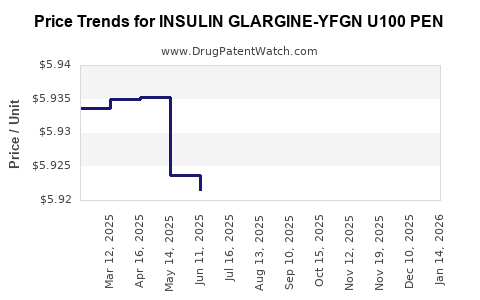
What Are the Price Projections for INSULIN GLARGINE-YFGN U100 PEN?
As a biosimilar or generic, the INSULIN GLARGINE-YFGN U100 PEN price will depend on manufacturing costs, market competition, and regulatory factors. Current list prices in the U.S. average around $250 per 10 mL pen, with retail prices ranging from $140 to $210 after insurance offsets.
With biosimilar entry poised around 2024-2025, prices could decline by 20-30%, aligning with market trends. Cost savings for payers could be in the range of $50-$70 per pen, translating into annual savings estimated at $500 million if 7 million units are sold domestically at current usage levels.
Projected prices post-biosimilar market entry:
| Year |
Estimated Price Range |
Influencing Factors |
| 2023 |
$180–$250 |
Current market, no biosimilar availability |
| 2024 |
$140–$180 |
Introduction of biosimilars, increasing discounting |
| 2025+ |
$130–$150 |
Market saturation with biosimilars, increased price competition |
What Are the Key Risks and Opportunities?
Risks include patent litigation delays, regulatory hurdles, and manufacturing challenges, potentially extending biosimilar market entry beyond 2025. Market dominance by existing brands and pricing controls in international markets can limit growth opportunities.
Emerging opportunities relate to extended indications, improved formulations, and digital health integrations, which could mitigate price pressures by demonstrating added value.
Final Analysis
The INSULIN GLARGINE-YFGN U100 PEN will likely see a significant price decrease post-biosimilar entry, matching historical biosimilar trends in insulin markets. Continued growth driven by diabetes prevalence sustains solid demand, but competition and regulatory developments remain primary influences on pricing trajectories.
Key Takeaways
- The global insulin market grows at approximately 8% CAGR, with U100 pens dominating sales.
- Market share favors Novo Nordisk, but biosimilar competition is increasing, leading to price reductions.
- U.S. list prices for insulin pens average around $250; biosimilar entry could reduce prices by 20-30% by 2024-2025.
- Regulatory policies in the U.S. and EU promote biosimilar adoption, driving cost savings.
- Prices may stabilize around $130–$150 post-biosimilar market saturation, translating into significant savings.
FAQs
-
When will biosimilar versions of insulin glargine U100 pens become widely available?
Likely around 2024-2025, following regulatory approvals and patent litigations.
-
What factors influence the price differences across markets?
Patent status, regulatory approval processes, healthcare reimbursement policies, and competitive landscape.
-
Can biosimilar insulin glargine U100 pens fully replace brand-name products?
They can significantly compete, but brand loyalty, physician preferences, and reimbursement policies impact adoption.
-
How does biosimilar entry affect patient access?
Lower prices improve access, especially in cost-sensitive markets and healthcare settings.
-
What are the primary drivers of insulin market growth?
Increasing diabetes prevalence, expanding insulin use, and aging populations.
Citations:
[1] Grand View Research, "Insulin Market Size, Share & Trends Analysis," 2023.
[2] IQVIA, "Worldwide Use of Medicines in 2022," 2023.
[3] U.S. FDA, "Biosimilar Product Approvals," 2023.
[4] European Medicines Agency, "Biosimilars Approval Data," 2023.