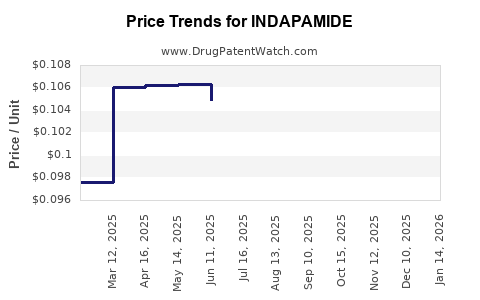
Last updated: February 12, 2026
How is the global market for indapamide structured?
Indapamide is a thiazide-like diuretic primarily used to treat hypertension and edema. It is sold under various brand names by generic and branded drug manufacturers. The key markets include the United States, Europe, Japan, and emerging economies in Asia and Latin America.
As of 2022, the global antihypertensive drug market valued over $24 billion, with diuretics representing roughly 15%. Indapamide accounts for approximately 10% of the diuretic sector, which makes its direct market size estimate around $360 million globally.
Main competitors include Indapamide by Servier, and generics produced by companies like Teva, Sandoz, and Mylan. Patent expiration for indapamide occurred in the early 2000s, limiting exclusivity and fostering a competitive generics environment.
What are current market dynamics affecting indapamide?
Generics Dominance: After patent expiry, generics capture most market share. Price competition leads to significant discounts, especially in price-sensitive markets like India, China, and Latin America.
Manufacturing and Supply: Global supply is concentrated with key API producers in India and China. Regulatory challenges or supply chain disruptions in these regions impact availability and pricing.
Regulatory landscape: Off-label and off-patent use limitations influence prescribing patterns. In the U.S., the FDA has approved generic versions with bioequivalence, increasing market penetration.
Healthcare Trends: Growing emphasis on combination therapy for hypertension favors fixed-dose combinations, which may contain indapamide as an ingredient, expanding its market scope.
How are prices projected to change in the next 5 years?
Price declines are expected to persist due to continued generic competition and increased market penetration in emerging economies.
Price trends in major markets:
| Region |
2022 Average Price per 2.5 mg tablet |
2027 Projected Price per 2.5 mg tablet |
Change (%) |
| United States |
$0.12 |
$0.09 |
-25 |
| Europe |
€0.10 (~$0.11) |
€0.08 (~$0.09) |
-20 |
| Japan |
¥15 (~$0.14) |
¥12 (~$0.11) |
-20 |
| India |
₹2 (~$0.03) |
₹2 (~$0.03) |
0 |
| Latin America |
$0.05 |
$0.04 |
-20 |
Drivers of price decline:
- Increase in generic supply lowers prices.
- Market saturation reduces willingness to pay premium prices.
- Price sensitivity in developing economies maintains low prices.
Potential price stabilization:
In specific regions, price stabilization can occur where supply chain constraints exist or regulatory barriers limit generic entry. Also, if a new formulation or delivery mechanism emerges, higher prices could temporarily re-emerge.
What are the key factors influencing future market growth?
Growth Drivers:
- Rising prevalence of hypertension globally increases demand for affordable antihypertensives.
- Expansion of healthcare systems in emerging markets improves accessibility.
- Fixed-dose combination products incorporating indapamide receive regulatory approval, expanding use cases.
Constraints:
- Competition from newer classes, such as ARBs and CCBs, influences share.
- Increasing generic penetration pressures prices downward.
- Regulatory barriers in some markets limit accessibility.
What are future price projections based on drug production and market trends?
Given the current trajectory of generic competition and regional pricing differences, a conservative 5% annual price decline is anticipated in mature markets like the US and Europe. In emerging markets, prices may stabilize or fluctuate minimally, maintaining affordability levels.
Projected prices by 2027:
- US: around $0.09 per 2.5 mg tablet.
- Europe: approximately €0.08 (~$0.09).
- Japan: about ¥12 (~$0.11).
- India: unchanged at around $0.03.
In regions with constrained supply chains or regulatory hurdles, prices may stay flat or slightly increase if shortages occur.
What are the implications for stakeholders?
Manufacturers: Focus on cost-efficient production, reduce API costs, and develop combination therapies to maintain margins amid price declines.
Healthcare providers: Emphasize the affordability of generics while monitoring evolving therapeutic guidelines, including the role of indapamide in combination regimens.
Investors: Anticipate declining revenue from indapamide due to saturation and competition, but consider opportunities in combination drug development or new formulations.
Key Takeaways
- Indapamide's market is largely dictated by generic competition with prices declining by 20-25% over the next five years.
- The total global market value is around $360 million, with significant variation across regions.
- Price stabilization may occur in markets with supply chain disruptions or regulatory barriers.
- Demand growth driven by hypertension prevalence is counterbalanced by competition from newer antihypertensive agents.
- Investment in combination therapies or new formulations may offer growth avenues.
FAQs
1. Is indapamide still patent-protected?
No. Patent expiration occurred in the early 2000s, leading to widespread generic availability.
2. Which regions offer the highest growth potential for indapamide?
Emerging markets like India and Latin America showcase growth potential due to increasing hypertension prevalence and healthcare infrastructure expansion.
3. How does indapamide compare priced against other diuretics?
Generic indapamide typically costs less than competing diuretics like chlorthalidone or loop diuretics, especially in low-income regions.
4. Are there new developments in indapamide formulations?
Currently, no major new formulations have received regulatory approval. Fixed-dose combinations are expanding its therapeutic use.
5. What factors could reverse the declining price trend?
Supply chain disruptions, regulatory restrictions, or patenting new formulations could temporarily increase prices, but these are unlikely in the near term given current market trends.
Sources:
- MarketWatch. (2022). "Global Antihypertensive Drugs Market Report."
- IQVIA. (2022). "Pharmaceutical Price Trends."
- U.S. FDA. (2022). "Generic Drug Approvals."
- Statista. (2022). "Diuretics Market Overview."
- World Health Organization. (2021). "Global Hypertension Prevalence and Management."