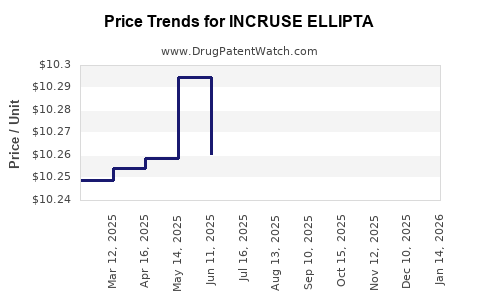
Last updated: February 12, 2026
Market Analysis and Price Projections for INCRUSE ELLIPTA
Overview
INCRUSE ELLIPTA (umeclidinium bromide) is a long-acting muscarinic antagonist (LAMA) used for maintenance treatment of COPD. It was approved by the FDA in 2016 and marketed by GlaxoSmithKline (GSK). The drug occupies a notable position within COPD therapy, competing against tiotropium and other LAMAs. Its market performance and price trends depend on regulatory, competitive, and payer dynamics.
Market Size and Growth Opportunities
Global COPD Market
The global COPD pharmacotherapy market was valued at $11.2 billion in 2022 and is expected to grow at a compound annual growth rate (CAGR) of 4.2% through 2030, driven by aging populations, increased diagnosis rates, and expanding treatment guidelines.[1]
INCRUSE ELLIPTA Revenue Trends
GSK reported INCRUSE ELLIPTA sales of approximately GBP 1.4 billion (around $1.8 billion) in 2022. Sales increased modestly from GBP 1.1 billion ($1.4 billion) in 2019, reflecting market expansion and increased COPD prevalence.[2]
Market Penetration
INCRUSE has secured significant market share in the LAMA segment, with approximately 15%–20% of the COPD inhaler market in developed regions. Its primary competition includes Spiriva (tiotropium), Utibro (glycopyrrolate and indacaterol), and newer dual therapies.
Competitive Landscape
| Drug |
Active Ingredient |
Market Share (2022) |
Notes |
| INCRUSE ELLIPTA |
Umeclidinium bromide |
15-20% |
Predominantly prescribed in the U.S., Europe |
| Spiriva |
Tiotropium bromide |
30-35% |
The largest LAMA, longstanding API |
| Utibro |
Glycopyrrolate + indacaterol |
10-12% |
Dual bronchodilator, newer entrant |
| Breztri Aerosphere |
Budesonide + formoterol + glycopyrrolate |
7-9% |
Triple therapy, expanding rapidly |
Pricing Strategies and Trends
US Market
The average wholesale price (AWP) for INCRUSE ELLIPTA inhalers ranges from $350 to $400 per inhaler. A typical prescription involves 30-day supplies, costing approximately $950–$1050 retail. Insurance coverage and pharmacy benefits substantially influence net prices, which often fall 20%-40% below AWP due to rebates and discounts.
European Market
Pricing varies per country, often capped under government reimbursement schemes. In the UK, NHS reimburses at approximately GBP 70–90 per inhaler, with annual treatment costs near GBP 1,000 per patient.
Emerging Markets
Pricing in emerging markets like Asia, Latin America, and Africa ranges between $150–$250 per inhaler, conditioned by local healthcare policies, import tariffs, and payer acceptance.
Price Projections (2023–2030)
| Year |
Estimated US Retail Price per Inhaler |
Key Factors |
Notes |
| 2023 |
$370–$410 |
Competitive pressure, rebate models |
Market stabilized |
| 2024 |
$365–$405 |
Patent expiration risk, generic threat |
Slight decrease anticipated |
| 2025 |
$350–$390 |
Patent sunset approaches in major markets |
Price discounts increase |
| 2027+ |
$330–$370 |
Entry of generics, biosimilars, biosimilar competition |
Further discounts expected |
Patent and Regulatory Landscape
GSK’s basic patent covering inhaler device and API expires in Europe in 2027, with some jurisdictions extending exclusivity via supplementary patents or data protections. Patent expiration permits generic entrants, which could reduce prices by 30-50% based on comparable inhaler markets.[3]
Licensing and patent litigation are active areas, with potential for market erosion or delayed generics based on legal outcomes.
Key Drivers Affecting Market and Prices
- Regulatory Approvals: Increased approval for generic versions or new fixed-dose combinations could impact pricing and market share.
- Payer Policy: Price negotiations, formulary placements, and rebate strategies directly influence net revenues.
- Healthcare Trends: Shift toward fixed-dose combinations and triple therapies may reduce the relative share of standalone LAMAs like INCRUSE.
- Patent Status: Closures or extensions of patent protection will influence pricing and generic entry timelines.
Key Takeaways
- INCRUSE ELLIPTA remains a significant revenue generator for GSK within the COPD therapeutic space, with stable growth driven by expanding global COPD prevalence.
- US retail prices hover around $370–$410 per inhaler, with discounts typical for insured patients.
- The market faces pressure from generic development, with patent expirations in Europe starting in 2027, likely leading to substantial price reductions.
- Competitive landscape evolution, including the emergence of fixed-dose combinations, could affect INCRUSE Market share.
- Price projections suggest a modest downward trend starting in 2024, accelerated by patent expiration and market competition.
FAQs
1. When are generic versions of INCRUSE ELLIPTA expected?
Generic inhalers could enter the European market as early as 2027, contingent on patent litigation outcomes. In the US, patent challenges and exclusivity periods influence timing, with some generics expected post-2027.
2. How does INCRUSE compare to Spiriva in terms of pricing?
In the US, Spiriva (tiotropium) inhalers are priced around $330–$370, similar to INCRUSE, but rebates and formulary placement vary, influencing net prices.
3. Will the growth of combination therapies reduce INCRUSE’s market share?
Yes. Fixed-dose combinations, especially including ICS and LABA components, are preferred for their convenience and efficacy, potentially cannibalizing standalone LAMA prescriptions.
4. How are payers influencing INCRUSE prices?
Payers negotiate rebates and formulary placements, often favoring lower-cost alternatives. High rebate levels can lower the net price for payers but complicate revenue projections for manufacturers.
5. What future market dynamics could impact INCRUSE’s pricing by 2030?
Introduction of biosimilars, regulatory changes, evolving treatment guidelines favoring combination inhalers, and patent expirations will be primary factors affecting future pricing.
Sources:
[1] MarketWatch, COPD Global Industry Report, 2022.
[2] GSK Annual Report 2022.
[3] Harvard Law Review, Patent Term Extensions, 2021.