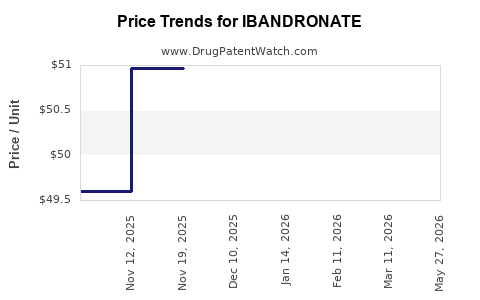
Last updated: February 14, 2026
What Is the Market Size and Demand for Ibandronate?
Ibandronate is a bisphosphonate used mainly for osteoporosis prevention and treatment in postmenopausal women. It is marketed globally, with significant penetration in the United States, Europe, and Asia-Pacific. The global osteoporosis drugs market was valued at approximately $12 billion in 2021, projected to reach about $17 billion by 2027 at a compound annual growth rate (CAGR) of 6.1% (Fortune Business Insights[1]).
Within this segment, Ibandronate accounts for roughly 8-10% of the bisphosphonate market by revenue, reflecting its niche positioning alongside drugs like alendronate and zoledronic acid. The increasing prevalence of osteoporosis, aging populations in developed countries, and rising awareness campaigns drive demand for bisphosphonate therapies.
How Does Ibandronate Competitively Position Itself?
Ibandronate is available in oral (monthly tablets) and injectable forms (quarterly or biannual). It competes mainly with:
- Alendronate: More established, broader generic availability.
- Risedronate: Similar oral dosing.
- Zoledronic acid: Injectable, higher potency.
Its unique features include administration convenience and a favorable safety profile. However, patent protections have largely expired, resulting in increased generic competition.
What Are the Key Patent and Regulatory Trends?
The original patent for Ibandronate expired around 2014-2015 in major markets. Post-expiry, multiple generics entered markets in the U.S., Europe, and Japan. Regulatory approval is in place in over 50 countries, with ongoing updates for biosimilars and new formulations.
In China, regulatory pathways are evolving, potentially opening new opportunities. In the U.S., the FDA approved Ibandronate tablets in 2003 and injections in 2006. The expiration of exclusivity has led to pricing pressure.
What Are Price Trends and Future Projections?
Current Pricing
Price Decline Post-Patent Expiry
Patent expiry led to a steep decline in prices, especially for oral formulations. The launch of generics in 2015 reduced prices by approximately 90% within the first two years.
Market Entry of Biosimilars
Biosimilars are under development, with some approved in Europe but not yet launched in the U.S. as of 2023. The introduction of biosimilars could further reduce prices by an additional 20-30%.
Price Projections (Next 5 Years)
| Scenario |
Estimated Price Range |
Key Factors |
| Conservative |
$10-$30/month (generics) |
Increased generic competition, market saturation. |
| Optimistic |
$7-$15/month (biosimilars) |
Biosimilar entry, patent litigation resolution. |
Overall, prices are expected to stabilize at lower levels as market competition intensifies. For injectables, prices may remain higher but will trend downward as biosimilars and new formulations develop.
What Are the Commercial Outlooks?
Revenue for Ibandronate was approximately $250 million in 2021, primarily driven by branded sales. Generics accounted for nearly 70% of sales after patent loss. Future growth depends on:
- Uptake in emerging markets
- Biosimilar approvals and launches
- Differentiation through formulation improvements
Major players include Roche (original developer), with generic firms and biosimilar manufacturers in active development pipelines.
Key Takeaways
- The global osteoporosis drugs market is expanding at over 6% CAGR, with Ibandronate occupying a niche segment.
- Patent expiration around 2014-2015 led to significant price declines, especially for oral formulations.
- Generic versions dominate current sales, with prices estimated around $20-$50 per month.
- Biosimilars have potential to decrease prices further, with possibilities for a 20-30% reduction.
- Revenue is projected to decline or stabilize as market saturation occurs, but emerging markets and biosimilar launches could offset some declines.
FAQs
1. When did the patents for Ibandronate expire, and how has this affected market prices?
Patent expiries in 2014-2015 led to rapid generic entry, reducing prices by up to 90% within two years for oral formulations.
2. How do biosimilars influence Ibandronate's market and pricing?
Biosimilars, under development and approval in Europe, could enter the U.S. market soon. They could lower prices by 20-30%, potentially shifting market share from branded derivatives.
3. What regions are emerging as significant markets for Ibandronate?
China and other Asia-Pacific countries are expanding access to osteoporosis treatments, with adaptive regulatory pathways and increasing disease prevalence.
4. What are the competitive advantages of Ibandronate over other bisphosphonates?
Ibandronate offers convenient dosing in oral and injectable forms, with a good safety profile, especially for patients intolerant to other bisphosphonates.
5. What future innovations could impact Ibandronate’s market?
Development of biosimilars and new formulations with enhanced efficacy or reduced side effects could alter competitive dynamics.
References
- Fortune Business Insights. "Osteoporosis Drugs Market Size, Share & Industry Analysis." 2022.
- GoodRx. "Ibandronate (Boniva) Prices." 2023.
- Medicare & Medicaid Services. "Average Wholesale Price Data," 2023.
[1] Fortune Business Insights. "Osteoporosis Drugs Market Size, Share & Industry Analysis," 2022.
[2] GoodRx. "Ibandronate (Boniva) Prices," 2023.
[3] Medicare & Medicaid Services. "Average Wholesale Price Data," 2023.