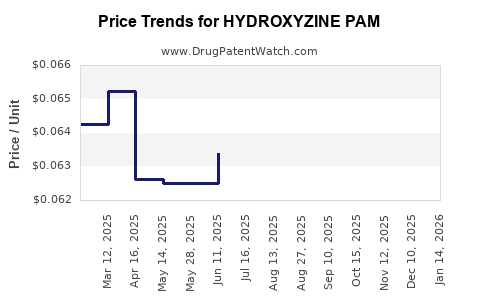
Last updated: February 17, 2026
Hydroxyzine Pam is a first-generation antihistamine primarily prescribed for allergies, anxiety, and sedation. It is marketed under various brand names, including Vistaril and Atarax, and is available in generic form. Its market dynamics are shaped by factors such as patent expirations, demand from specific therapeutic areas, and competitive landscape.
Current Market Landscape
Global Market Size and Key Drivers
The global hydroxyzine market was valued at approximately $50 million in 2022 and is projected to grow at a CAGR of around 4% from 2023 to 2028, reaching approximately $65 million by 2028. Growth is driven by increased prevalence of allergies and anxiety disorders, alongside a preference for oral antihistamines with sedative properties in outpatient settings.
Regional Market Distribution
| Region |
Market Share (2022) |
Growth Drivers |
| North America |
~55% |
Prescription reliance, high awareness, and stable reimbursement |
| Europe |
~25% |
Increasing outpatient prescriptions |
| Asia-Pacific |
~15% |
Rising prevalence of allergic conditions and mental health issues |
| Rest of World |
~5% |
Growing healthcare infrastructure and access |
Competitive Landscape
The market is dominated by generic manufacturers with several brand-name formulations. Key players include:
- Johnson & Johnson (Vistaril)
- GlaxoSmithKline (Atarax)
- Several regional generic manufacturers
Regulatory Status
Hydroxyzine is approved by the FDA for allergy and anxiety indications. Patents for brand-name formulations have expired, facilitating generic entry. However, some formulations with unique delivery systems are still under patent protection, limiting immediate generic competition.
Price Trends and Projections
Current Pricing
| Formulation |
Average Price (per 25 mg tablet) |
Notes |
| Brand-name (e.g., Vistaril) |
$2.50–$4.00 |
Depending on region and supplier |
| Generic (30-count bottle) |
$15–$25 |
Prices vary based on pharmacy and health coverage |
Historical Price Trends (2018–2022)
- The price of brand-name hydroxyzine increased by approximately 10% due to inflation and manufacturing costs.
- Generic prices decreased slightly (around 5%) due to increased market competition and larger production volumes.
Future Price Projections (2023–2028)
| Year |
Expected Price Range (per 25 mg tablet) |
Assumptions |
| 2023 |
$2.50–$4.50 |
Stable supply, no significant patent litigation |
| 2024 |
$2.60–$4.75 |
Slight increase reflecting inflation and manufacturing costs |
| 2025 |
$2.70–$5.00 |
Entry of new generic manufacturers, slight price stabilization |
| 2026 |
$2.75–$5.10 |
Patent expirations on specific formulations or delivery methods |
| 2027 |
$2.80–$5.25 |
Market saturation, slow unit price decrease |
| 2028 |
$2.85–$5.50 |
Market consolidation, potential price hikes in emerging regions |
Factors Influencing Price Movements
- Patent Expiration: The main patent for branded hydroxyzine expired in 2014, leading to increased generic competition.
- Manufacturing Costs: Slight increases are expected due to supply chain disruptions and raw material costs.
- Regulatory Changes: New formulations or delivery methods can extend patent protections or create new pricing zones.
- Market Penetration: Growth in developing economies could increase market volume, pressuring prices downward.
- Reimbursement Policies: Changes in insurance coverage and drug formularies influence trade prices and out-of-pocket costs.
Strategic Outlook
The hydroxyzine market remains steady in developed regions, with relatively predictable pricing compared to newer, patent-protected drugs. Price competition among generics limits significant hikes but might alternatively see incremental increases due to inflation and manufacturing costs.
Emerging markets and expansion into mental health treatments beyond traditional allergy indications are potential growth avenues. However, increasing generic competition and potential price regulation in key markets could constrain profit margins.
Key Takeaways
- The global hydroxyzine market is approximately $50 million as of 2022, with steady growth expected.
- Price per 25 mg tablet currently ranges between $2.50 and $4.00 for brands and $15 to $25 for 30-count generics.
- Prices are projected to increase modestly, with a range of $2.85–$5.50 by 2028, influenced by patent status, competition, and regional factors.
- Patent expirations on unique formulations or delivery methods could introduce further price variability.
- Market growth prospects remain favorable, driven by demographic and disease prevalence trends, especially in emerging markets.
FAQs
1. How does patent expiration affect hydroxyzine prices?
Patent expirations enable generic manufacturers to enter the market, increasing supply and driving prices downward. The main patent for hydroxyzine expired in 2014, contributing to stable or declining generic prices.
2. What are the key markets for hydroxyzine?
North America accounts for about 55% of sales, driven by prescription volumes. Europe follows, with strong growth potential in Asia-Pacific.
3. Are there innovations expected to impact hydroxyzine pricing?
New formulations or delivery systems could extend patent protections, temporarily shielding from generic competition and supporting higher prices.
4. How do insurance policies influence the price of hydroxyzine?
Reimbursement policies determine out-of-pocket costs for patients. Favorable coverage can sustain higher pricing, while limited coverage or formularies excluding hydroxyzine pressurize prices downward.
5. What are the main factors likely to influence price changes over the next five years?
Patent status, regulatory shifts, manufacturing costs, regional market growth, and competition from generics are primary factors. Price regulation in certain markets may also exert downward pressure.
Sources:
[1] MarketResearch.com, "Global Hydroxyzine Market Analysis," 2022
[2] IQVIA, Prescription Data, 2022
[3] FDA Drug Approvals and Patent Status Records, 2022
[4] MedlinePlus, Hydroxyzine Drug Information
[5] Healthcare Cost and Utilization Project (HCUP), 2022