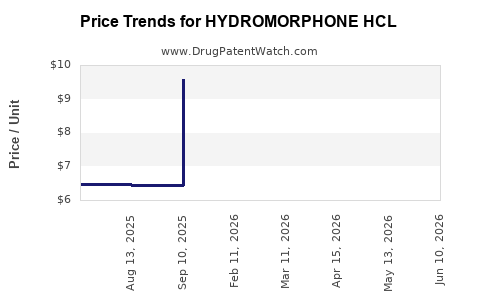
Last updated: July 17, 2026
Hydromorphone hydrochloride (hydromorphone HCl) is a high-volume, generic-dominated opioid analgesic in the US with limited remaining branded exclusivity and a pricing floor driven by competition among multiple authorized generics and ANDA filers. Price trajectory over the next decade is expected to be flat-to-down in nominal terms and more likely to decline in real terms, with periodic pressure during generic entry and ongoing headwinds from opioid class scrutiny, payer controls, and state-by-state contracting.
Is hydromorphone HCl a branded or generic market, and who sells it in the US?
Hydromorphone HCl is primarily a generic product category. Originator brand exposure is typically concentrated in older labeled strengths and extended-release (ER) or opioid-naïve safety-positioned SKUs, but market share today is largely held by multiple generic manufacturers and authorized generics where available.
What dosage forms drive the market (IR vs ER)
Key commercial penetration is split across:
- Immediate-release (IR) tablets and liquids (typical use in short-term pain, breakthrough pain, titration).
- Extended-release (ER) tablets (used for around-the-clock chronic pain where clinically appropriate).
- Injectable formulations (hospital and procedural settings).
How strong is competitive intensity
Competition is structurally high because:
- Hydromorphone is off-patent in the US for core active ingredient and most foundational compositions of matter.
- Manufacturing and generic replication are well established.
- Payers prefer lower net price in opioid analgesic classes under preferred drug lists (PDLs) and step edits.
Bottom line: the market behaves like a mature generic commodity with sporadic volatility around launches, shortages, and negotiated payer discounts.
What is the current US pricing level for hydromorphone HCl, and what determines net price?
Net price is typically set by pharmacy benefit managers, wholesaler contracts, state Medicaid formularies, and contracting in 340B and hospital systems, not by list price alone.
Key price determinants
- Generic-to-generic competition
- More ANDA entrants compress pricing, especially at common strengths (e.g., 2 mg, 4 mg, 8 mg IR) and frequent ER dosing intervals.
- Supply constraints
- Manufacturing disruptions, raw material availability, and DEA-related operational constraints can temporarily increase wholesale prices.
- Payer policy
- Opioid utilization management (prior authorization, quantity limits, duration limits) can shift demand away from certain strengths and toward alternatives, indirectly affecting SKU-level pricing.
- Formulary position
- Preferred status in commercial and Medicaid formularies can stabilize net price at slightly higher levels versus non-preferred SKUs.
Featured-snippet answer: Hydromorphone HCl’s US pricing is primarily a negotiated generic market outcome, with list prices less predictive than contracted net price, and with volatility tied to supply and payer contracting rather than exclusivity.
When does hydromorphone HCl lose exclusivity, and does that affect price?
For hydromorphone HCl, the market impact of “exclusivity loss” is less relevant than the timing of new ANDA entries, authorized generic expansions, and litigation-driven launch delays (if any).
What matters more than exclusivity dates
- ANDA filing and approval timelines that enable launch.
- Patent settlement terms that affect “at-risk” launch timing.
- Shortage conditions that change supply-demand balance.
Price implication: even where individual patent estates expire later for specific formulations, the category’s overall pricing is mostly governed by generic competition and contracting rather than brand-to-generic switching.
What patents cover hydromorphone HCl, and how strong is the patent estate?
For the active ingredient hydromorphone and common IR/ER formats, most major patent barriers have historically been cleared in the US. Remaining IP, where present, tends to cluster around:
- Formulation-specific patents (excipients, coatings, controlled-release matrices).
- Manufacturing/process patents.
- Method-of-use or risk-management related claims (often less enforceable commercially).
Market impact: the practical effect is that new generic entries are enabled once formulation and process barriers are cleared for a specific SKU, leading to localized price drops at the strength/dosage level.
How does hydromorphone HCl pricing compare with alternative opioids?
Hydromorphone competes on contract coverage rather than therapeutic differentiation against:
- morphine sulfate (IR/ER),
- oxycodone IR/ER,
- oxymorphone,
- fentanyl products (including patches),
- tapentadol (ER),
- tramadol (where covered).
Relative price pressure
- If hydromorphone is non-preferred, net price often declines quickly relative to preferred alternatives because utilization is managed.
- Where hydromorphone is preferred, it holds better pricing because patient switching friction is higher and prescribers already titrate to existing regimens.
Business takeaway: pricing stability in hydromorphone usually tracks formulary preference more than clinical preference.
What generic entry risks exist for hydromorphone HCl, and what could cause price spikes?
Price spikes typically arise from supply-side events, not from exclusivity.
Main “risk events” that move price
- Plant downtime or regulatory actions at one or two major manufacturing sites.
- DEA schedule or compliance operational disruptions affecting distribution.
- Raw material shortages or quality system holds.
- Settlement terms delaying one filer, shifting volume to remaining SKUs.
Generic entry behavior
When a new ANDA launch hits a heavily used strength, net price often drops immediately and then stabilizes after a short period as wholesalers normalize inventory.
What does the FDA status of hydromorphone HCl imply for future price?
Hydromorphone HCl is an established opioid on the FDA market, with ongoing generic manufacturing under ANDA frameworks. FDA oversight affects manufacturing continuity rather than price directly, but it can influence:
- approval lead times for new entrants,
- changes in label restrictions (guideline-driven),
- formulation adjustments tied to safety or abuse-deterrence strategies.
Net effect: FDA status is more relevant to supply reliability and launch timing than to category-level pricing direction.
Price projection model for hydromorphone HCl: what range is likely and why? (2026–2036)
A practical projection for mature generic opioids is best framed as ranges by regime: normal competition vs shortage-driven deviation vs policy-driven utilization changes.
Base case (most likely): flat-to-down nominal, down in real terms
- Nominal net price: tends to be flat to -1.5% CAGR as incremental competition offsets inflation.
- Real net price: -1.5% to -3.0% CAGR as contracting grows and generic mix shifts to lower-cost SKUs.
- SKU-level variation: IR strengths may see faster declines than less common ER strengths if ER volumes are managed via PA and quantity limits.
Upside case: intermittent supply constraints
- Nominal swings: short periods of +5% to +15% net price impact during shortage conditions.
- Supply normalization returns price toward base case within 1–4 quarters depending on inventory and capacity.
Downside case: stronger payer contraction or rapid new entrant launches
- Nominal: -2.5% to -5.0% CAGR if multiple suppliers launch simultaneously at dominant strengths and payers strengthen preferred status for the lowest-cost SKU.
Actionable framing for business: build inventory and contracting assumptions around a base-case downward drift with volatility bands of roughly ±10% around shortage and normalized demand events.
How should companies forecast revenue exposure by formulation (IR vs ER vs injectable)?
IR tablets and solutions
- Highest volume.
- Fastest pricing compression when new entrants launch.
- More resilient to occasional reimbursement changes due to broad clinical familiarity.
Forecast behavior: price declines most predictably with competition; supply shocks create temporary spikes.
ER tablets
- Lower volume than IR but can be sticky due to titration schedules.
- Higher payer management risk: step edits and quantity limits can reduce utilization.
Forecast behavior: slower price compression, more utilization variability.
Injectables
- Hospital/procedural demand.
- More sensitive to supply reliability, distribution disruptions, and wholesaler allocation.
Forecast behavior: higher volatility tied to supply continuity; pricing can spike during operational constraints.
What licensing or litigation outcomes could materially change hydromorphone HCl pricing?
For a mature generic category, the “material” change is usually not a settlement on the whole category, but settlement terms that delay a specific entrant for a specific formulation/strength.
Settlement and patent timing channels
- Delayed generic entry keeps price higher for the affected SKU until the launch date.
- Early entry forces immediate discounting, typically within 1–2 quarters.
Practical implication: track settlement schedules at the strength/dosage level rather than relying on active ingredient-level assumptions.
Key takeaways
- Hydromorphone HCl pricing is expected to follow mature generic dynamics: flat-to-down nominal with real declines driven by contracting and competitive mix.
- IR strengths will see the most consistent price pressure; ER is more vulnerable to utilization management effects; injectables are most sensitive to supply disruptions.
- Forecasts should assume a base-case downward drift with ±10% volatility bands around shortage and capacity events.
- Material price jumps are more likely from supply and compliance continuity than from patent exclusivity changes.
FAQs
1) What drives hydromorphone HCl net price more: list price or contracts?
Net price is driven primarily by payer and wholesaler contracting, not list price, with temporary list-to-net divergence during supply constraints.
2) Will hydromorphone HCl prices decline faster if more ANDA approvals are granted?
Yes, at the affected strength and dosage level, additional ANDA launches typically compress net pricing quickly.
3) Are ER hydromorphone HCl products likely to be more price-stable than IR?
They can be more stable on price but more variable on volume because ER is more exposed to prior authorization and quantity limits.
4) What events most often create short-term hydromorphone HCl price spikes?
Manufacturing downtime, quality holds, distribution interruptions, and shortage allocation driven by supply constraints.
5) How do opioid-related payer policies affect hydromorphone HCl pricing indirectly?
Policies that restrict utilization can shift demand toward preferred SKUs and alternatives, reducing hydromorphone volume and pressuring net pricing on non-preferred strengths.