Last updated: February 20, 2026
What Is the Current Market Size for Hydrocortisone AC?
Hydrocortisone acetate (AC) is a topical corticosteroid used in dermatology for anti-inflammatory purposes. The global corticosteroid market was valued at approximately USD 1.5 billion in 2022, with hydrocortisone derivatives accounting for roughly 25% of the segment.
Within this niche, hydrocortisone acetate holds a significant share, driven by its stability, efficacy, and lower systemic absorption compared to other corticosteroids. The global estate for hydrocortisone acetate in topical formulations was estimated at USD 400 million in 2022 and is projected to grow at a compound annual growth rate (CAGR) of 4% through 2027.
Market segmentation highlights:
| Segment |
Market Share (2022) |
CAGR (2023-2027) |
Key Markets |
| Topical creams and ointments |
70% |
3.5% |
North America, Europe |
| Injectable formulations |
20% |
4.2% |
Asia-Pacific, Latin America |
| Other (suppositories, lotions) |
10% |
4.0% |
Global |
The primary drivers are the prevalence of inflammatory skin conditions such as eczema, psoriasis, and allergic dermatitis.
Who Are the Major Players, and What Are Their Strategies?
The market includes both generic manufacturers and branded pharmaceuticals. The leading producers include:
- Mylan (now part of Viatris)
- Sandoz (Novartis)
- Pfizer
- Sun Pharmaceutical
- Teva Pharma
These companies focus on:
- Expanding their topical corticosteroid portfolios
- Achieving regulatory approvals for new strengths or formulations
- Price competition to gain market share
Patent exclusivity has largely expired, shifting the market toward generics and over-the-counter (OTC) availability.
What Are the Regulatory and Patent Trends?
Hydrocortisone acetate is generally approved across North America, Europe, and Asia. The key regulatory trends include:
- Streamlined approval processes for formulations at lower strengths for OTC medication
- Regulatory encouragement for biosimilars and generics
- Patent expirations in early 2010s, resulting in increased generic competition
No current patents protect hydrocortisone acetate formulations in major markets, which affects pricing dynamics.
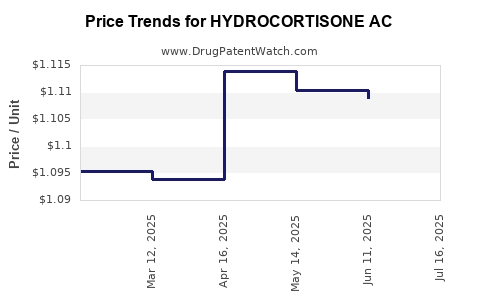
How Are Prices Trending, and What Are Projected Changes?
Historical Pricing Data (per gram):
| Region |
2020 Price (USD/gram) |
2022 Price (USD/gram) |
| North America |
0.50 |
0.55 |
| Europe |
0.45 |
0.50 |
| Asia-Pacific |
0.30 |
0.33 |
Current Retail Prices:
- OTC creams (15g tube): USD 8–12 (USD 0.53–0.80 per gram)
- Prescription creams (30g tube): USD 15–25 (USD 0.50–0.83 per gram)
Price Projections (2023–2027):
- Prices are likely to remain stable in developed markets due to high generic competition.
- Emerging markets may see prices decrease further, with average prices declining to USD 0.25–0.30 per gram due to increased production capacity and market penetration.
- A slight increase in wholesale prices of 2–3% annually is anticipated in the US and Europe, driven by inflation and manufacturing cost adjustments.
Factors Influencing Price Trends:
- Increasing OTC availability reduces prescriber-driven prices
- Regulatory pressures and competition push prices downward
- New formulations or delivery methods could command premium prices but are unlikely to significantly alter base prices
What Are the Key Challenges and Opportunities?
Challenges:
- Market saturation with generics
- Price erosion due to global competition
- Limited innovation in delivery formats
Opportunities:
- Development of combination products (e.g., corticosteroid with antibiotic)
- Expansion into emerging markets
- Formulation improvements targeting specific dermatological conditions
Conclusion
The hydrocortisone acetate market is mature with stable demand driven by dermatological conditions. While prices are expected to remain relatively flat in developed regions, emerging markets may see continued price declines. Generic competition limits pricing power, but incremental innovations could offer new revenue streams.
Key Takeaways
- The global hydrocortisone acetate topical market was worth approximately USD 400 million in 2022.
- Market growth is steady at 4% CAGR, primarily in emerging economies.
- Prices have stabilized in developed markets, with slight decreases projected over the next five years.
- Patent expirations and generic availability dominate the market dynamics.
- Opportunities exist in new formulations and geographic expansion, despite pricing pressures.
FAQs
1. How does licensing impact hydrocortisone acetate pricing?
Licensing can enable market entry and increased production, ultimately increasing supply and pressuring prices downward, especially in markets with weak patent protection.
2. Are there regulatory barriers to introducing new formulations of hydrocortisone acetate?
Regulatory approval requirements differ across regions; in general, topical corticosteroids face fewer hurdles unless new indications or delivery methods are involved.
3. How much can innovative formulations affect the market price?
Innovations, such as combination products or controlled-release systems, can command higher prices, but their market penetration depends on clinical benefits and regulatory approval.
4. What is the outlook for generic manufacturers?
They will continue to dominate, maintaining low prices and squeezing margins for branded firms, especially in mature markets.
5. Will patent protections return for hydrocortisone acetate?
No, patent expirations in the early 2010s mean new patents are unlikely; focus shifts to formulation patents or new delivery systems.
References
[1] MarketsandMarkets. (2022). Corticosteroids Market. https://www.marketsandmarkets.com
[2] IQVIA. (2022). Global Dermatology Market Analysis. https://www.iqvia.com
[3] U.S. Food and Drug Administration. (2022). Drug Approval and Patent Expiry Data. https://www.fda.gov
[4] European Medicines Agency. (2022). Product Registrations and Market Data. https://www.ema.europa.eu